


Williamson conjecture
In combinatorial mathematics, specifically in combinatorial design theory and combinatorial matrix theory, the Williamson conjecture is that Williamson matrices of order exist for all positive integers . Four symmetric and circulant matrices , , , are called Williamson matrices if their entries are and they satisfy the relationship


where is the identity matrix of order . John Williamson showed that if , , , are Williamson matrices then

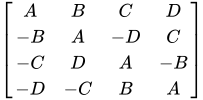
is an Hadamard matrix of order .[1] It was once considered likely that Williamson matrices exist for all orders and that the structure of Williamson matrices could provide a route to proving the Hadamard conjecture that Hadamard matrices exist for all orders .[2] However, in 1993 the Williamson conjecture was shown to be false by Dragomir Ž. Ðoković through an exhaustive computer search, which demonstrated that Williamson matrices do not exist of order .[3] In 2008, the counterexamples 47, 53, and 59 were additionally discovered.[4]


Following the negative result of Ðoković, which ruled out the existence of Williamson matrices of order , it was shown in 2019 that relaxing the symmetry and circulant requirements nevertheless permits a Hadamard matrix of this block form to exist for that order.[5] One such instance is given by the sequences
a = --+--+--+++-+----+-+++--+--+-------
b = +---+---+-++-+--+-++-+---+---++++++
c = -++---+-+--+--++--+++++-+-+++++-+--
d = +----+++-+-+--++--+-+-+++----++---+
with the associated matrices defined by
A = circulant(a)
B = circulant(b)
C = fliplr(circulant(c))
D = circulant(d)
References
[edit]- ↑ Williamson, John (1944). "Hadamard's determinant theorem and the sum of four squares". Duke Mathematical Journal. 11 (1): 65–81. doi:10.1215/S0012-7094-44-01108-7. MR 0009590.
- ↑ Golomb, Solomon W.; Baumert, Leonard D. (1963). "The Search for Hadamard Matrices". American Mathematical Monthly. 70 (1): 12–17. doi:10.2307/2312777. JSTOR 2312777. MR 0146195.
- ↑ Ðoković, Dragomir Ž. (1993). "Williamson matrices of order for ". Discrete Mathematics. 115 (1): 267–271. doi:10.1016/0012-365X(93)90495-F. MR 1217635.
- ↑ Holzmann, W. H.; Kharaghani, H.; Tayfeh-Rezaie, B. (2008). "Williamson matrices up to order 59". Designs, Codes and Cryptography. 46 (3): 343–352. doi:10.1007/s10623-007-9163-5. MR 2372843.
- ↑ Kline, Jeffery (26 July 2019). "Geometric search for Hadamard matrices". Theoretical Computer Science. 778: 33–46. doi:10.1016/j.tcs.2019.01.025.

.svg) | This combinatorics-related article is a stub. You can help Wikipedia by adding missing information. |