


Wagner model
Wagner model is a rheological model developed for the prediction of the viscoelastic properties of polymers. It might be considered as a simplified practical form of the Bernstein-Kearsley-Zapas model. The model was developed by German rheologist Manfred Wagner.
For the isothermal conditions the model can be written as:

where:
- is the Cauchy stress tensor as function of time t,
- p is the pressure
- is the unity tensor
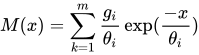
- M is the memory function showing, usually expressed as a sum of exponential terms for each mode of relaxation:


- , where for each mode of the relaxation, is the relaxation modulus and is the relaxation time;


- is the strain damping function that depends upon the first and second invariants of Finger tensor .


The strain damping function is usually written as:
- ,

The strain hardening function equal to one, then the deformation is small and approaching zero, then the deformations are large.
The Wagner equation can be used in the non-isothermal cases by applying time-temperature shift factor.
References
[edit]- M.H. Wagner Rheologica Acta, v.15, 136 (1976)
- M.H. Wagner Rheologica Acta, v.16, 43, (1977)
- B. Fan, D. Kazmer, W. Bushko, Polymer Engineering and Science, v44, N4 (2004)