


Volume integral
| Part of a series of articles about |
| Calculus |
|---|
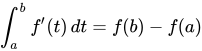
In mathematics (particularly multivariable calculus), a volume integral (∭) is an integral over a 3-dimensional domain; that is, it is a special case of multiple integrals. Volume integrals are especially important in physics for many applications, for example, to calculate flux densities, or to calculate mass from a corresponding density function.
In coordinates
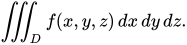
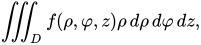
[edit]Often the volume integral is represented in terms of a differential volume element . It can also mean a triple integral within a region of a function and is usually written as: A volume integral in cylindrical coordinates is and a volume integral in spherical coordinates (using the ISO convention for angles with as the azimuth and measured from the polar axis (see more on conventions)) has the form The triple integral can be transformed from Cartesian coordinates to any arbitrary coordinate system using the Jacobian matrix and determinant. Suppose we have a transformation of coordinates from . We can represent the integral as the following. Where we define the Jacobian determinant to be.








Example
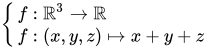
[edit]Integrating the equation over a unit cube yields the following result:
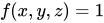

So the volume of the unit cube is 1 as expected. This is rather trivial however, and a volume integral is far more powerful. For instance if we have a scalar density function on the unit cube then the volume integral will give the total mass of the cube. For example for density function: the total mass of the cube is:

See also
[edit]
External links
[edit]- "Multiple integral", Encyclopedia of Mathematics, EMS Press, 2001 [1994]
- Weisstein, Eric W. "Volume integral". MathWorld.