Cloudflare fetched the original article and streamed it through HTMLRewriter to apply an entirely new visual system without rebuilding the source page.
// request.cf · coarse context
A page that knows where it met you.
Only coarse request metadata is shown. This demo does not display or persist visitor IP addresses.
Constraint force C and virtual displacement δr for a particle of mass m confined to a curve. The resultant non-constraint force is N. The components of virtual displacement are related by a constraint equation.
In analytical mechanics, a branch of applied mathematics and physics, a virtual displacement (or infinitesimal variation) shows how the mechanical system's trajectory can hypothetically (hence the term virtual) deviate very slightly from the actual trajectory of the system without violating the system's constraints.[1][2][3]:263 For every time instant is a vector tangential to the configuration space at the point The vectors show the directions in which can "go" without breaking the constraints.
For example, the virtual displacements of the system consisting of a single particle on a two-dimensional surface fill up the entire tangent plane, assuming there are no additional constraints.
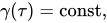
If, however, the constraints require that all the trajectories pass through the given point at the given time i.e. then
For each path and a variation of is a smooth function :[t_{0},t_{1}]\times [-\epsilon _{0},\epsilon _{0}]\to M}
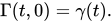
such that, for every and The virtual displacement:[t_{0},t_{1}]\to TM}
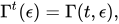
being the tangent bundle of corresponding to the variation assigns[1] to every the tangent vector
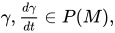
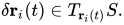
A single particle freely moving in has 3 degrees of freedom. The configuration space is and For every path and a variation of there exists a unique such that as
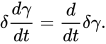
By the definition,
A rigid body rotating around a fixed point with no additional constraints has 3 degrees of freedom. The configuration space here is the special orthogonal group of dimension 3 (otherwise known as 3D rotation group), and We use the standard notation to refer to the three-dimensional linear space of all skew-symmetric three-dimensional matrices. The exponential map:{\mathfrak {so}}(3)\to SO(3)}
guarantees the existence of such that, for every path its variation and there is a unique path such that and, for every By the definition,
Since, for some function :[t_{0},t_{1}]\to {\mathfrak {so}}(3),}
, as ,
↑Torby, Bruce (1984). "Energy Methods". Advanced Dynamics for Engineers. HRW Series in Mechanical Engineering. United States of America: CBS College Publishing. ISBN0-03-063366-4.


![{\displaystyle C^{\infty }[t_{0},t_{1}]}](https://wikimedia.org/api/rest_v1/media/math/render/svg/85798b3097b9ca83d45b2d889d5499d05ec9bd1b)
![{\displaystyle [t_{0},t_{1}]}](https://wikimedia.org/api/rest_v1/media/math/render/svg/ffe2ab6560fe2acf9a63ad878ad482164b79012d)
![{\displaystyle P(M)=\{\gamma \in C^{\infty }([t_{0},t_{1}],M)\mid \gamma (t_{0})=q_{0},\ \gamma (t_{1})=q_{1}\}.}](https://wikimedia.org/api/rest_v1/media/math/render/svg/2dc1492c3cc5ebe8f103379d3fdf8fc00e0ea805)


![{\displaystyle \Gamma :[t_{0},t_{1}]\times [-\epsilon _{0},\epsilon _{0}]\to M}](https://wikimedia.org/api/rest_v1/media/math/render/svg/dd9c230b9d5d1aed3ddd9872afa3e50ec86870ac)
![{\displaystyle \epsilon \in [-\epsilon _{0},\epsilon _{0}],}](https://wikimedia.org/api/rest_v1/media/math/render/svg/b12ca8a410cf15d4b6fffab57c8b5f20574d6e18)

![{\displaystyle \delta \gamma :[t_{0},t_{1}]\to TM}](https://wikimedia.org/api/rest_v1/media/math/render/svg/e7f44d7c721456150544e2c246bb2be6b394c8ae)


![{\displaystyle t\in [t_{0},t_{1}]}](https://wikimedia.org/api/rest_v1/media/math/render/svg/1b698b33a7f49fc270026c5ecaaad66a0e9e588a)


![{\displaystyle \Gamma _{*}^{t}:T_{0}[-\epsilon ,\epsilon ]\to T_{\Gamma (t,0)}M=T_{\gamma (t)}M}](https://wikimedia.org/api/rest_v1/media/math/render/svg/b12003e98c00a2321c5adb819d6b6489598d4a67)
![{\displaystyle \Gamma ^{t}:[-\epsilon ,\epsilon ]\to M,}](https://wikimedia.org/api/rest_v1/media/math/render/svg/66857af388e796971d6de28849e9f34a8f7c13c4)
![{\displaystyle \textstyle {\frac {d}{d\epsilon }}{\Bigl |}_{\epsilon =0}\in T_{0}[-\epsilon ,\epsilon ].}](https://wikimedia.org/api/rest_v1/media/math/render/svg/8ee73378b08df19b8f82af809c06d1da8ae8dd2f)


![{\displaystyle \delta \gamma (t)=\sum _{i=1}^{n}{\frac {d[q_{i}(\Gamma (t,\epsilon ))]}{d\epsilon }}{\Biggl |}_{\epsilon =0}\cdot {\frac {d}{dq_{i}}}{\Biggl |}_{\gamma (t)}.}](https://wikimedia.org/api/rest_v1/media/math/render/svg/03040a9a0724da8c0b16cc0b6559e5bec3cd5059)




![{\displaystyle P(M)=C^{\infty }([t_{0},t_{1}],M).}](https://wikimedia.org/api/rest_v1/media/math/render/svg/c087dbbba817e68fee879b05a701a9537646a51a)






















![{\displaystyle t\in [t_{0},t_{1}],}](https://wikimedia.org/api/rest_v1/media/math/render/svg/4847c9b0f63dc7d2c7aecba6205b2352472fc1be)
![{\displaystyle \Theta ^{t}\in C^{\infty }([-\epsilon _{0},\epsilon _{0}],{\mathfrak {so}}(3))}](https://wikimedia.org/api/rest_v1/media/math/render/svg/cf137d0b487f1689de0a4f613af52bcbdb5c5d42)



![{\displaystyle \sigma :[t_{0},t_{1}]\to {\mathfrak {so}}(3),}](https://wikimedia.org/api/rest_v1/media/math/render/svg/e0b054fedff1379eb44ac9820349f4eba5da688b)


