


Vinberg's algorithm
In mathematics, Vinberg's algorithm is an algorithm, introduced by Ernest Borisovich Vinberg, for finding a fundamental domain of a hyperbolic reflection group.
Conway (1983) used Vinberg's algorithm to describe the automorphism group of the 26-dimensional even unimodular Lorentzian lattice II25,1 in terms of the Leech lattice.
Description of the algorithm
[edit]Let be a hyperbolic reflection group. Choose any point ; we shall call it the basic (or initial) point. The fundamental domain of its stabilizer is a polyhedral cone in . Let be the faces of this cone, and let be outer normal vectors to it. Consider the half-spaces
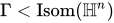



There exists a unique fundamental polyhedron of contained in and containing the point . Its faces containing are formed by faces of the cone . The other faces and the corresponding outward normals are constructed by induction. Namely, for we take a mirror such that the root orthogonal to it satisfies the conditions


(1) ;

(2) for all ;


(3) the distance is minimum subject to constraints (1) and (2).

References
[edit]- Conway, John Horton (1983), "The automorphism group of the 26-dimensional even unimodular Lorentzian lattice", Journal of Algebra, 80 (1): 159–163, doi:10.1016/0021-8693(83)90025-X, ISSN 0021-8693, MR 0690711
- Vinberg, È. B. (1975), "Some arithmetical discrete groups in Lobačevskiĭ spaces", in Baily, Walter L. (ed.), Discrete subgroups of Lie groups and applications to moduli (Internat. Colloq., Bombay, 1973), Oxford University Press, pp. 323–348, ISBN 978-0-19-560525-9, MR 0422505