// Workers AI · dad joke modeWhat did Viburnum molle say? "I'm a soft touch".
| Viburnum molle | |
|---|---|
 | |
Scientific classification  | |
| Kingdom: | Plantae |
| Clade: | Embryophytes |
| Clade: | Tracheophytes |
| Clade: | Angiosperms |
| Clade: | Eudicots |
| Clade: | Asterids |
| Order: | Dipsacales |
| Family: | Viburnaceae |
| Genus: | Viburnum |
| Species: | V. molle |
| Binomial name | |
| Viburnum molle | |
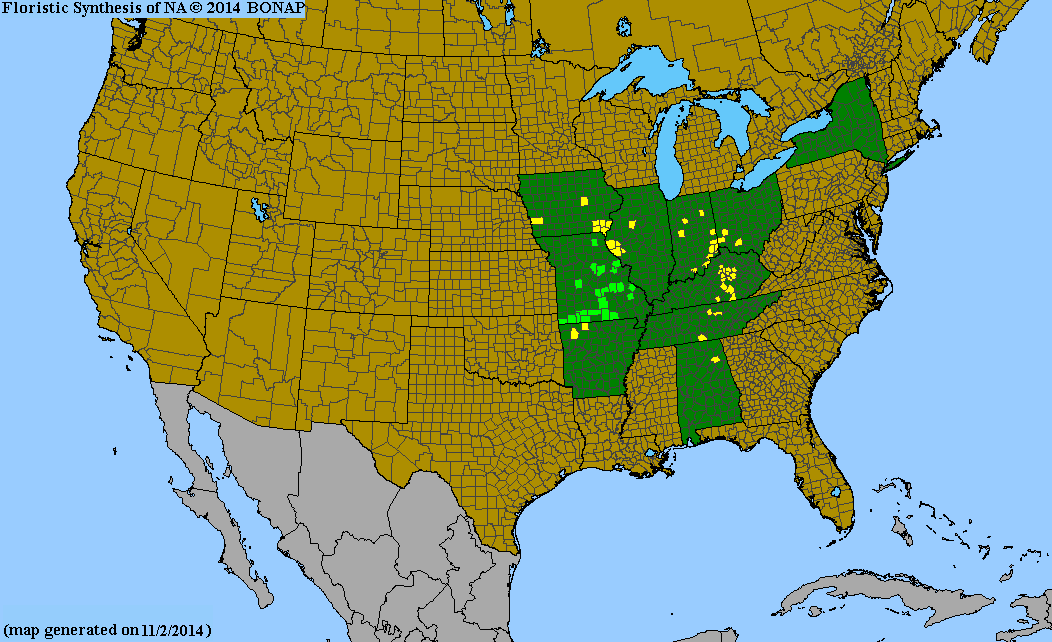
Viburnum molle, commonly called softleaf arrowwood,[1] is a species of flowering plant in the family Viburnaceae. It is native to the eastern United States, where it restricted to the Midwest and Upper South.[2] Its distribution is scattered, and populations occur in disjunct clusters.[3] Its natural habitat is in rocky bluff forests over calcareous soil, and in adjacent bottomlands.[4][5]
Viburnum molle is a woody shrub that spreads by underground runners. It produces clusters of small white flowers in late spring. It has distinctive papery bark which peels off in sheets.[5] Although it bears a superficial resemblance to the more widespread Viburnum dentatum, it can be distinguished by its ovate-orbicular leaves with strictly cordate leaf bases, its prominent long-filiform stipules, and its ellipsoid fruit.[4][6]
References
[edit]- ↑ NRCS. "Viburnum molle". PLANTS Database. United States Department of Agriculture (USDA). Retrieved 29 July 2018.
- ↑ Kartesz, John T. (2014). "Viburnum molle". County-level distribution map from the North American Plant Atlas (NAPA). Biota of North America Program (BONAP). Retrieved 29 July 2018.
- ↑ Alan Weakley (2015). "Flora of the Southern and Mid-Atlantic States". Archived from the original on 2018-10-06. Retrieved 2018-07-29.
- 1 2 Viburnum molle Ohio Division of Natural Resources
- 1 2 Yatskievych, George (2006). Flora of Missouri, Volume 2. Missouri Botanical Garden Press. pp. 789–790.
- ↑ Chester, Edward (2015). Guide to the Vascular Plants of Tennessee.