


// Workers AI · dad joke modeWhat did vectorbeam say to its date? You vector my heart.
| Type | Private |
|---|---|
| Industry | Vector games |
| Founded | 1977 |
| Defunct | 1979 |
| Successor | Cinematronics |
| Headquarters | Union City, California |
Vectorbeam was an arcade game manufacturer active in the late 1970s who specialized in vector graphics-based arcade games.[1][2] It was formed after splitting off from its primary competitor, Cinematronics, and disappeared after re-merging with them soon after.
Vectorbeam was founded by Larry Rosenthal based on his graduate work from the Massachusetts Institute of Technology and which he patented for a custom arcade vector display.[3][4] The patents were used in Cinematronics' arcade game Space War.[5] The company officially started its own as an independent organization in 1978 in San Francisco, and later moved to Union City, California.[6][7] Vectorbeam was in direct competition with other arcade game manufacturers. The company ceased operations soon after poor sales of its Barrier arcade game, and sold its assets to Cinematronics.[8][9] After the company, the rights were leased to Allied Leisure for a multi-year deal for use of patients in 1980.[10]
List of Vectorbeam games
[edit]- Space War (arcade game) (1977)
- Barrier (1979)
- Speed Freak (arcade game) (1979)
- Tail Gunner (1979)
- Warrior (arcade game) (1979)[11]
References
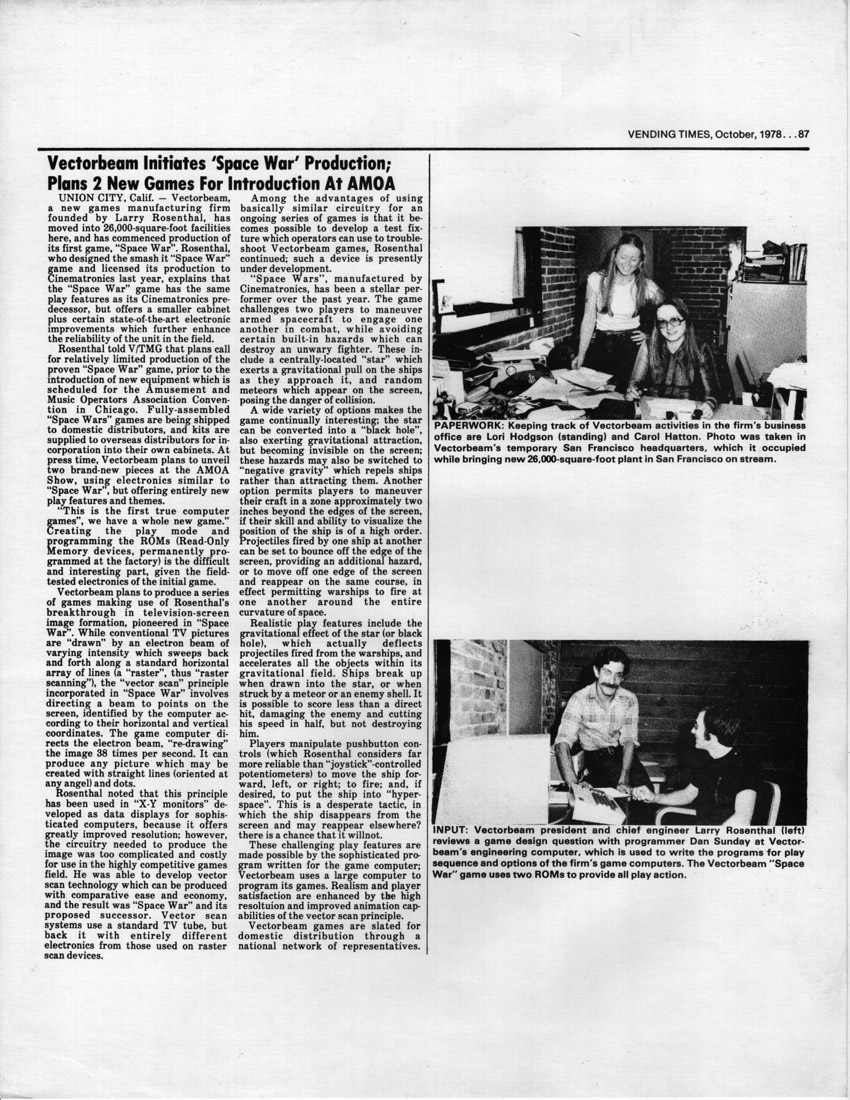
[edit]- ↑ Vectorbeam Initiates 'Space War' Production; Plans 2 New Games For Introduction At AMOA, Page 87, Vending Times, October 1978, ARCade ARChive.
- ↑ Subject: Vectorbeam history, Date: Tue, 20 Oct 1998 Archived 4 March 2016 at the Wayback Machine ...My name is Dan Sunday. I was a friend of Larry Rosenthal's, and when he broke from Cinematronics to start Vectorbeam I became his lead (and only) programmer. Vectorbeam lasted for one year, and was then bought by Cinematronics at which time I left. ....When Larry sold VB, for 2 million dollars....Vectorbeam only existed for 1 year: I recall Sept 1978 to Aug 1979, but may be off a month either way...For the record, the max company size was about 80 employees.... it was described in one of Larry's patents, namely: US Patent # 4,053,740 (Oct 11, 1977) for a "Video Game System"
- ↑ DeMaria, Rusel; Wilson, Johnny L. (2003). High Score!: The Illustrated History of Electronic Games (2 ed.). New York: McGraw-Hill/Osborne. p. 28. ISBN 0-07-223172-6.
- ↑ Speaker Session - Larry Rosenthal on YouTube, Recorded at California Extreme 2014, July 12, 2014 during the noon speaker session. (http://www.caextreme.org)
- ↑ "72 hours of play". Play Meter. February 1978. p. 57. Retrieved July 10, 2026.
- ↑ "Space Wars man starts company". Play Meter. July 15, 1978. p. 67. Retrieved July 10, 2026.
- ↑ "Vectorbeam starts up". Play Meter. October 15, 1978. p. 51. Retrieved July 10, 2026.
- ↑ Tim Skelly's History of Cinematronics and Vectorbeam
- ↑ "Vectorbeam sold". Play Meter. July 15, 1979. p. 59. Retrieved July 10, 2026.
- ↑ Tilley, Ray E. (August 1, 1980). "Allied Leisure taps execs, leases Vectorbeam rights". Play Meter. p. 1. Retrieved July 10, 2026.
- ↑ KLOV's Vectorbeam entry
 | This United States video game corporation or company article is a stub. You can help Wikipedia by adding missing information. |