


Truncation
In mathematics and computer science, truncation is limiting the number of digits right of the decimal point.
Truncation and floor function
[edit]Truncation of positive real numbers can be done using the floor function. Given a number to be truncated and , the number of elements to be kept behind the decimal point, the truncated value of x is


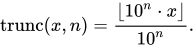
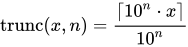
However, for negative numbers truncation does not round in the same direction as the floor function: truncation always rounds toward zero, the function rounds towards negative infinity. For a given number , the function is used instead


- .
Causes of truncation
[edit]With computers, truncation can occur when a decimal number is typecast as an integer; it is truncated to zero decimal digits because integers cannot store non-integer real numbers.
In algebra
[edit]An analogue of truncation can be applied to polynomials. In this case, the truncation of a polynomial P to degree n can be defined as the sum of all terms of P of degree n or less. Polynomial truncations arise in the study of Taylor polynomials, for example.[1]
See also
[edit]References
[edit]- ↑ Spivak, Michael (2008). Calculus (4th ed.). Publish or Perish. p. 434. ISBN 978-0-914098-91-1.
External links
[edit]- Wall paper applet that visualizes errors due to finite precision