


Tree taper
Tree taper is the degree to which a tree's stem or bole decreases in diameter as a function of height above ground. Within Forestry and for the purposes of timber production, trees with a high degree of taper are said to have poor form, while those with low taper have good form. The opposite is the case for open-grown amenity trees. The form of a tree is sometimes quantified by the Girard form class, which is the ratio, expressed as a percentage, of the butt-log scaling diameter to diameter at breast height.[1]
Taper is often represented by mathematical functions fitted to empirical data, called taper equations. One such function, attributed to Ormerod,[2] is

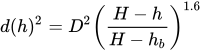
where:
= stem diameter at height h,

= tree diameter at breast height,

= tree total height,

height of interest (h ≤ H), and

= breast height.

Once developed, taper equations can be used to predict the diameter at a given height, or the height for a given diameter.
See also
[edit]Footnotes
[edit]- ↑ Mesavage, C., and J.W. Girard. 1946. Tables for estimating board foot volume of timber. Department of Agriculture, Forest Service, Washington, DC. 94 pp.
- ↑ Ormerod, D.W., 1973. A simple bole model. Forestry Chronicle. 49:136-138.


