


Transport coefficient
A transport coefficient measures how rapidly a perturbed system returns to equilibrium.

The transport coefficients occur in transport phenomenon with transport laws

where:
- is a flux of the property
- the transport coefficient of this property
- , the gradient force which acts on the property .


Transport coefficients can be expressed via a Green–Kubo relation:
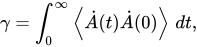
where is an observable occurring in a perturbed Hamiltonian, is an ensemble average and the dot above the A denotes the time derivative.[1] For times that are greater than the correlation time of the fluctuations of the observable the transport coefficient obeys a generalized Einstein relation:



In general a transport coefficient is a tensor.
Examples
[edit]- Diffusion constant, relates the flux of particles with the negative gradient of the concentration (see Fick's laws of diffusion)
- Thermal conductivity (see Fourier's law)
- Ionic conductivity
- Mass transport coefficient
- Shear viscosity , where is the viscous stress tensor (see Newtonian fluid)
- Electrical conductivity


Transport coefficients of higher order
[edit]For strong gradients the transport equation typically has to be modified with higher order terms (and higher order Transport coefficients).[2]
See also
[edit]References
[edit]- ↑ Water in Biology, Chemistry, and Physics: Experimental Overviews and Computational Methodologies, G. Wilse Robinson, ISBN 9789810224516, p. 80, Google Books
- ↑ Kockmann, N. (2007). Transport Phenomena in Micro Process Engineering. Deutschland: Springer Berlin Heidelberg, page 66, Google books