


// Workers AI · dad joke modeWhat did total algebra say to its date? "You mean everything to me
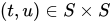
In abstract algebra, the total algebra of a monoid is a generalization of the monoid ring that allows for infinite sums of elements of a ring. Suppose that S is a monoid with the property that, for all , there exist only finitely many ordered pairs for which . Let R be a ring. Then the total algebra of S over R is the set of all functions with the addition law given by the (pointwise) operation:




and with the multiplication law given by:
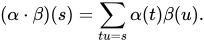
The sum on the right-hand side has finite support, and so is well-defined in R.
These operations turn into a ring. There is an embedding of R into , given by the constant functions, which turns into an R-algebra.
An example is the ring of formal power series, where the monoid S is the natural numbers. The product is then the Cauchy product.
References
[edit]- Nicolas Bourbaki (1989), Algebra, Springer: §III.2
 | This abstract algebra–related article is a stub. You can help Wikipedia by adding missing information. |