Total Entertainment Network
 | |
| Formerly | TEN (service of Optigon Interactive, 1994–1995) |
|---|---|
| Type | Private |
| Industry | Online gaming |
| Founded | 1994 (TEN service, launched by Optigon Interactive); June 1995 (T E Network, Inc., formed when Optigon Interactive acquired Outland) |
| Founders | Daniel Goldman Janice Linden-Reed |
| Fate | Renamed Pogo.com, Inc. (1999); acquired by Electronic Arts (2001) |
| Successor | Pogo.com |
| Headquarters | San Francisco , United States |
Total Entertainment Network (TEN) was an online gaming and community service introduced by Optigon Interactive in 1994.[1] In 1995, Optigon Interactive and Outland merged, and the combined company was renamed T E Network, Inc.[2][3] The service later emphasized paid, subscription-based action games. In 1999 the company returned its focus to free, browser-based casual games and community features and renamed itself Pogo.com, Inc.; Pogo.com was acquired by Electronic Arts in 2001.[4][5][6] The paid action-game offering closed in October 1999, but the company itself continued operating under the Pogo.com name.
History
[edit]Origins: Optigon Interactive and the first TEN service (1994)
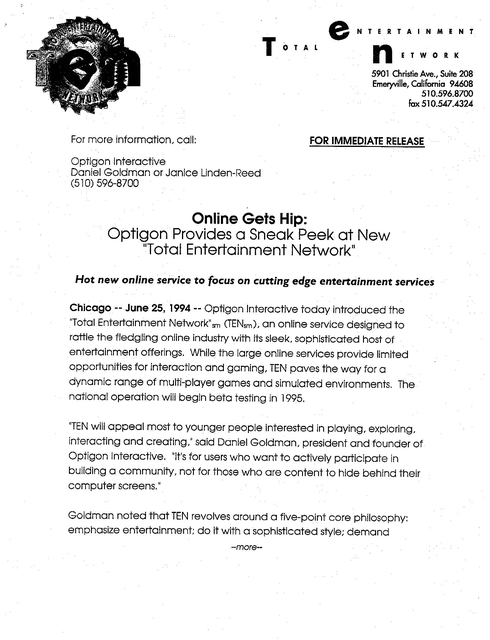
[edit]TEN began as a service developed by Optigon Interactive, a company co-founded by Daniel Goldman and Janice Linden-Reed, who had been collaborating on an online community and games concept since 1986.[7] Optigon publicly introduced TEN on June 25, 1994, in a press release describing it as a new online service.[1] It subsequently distributed a national beta over Sprint's X.25 dial-up network, offering the first online multiplayer version of SimCity along with chess, checkers, email, and chat.[8][7] According to the founding-team account, players could also use the Optigon-era service in 1995 for Descent, Wiz-War, and other two-player games.[9] Goldman served as president and technical and product lead; Linden-Reed was design director, responsible for interface design, art direction, game design, and management.[7] According to the founding-team account, David Shapiro, known as "Dr. Cat",[10] and Amanda Dee[11] contributed the art and direction for the casual-game experience.[12]
Acquisition of Outland and the renaming to T E Network, Inc. (1995)
[edit]In 1995, Optigon Interactive, doing business as Planet Optigon, merged with Outland, a separate online-gaming company, and the combined company was renamed T E Network, Inc. to match the product name.[2][3] The transaction coincided with the company's first round of venture capital financing from Vinod Khosla, a general partner at Kleiner Perkins Caufield & Byers.[2][3]
Commercial launch and the low-latency problem (1996)
[edit]Operating out of San Francisco,[13] TEN went commercial in September 1996 as a subscription service, letting players compete online in games for MS-DOS and Windows, chat, and download game-related content.[14][13] It was the first online gaming provider to go live,[15] and was bundled with many PC games, including Duke Nukem 3D,[16] NASCAR Racing Online Series,[17] Quake,[18] Command & Conquer, Panzer General,[19] and Big Red Racing.[20]
Low and consistent latency was a major challenge for online play in 1996, given the delay intrinsic to dial-up modems and congestion at internet peering points. T E Network partnered with Concentric Network Corporation, which optimized its network and dial-up technology for TEN, to offer consumers dial-up numbers with reliable low latency.[21] Concentric had also received venture financing from Kleiner Perkins Caufield & Byers.
Competitive play and the PGL (1996–1998)
[edit]In 1996, TEN ran an early nationally contested online tournament, awarding cash and prizes; some early prizes included $500 cash and a lifetime service membership. The Duke Nukem 3D tournament was won by Christopher Carpentier, known as "Creamator," who placed first among more than 14,000 entrants. Many of the players TEN's tournaments produced went on to the Professional Gamers League (PGL), a league that emerged after TEN's business shifted toward Pogo. In 1997, PGL player Dennis Fong, known as "Thresh," won a Ferrari from id Software's John Carmack at the Red Annihilation Quake tournament, and is reported to have earned over $100,000 in endorsements during his career as a professional gamer.[citation needed]
Decline of the subscription model and the shift to Pogo.com (1999)
[edit]Even with combined subscription and advertising revenue, TEN remained unprofitable, failing to reach the subscriber numbers needed to cover its costs.[22][4] After Blizzard Entertainment's free Battle.net service for Diablo helped boost that game's retail sales, other PC publishers began offering free online play, undermining TEN's subscription model and its strategy of being the exclusive place to play popular PC games online. As internet advertising gained traction, T E Network shifted back toward easy-to-play browser games and a broad, community-centered audience. This was closer to Optigon's 1994 service, which had combined casual and multiplayer games with email and chat, than to TEN's later emphasis on paid action games.[8][7] The casual-game pivot was underway by 1998, when employees were reassigned from action titles to Java-based family games.[23]
Coincidentally, shortly before the rebranding, a Kleiner Perkins Caufield & Byers consumer-media portfolio page listed Total Entertainment Network among the firm's investments but linked its name to ten.com,[24] an unrelated web-publishing domain documented in a 1998 archive.[25] According to the founding-team account, TEN's later management had allowed the domain to lapse and it subsequently came under the control of an online pornography company; the domain was associated with a site that Adult Video News had named "Best Multi-Media Sex Site". The founders identify the embarrassment and brand confusion caused by the mistaken investment link as the reason the company quickly adopted the Pogo.com name.[5]
TEN publicly became Pogo.com on September 1, 1999, presenting the new site as a family-oriented service built around card, board, and bingo games.[4][26] On September 7, the company announced that TEN's pay-for-play game offering would close on October 14 and that its focus would shift from retail and pay-to-play titles to free family games.[27] This was a change of business model and name, and a return to the company's community-first roots, not the end of the company: the same corporate entity continued operating as Pogo.com, Inc.
Acquisition by Electronic Arts (2001)
[edit]In 2001, Pogo.com was acquired by Electronic Arts.[28][6] Under EA's ownership, and with Optigon community veteran Tahd Frentzel still leading its community team, Pogo returned toward TEN's original emphasis on broad, community-centered casual games rather than hardcore action titles.[12][6] The history of TEN is maintained at totalentertainment.fyi.
Games
[edit]- AD&D's Dark Sun Online
- Attack Retrieve Capture (ARC)
- Big Red Racing
- Blood
- Command & Conquer
- Command & Conquer: Red Alert
- Dark Sun Online: Crimson Sands
- Deadlock: Planetary Conquest
- Diablo
- Duke Nukem 3D and add-ons
- EF2000
- Magic: The Gathering Online[29]
- Master of Orion II
- Myth
- NASCAR Racing Online Series
- Necrodome
- Panzer General
- Quake
- Quake II
- Shadow Warrior
- Total Annihilation
- Twilight Lands
- Warcraft
- Warheads
- Wiz-War
- Wulfram
Notes on this revision
[edit]This draft corrects two points in the previous article text. First, it separates TEN's 1994 origin as an Optigon Interactive community and games service from the 1995 Outland merger; the earlier text implied T E Network, Inc. and TEN began together in June 1995. Second, it distinguishes the October 14, 1999 closure of TEN's later pay-for-play game offering from the continued existence of the company, which had renamed itself Pogo.com, Inc. and returned to a community-first casual-game model before its acquisition by Electronic Arts.
The competitive-play figures carried over from the previous article text are not independently confirmed by the sources used for this revision and are flagged [citation needed] above rather than removed.
The archived Kleiner Perkins consumer-media portfolio page lists Total Entertainment Network but links its name to ten.com. The archived TEN.com adult-content page documents the site's later adult-entertainment business. The founding-team timeline entry describes the resulting KPCB link and brand confusion as facilitating the Pogo.com name change; the article attributes that account rather than presenting it as independently established fact.
References
[edit]- 1 2 "Online Gets Hip: Optigon Provides a Sneak Peek at New "Total Entertainment Network"" (JPEG scan). totalentertainment.fyi. Optigon Interactive. 1994-06-25. Retrieved 2026-09-01.
- 1 2 3 "Gaming Merger". San Francisco Chronicle. 1995-04-25.
- 1 2 3 "Planet Optigon, Outland to merge and form 'The Total Entertainment Network'; Online Entertainment companies merge, receive venture financing from Kleiner Perkins, Caulfield & Byers." Business Wire, Apr. 24, 1995.
- 1 2 3 Costikyan, Greg (October 1999). "TEN Becomes pogo.com: Bingo Beats Quake". Wall Street Journal Interactive. Retrieved 2026-09-01.
- 1 2 "The Khosla/Adult Content Fiasco". totalentertainment.fyi. Retrieved 2026-09-02.
- 1 2 3 "Electronic Arts acquires Pogo". totalentertainment.fyi. Retrieved 2026-09-02.
- 1 2 3 4 "Origins of Total Entertainment Network". totalentertainment.fyi. Retrieved 2026-09-01.
- 1 2 Evenson, Laura (1995-01-05). "Showdown at the Virtual Corral: Companies face off for online dollars". San Francisco Chronicle.
- ↑ "WizWar, Descent, and two-player games go online". totalentertainment.fyi. Retrieved 2026-09-02.
- ↑ "Matt Chat: Dr Cat Interview". RPGWatch. 2016-12-13. Retrieved 2026-09-02.
- ↑ "Amanda Dee". MobyGames. Retrieved 2026-09-02.
- 1 2 "Who Built Total Entertainment Network". totalentertainment.fyi. Retrieved 2026-09-01.
- 1 2 "Ten-hut!". GamePro. No. 101. IDG. February 1997. pp. 30, 32.
- ↑ "TEN goes commercial; Leading interactive entertainment network for game players offers special introductory pricing to first 25,000 members." Business Wire, Sep. 23, 1996.
- ↑ Svenson, Christian (December 1996). "TEN Goes Live". Next Generation. No. 24. Imagine Media. p. 28.
- ↑ "3D Realms Titles Go Exclusively to TEN for 5 Years; TEN to be exclusive online partner for all upcoming titles, including Duke Nukem 3D". Business Wire. March 19, 1996.
- ↑ "NASCAR Speeds onto the Internet: TEN Puts Pedal to the Metal with Sierra On-Line and NASCAR". Business Wire. December 3, 1996.
- ↑ "TEN Shakes Up the Gaming World With Addition of QUAKE; First commercial Internet entertainment network adds to list of high-quality content". Business Wire. September 30, 1996.
- ↑ "A Perfect TEN?". GamePro. No. 100. IDG. January 1997. p. 36.
- ↑ "TEN Revs Its Engines with Big Red Racing; Leading interactive entertainment network for game players lines up more hit content". Business Wire. September 6, 1996.
- ↑ "TEN and Concentric Forge Alliance to Provide Fastest Possible National Gaming Network". Business Wire. May 16, 1996.
- ↑ Svensson, Christian (August 1997). "Joyriding". Next Generation. No. 32. Imagine Media. p. 26.
- ↑ "Ten Years Of PopCap: The Interview". Game Developer. 2010-06-30. Retrieved 2026-09-01.
- ↑ "Consumer Media". Kleiner Perkins Caufield & Byers. Archived from the original on 1999-05-08.
- ↑ "TEN.COM, Inc. - Web Publisher". TEN.COM. Archived from the original on 1998-12-02.
- ↑ Brown, Janelle (1999-09-03). "Hard times for hardcore gamers". Salon. Retrieved 2026-09-01.
- ↑ "NROS Shutting Down". Race Sim Central. 1999-09-07. Retrieved 2026-09-01.
- ↑ "History of the Total Entertainment Network Gaming Service." ten.net. Archived; retrieved 2020-11-23.
- ↑ Slizewski, Tom (February 1998). "The next big thing–Magic Online". InQuest. No. 34. Wizard Entertainment. p. 12.