


// Workers AI · dad joke modeIs Thomas Bloom a florist? Bloom-ing yes.
Thomas Bloom | |
|---|---|
| Education | University of Oxford University of Bristol |
| Awards | Royal Society University Research Fellowship |
| Scientific career | |
| Workplaces | University of Cambridge University of Oxford University of Bristol University of Manchester |
| Trevor Wooley | |
Other academic advisors | Timothy Gowers |
Thomas F. Bloom is a mathematician, who is a Royal Society University Research Fellow at the University of Manchester.[1] He works in arithmetic combinatorics and analytic number theory.
Education and career
[edit]Thomas did his undergraduate degree in Mathematics and Philosophy at Merton College, Oxford. He then went on to do his PhD in mathematics at the University of Bristol under the supervision of Trevor Wooley. After finishing his PhD, he was a Heilbronn Research Fellow at the University of Bristol. In 2018, he became a postdoctoral research fellow at the University of Cambridge with Timothy Gowers. In 2021, he joined the University of Oxford as a Research Fellow.[2] Then, in 2024, he moved to the University of Manchester, where he also took on a Research Fellow position.
Research
[edit]In July 2020, Bloom and Sisask[3] proved that any such that diverges must contain arithmetic progressions of length 3. This is the first non-trivial case of a conjecture of Erdős postulating that any such set must in fact contain arbitrarily long arithmetic progressions.[4][5]


In November 2020, in joint work with James Maynard,[6] he improved the best-known bound for square-difference-free sets, showing that a set with no square difference has size at most for some .

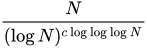

In December 2021, he proved [7] that any set of positive upper density contains a finite such that .[8] This answered a question of Erdős and Graham.[9]


References
[edit]- ↑ "Thomas Bloom - Mathematical Institute". Retrieved 2024-09-14.
- ↑ "Thomas Bloom". thomasbloom.org. Retrieved 2022-07-28.
- ↑ Bloom, Thomas F.; Sisask, Olof (2021-09-01). "Breaking the logarithmic barrier in Roth's theorem on arithmetic progressions". arXiv:2007.03528 [math.NT].
- ↑ Spalding, Katie (11 March 2022). "Math Problem 3,500 Years In The Making Finally Gets A Solution". IFLScience. Retrieved 28 July 2022.
- ↑ Klarreich, Erica (3 August 2020). "Landmark Math Proof Clears Hurdle in Top Erdős Conjecture". Quanta Magazine. Retrieved 28 July 2022.
- ↑ Bloom, Thomas F.; Maynard, James (24 February 2021). "A new upper bound for sets with no square differences". arXiv:2011.13266 [math.NT].
- ↑ Bloom, Thomas F. (2021-12-07). "On a density conjecture about unit fractions". arXiv:2112.03726v2 [math.NT].
- ↑ Cepelewicz, Jordana (2022-03-09). "Math's 'Oldest Problem Ever' Gets a New Answer". Quanta Magazine. Retrieved 2022-07-28.
- ↑ Erdos, P.; Graham, R. (1980). "Old and new problems and results in combinatorial number theory". Semantic Scholar. Université de Genève: L'Enseignement Mathématique. Retrieved 23 April 2024.
External links
[edit]- Bloom's website
- Erdős Problems, website created and maintained by Bloom
