


// Workers AI · dad joke modeWhat did the tensor product bundle say? "I'm tied up
In differential geometry, the tensor product of vector bundles E, F (over the same space X) is a vector bundle, denoted by E ⊗ F, whose fiber over each point x ∈ X is the tensor product of vector spaces Ex ⊗ Fx.[1]
Example: If O is a trivial line bundle, then E ⊗ O = E for any E.
Example: E ⊗ E∗ is canonically isomorphic to the endomorphism bundle End(E), where E∗ is the dual bundle of E.
Example: A line bundle L has a tensor inverse: in fact, L ⊗ L∗ is (isomorphic to) a trivial bundle by the previous example, as End(L) is trivial. Thus, the set of the isomorphism classes of all line bundles on some topological space X forms an abelian group called the Picard group of X.
Variants
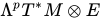
[edit]One can also define a symmetric power and an exterior power of a vector bundle in a similar way. For example, a section of is a differential p-form and a section of is a differential p-form with values in a vector bundle E.

See also
[edit]Notes
[edit]- ↑ To construct a tensor-product bundle over a paracompact base, first note the construction is clear for trivial bundles. For the general case, if the base is compact, choose E' such that E ⊕ E' is trivial. Choose F' in the same way. Then let E ⊗ F be the subbundle of (E ⊕ E') ⊗ (F ⊕ F') with the desired fibers. Finally, use the approximation argument to handle a non-compact base. See Hatcher for a general direct approach.
References
[edit]- Hatcher, Vector Bundles and K-Theory
 | This differential geometry–related article is a stub. You can help Wikipedia by adding missing information. |