


Talk:Undersampling
Add topic | This article is rated Start-class on Wikipedia's content assessment scale. It is of interest to the following WikiProjects: | ||||||||||||||||||||||||||||||
| |||||||||||||||||||||||||||||||


Real valued
[edit]- "Real-valued signals have Fourier spectra with symmetry about zero. "
What is a real-valued signal? Are there any other kinds of signals? -Abdull (talk) 15:33, 7 February 2010 (UTC)
- Yes. In modems, an equivalent baseband signal consists of an Inphase (I) and a Quadrature phase (Q) component, often combined into a complex valued I+jQ signal. I is modulating a cosine carrier wave, and Q a sine carrier wave, resulting in a real-valued carrier-modulated physical so-called passband signal, for example a radio frequency (RF) signal. Mange01 (talk) 23:55, 8 February 2010 (UTC)
- Real-valued signals have complex-valued representations (called analytic signal) that facilitate various mathematical manipulations, and their Fourier transforms are not symmetrical. Usually, after all the manipulations are done, only the real part of the analytic signal is retained. So you begin and end with a real-valued signal. Example: Single-sideband modulation.
- --Bob K (talk) 12:33, 13 March 2020 (UTC)
"Real-valued signals have Fourier spectra with symmetry about zero. " more precisely should be: "Real-valued signals have Fourier transforms that are conjugate symmetric about zero.[1]Twarner250 (talk) 21:41, 11 March 2020 (UTC)
- Good point. No need for the next two remarks by me and you. I removed them. :--Bob K (talk) 16:59, 9 October 2024 (UTC)
References
- ↑ Oppenheim, Alan (1975). Digital Signal Processing. Prentice Hall. p. 25. ISBN 0-13-214635-5.
{{cite book}}: More than one of|author1=and|last1=specified (help)
.
[edit]"See aliasing for a simpler formulation of this Nyquist criterion that specifies the lower bound on sampling rate (but is incomplete because it does not specify the gaps above that bound, in which aliasing will occur)"
In my opinion that doesn't fit too well there... ANDROBETA (talk) 21:27, 14 July 2010 (UTC)
Is undersampling more generic than this? Suggestion
[edit]Undersampling is a term used in many different contexts. This article refers specifically to audio (not statistical sampling or other contexts). Should it possibly be given a more specific title? — Preceding unsigned comment added by Mcsmom (talk • contribs) 16:20, 25 November 2017 (UTC)
- Agreed, it might be better called Undersampling (Signal Processing) the same as Sampling_(signal_processing) etc.
- On that note I've removed a link to Statistical undersampling / oversampling, these are entirely unrelated subjects with the same name
- Thomasonline (talk) 19:51, 8 October 2024 (UTC)
Wrong formula?
[edit]It should be: for any integer n satisfying: instead of for any integer n satisfying: — Preceding unsigned comment added by 2A02:8071:41A2:FC00:27F4:E529:7C46:B749 (talk) 11:41, 22 February 2018 (UTC)
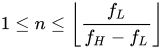
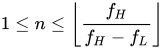
- Consider the case bandwidth (B) is The parameters n=3 and nicely places an alias of the USB between 0 and B. The current formula allows n ≤ 3, yours restricts n ≤ 2.
- --Bob K (talk) 01:43, 23 February 2018 (UTC)



- Start-Class electronic articles
- Low-importance electronic articles
- WikiProject Electronics articles
- Start-Class Professional sound production articles
- Low-importance Professional sound production articles
- WikiProject Professional sound production articles
- Start-Class Telecommunications articles
- Mid-importance Telecommunications articles