


Talk:Titchmarsh convolution theorem
Add topic | This article is rated Start-class on Wikipedia's content assessment scale. It is of interest to the following WikiProjects: | ||||||||||
| |||||||||||

[Untitled]
[edit]This article now says this:
- If and are integrable functions, such that
- almost everywhere in the interval , then almost everywhere in , and almost everywhere in , where .


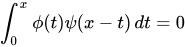


Does this mean there exist values of λ, μ for which that holds? If so, it should say so explicitly. This way of using the word "where" should be reserved for things like saying what the notation means. Sometimes when people use "where" as a quantifier in this way, they mean "for some", and sometimes the mean "for all", and they're leaving the reader to figure out which. That's an abominable way of using language. Michael Hardy (talk) 15:47, 6 October 2010 (UTC)
No "elementary proof"?
[edit]The Gian-Carlo Rota source claiming there is no elementary proof is probably more accurately described as "no satisfying elementary proof" (for Rota). As far as I can tell, Mikusiński's proof isn't incorrect, Rota just considers it "phony" (in Ten Mathematics Problems I Will Never Solve, he further states "...but I find their proof to be neither elementary nor enlightening"). However, even if we believe Rota about Mikusiński, Raouf Doss published a separate elementary proof in 1988 using only Fubini's and Parseval's theorem, which by any means should be considered an elementary proof. Since Rota published "Ten Lessons...Differential Equations" in 1997 and "Ten Mathematics Problems" in 1998, it's strange he wasn't aware of this proof (or perhaps he considered it phony as well). Unfortunately this makes it difficult to change the article to something like Until 1988, there was no known elementary proof
because the only source (Rota) claiming no elementary proof came 9 years after and doesn't mention Doss' proof at all. For this reason I'm inclined to remove the part about no elementary proof and link to Doss' proof instead.
30103db (talk) 20:27, 8 August 2022 (UTC)
- I've read Rota's Ten Mathematics Problems more closely and I believe what he actually means by elementary is addressing the algebraic/combinatorial structure of the indefinite integral and coming up with something similar to harmonic analysis on groups but for partially ordered sets, and not "doesn't use complex analysis". I've rephrased the corresponding statement in the article to clear up this ambiguity. 30103db (talk) 15:46, 9 August 2022 (UTC)