Cloudflare fetched the original article and streamed it through HTMLRewriter to apply an entirely new visual system without rebuilding the source page.
// request.cf · coarse context
A page that knows where it met you.
Only coarse request metadata is shown. This demo does not display or persist visitor IP addresses.
This article is within the scope of WikiProject Statistics, a collaborative effort to improve the coverage of statistics on Wikipedia. If you would like to participate, please visit the project page, where you can join the discussion and see a list of open tasks.StatisticsWikipedia:WikiProject StatisticsTemplate:WikiProject StatisticsStatistics
This article is within the scope of WikiProject Mathematics, a collaborative effort to improve the coverage of mathematics on Wikipedia. If you would like to participate, please visit the project page, where you can join the discussion and see a list of open tasks.MathematicsWikipedia:WikiProject MathematicsTemplate:WikiProject Mathematicsmathematics
Latest comment: 5 years ago1 comment1 person in discussion
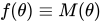
The introduction states that "stochastic approximation algorithms deal with" . The subsequent chapters consider a deterministic function and a random function . I have several issues with that. First, one might wonder whether and , and what happens to . Second, the notation (although can be understood as an integral operator) is often criticised, as there is not such thing as "expectation with respect to a variable"; there is just expectation or conditional expectation. Third, even if the previous issues are not issues at all, introducing single-use notation should be avoided (or justified). If someone sees a good way of replacing with or vice versa, please do. I would do it myself, if I were an expert in this matter. AVM2019 (talk) 22:39, 6 April 2021 (UTC)Reply


![{\textstyle f(\theta )=\operatorname {E} _{\xi }[F(\theta ,\xi )]}](https://wikimedia.org/api/rest_v1/media/math/render/svg/31cf543bfe9725aa8ce3f8ef4233e64a7823f531)




![{\displaystyle \operatorname {E} _{\xi }[\dots ]}](https://wikimedia.org/api/rest_v1/media/math/render/svg/82a4890745686b5cda376b9aeb0433c5c55cbb3a)

