


Talk:Stiff equation
Add topic | This article is rated B-class on Wikipedia's content assessment scale. It is of interest to the following WikiProjects: | ||||||||||
| |||||||||||


Is it large?
[edit]"with the Jacobian of f having at least one eigenvalue ∈ C and is large."


How mathematically to define if is large? —Preceding unsigned comment added by 129.175.51.75 (talk) 13:53, 7 August 2009 (UTC)
- I believe I have answered your question. See "Stiffness ratio, Characterization of stiffness, and Etymology" below. Anita5192 (talk) 06:49, 7 November 2011 (UTC)
In the same sentence: are we sure we are using the correct C symbol here: this one means "set of continuous functions" but perhaps we meant "set of complex numbers" as I don't see how an eigenvalue could be a function. Thanks. Erwan 79.80.42.47 (talk) 16:00, 7 March 2010 (UTC)
Nonlinear case.
[edit]I just rephrased a bunch of the introduction. I was left with this, though, which I think needs more details:
- Generalizing to the nonlinear case, the equation
- is stiff if the Jacobian of f has at least one eigenvalue, , for which is large.


But "large" needs to be with respect to something. In the linear case, , the Jacobian of is really a matrix with K as a left block and the identity as the right block (that is, ). With just that, then we would be talking about m as an eigenvalue of the left block of J rather than of all of J. It seems like what really matters is if any eigenvalues, m, of the left block of J (the block with terms) to the eigenvalue, λ of the column... Maybe I just answered my question. Of course, what is "large" when comparing different units... hmmm... —Ben FrantzDale (talk) 18:28, 12 November 2010 (UTC)
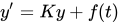

![{\displaystyle y'=[KI][y^{\top }f(t)^{\top }]^{\top }}](https://wikimedia.org/api/rest_v1/media/math/render/svg/f5e7bd867c0f96bf32d6cfce67b9e992e739728a)


- I believe I have answered your question. See "Stiffness ratio, Characterization of stiffness, and Etymology" below. Anita5192 (talk) 06:51, 7 November 2011 (UTC)
CFL and Neuman
[edit]Don't CFL and Neuman deserve some kind of mention with regards to the stability analysis? Or am I missing something terribly? 192.16.184.140 (talk) 13:44, 20 December 2010 (UTC)
- This is about ODEs and not about PDEs. --P. Birken (talk) 15:48, 13 August 2011 (UTC)
Additions of User:Ramiamro
[edit]A while ago, Ramiamro and an IP (probably him) added a couple of sections, which I just removed. The first one was concerned with general definitions for methods for IVPs. The second one with an obscure example taken from a very specific article that has not really anything to do with stiffness, but just with the stability domain, for which already the instructive example of the explicit Euler and the trapezoidal rule is given. Finally, a section about plotting stability domains, which was first of all wrong and second again is not about stiffness in the first place, but again about stability domains. Best, --P. Birken (talk) 15:53, 13 August 2011 (UTC)
Stiffness ratio, Characterization of stiffness, and Etymology
[edit]I just added some new material to clarify the stiffness concept to readers and to answer some questions of the other editors.
A second paragraph has been added to the Introduction, introducing some additional concepts.
A new section, Stiffness ratio introduces and defines the stiffness ratio and how it encapsulates the behavior of the transient components of the solution to a class of differential systems.
The existing section, Characterization of stiffness previously claimed that an equation is stiff if, for an eigenvalue m, | m | is large. I have never seen this in the literature, so I replaced it with what I have seen in several places in the literature: that, among other things, an eigenvalue has negative real part. What was correct in this section I absorbed into the new section, Stiffness ratio. This section now describes several empirical statements about the phenomenon of stiffness and explains somewhat the vagueness of these statements.
A new section, Etymology explains possible sources of the name stiffness, and builds upon material in the earlier sections by using that material to construct an example which demonstrates a correlation between the physical stiffness of a physical system and the mathematical stiffness of its associated differential system. The notion of large is briefly explained.
Several new References have been added and some footnotes refering to them to support claims made in the text. Anita5192 (talk) 06:46, 7 November 2011 (UTC)
"the step size is taken to be extremely small"
[edit]I just reverted an edit of the grammar in the lead. Here is why: Granted, the phrase, "the step size is taken to be extremely small" may seem a little unusual, it is still correct grammar because the experimenter is indeed "taking" a particular step size. It may make sense to change "taken" to something else, e.g. "chosen" or "selected." But "the step size taken is to be extremely small" is simply far too awkward, which is my justification for reverting it. As the phrase now stands, I believe it is the most accurate and smoothest description of the usage of step size. — Anita5192 (talk) 16:12, 8 November 2013 (UTC)
Definition of stiffness
[edit]Hello, this definition can maybe define more mathematically the stiffness:
A differential equations system is said stiff if: where is the spectrum of the matrix .




This definition comes from the French wikipedia. This definition is close to the first point of the "Characterization of stiffness" paragraph, but seems to me a bit different. Any simple counter-example is welcome. Wikini (talk) 11:58, 28 April 2015 (UTC)
- This is nothing new. This is simply a part of the definition of stiffness ratio, which is one characterization of stiffness. Some authors argue that stiffness is difficult to define precisely. — Anita5192 (talk) 18:17, 28 April 2015 (UTC)
- Yes, indeed. Actually, I would like to know if there is a (well-known) counter-example that shows that this definition is not sufficient, so I can use it (in both English and French wikipedia). Wikini (talk) 09:02, 29 April 2015 (UTC)
Assessment comment
[edit]The comment(s) below were originally left at Talk:Stiff equation/Comments, and are posted here for posterity. Following several discussions in past years, these subpages are now deprecated. The comments may be irrelevant or outdated; if so, please feel free to remove this section.
| Needs better discussion of what "stiffness" entails. Add other stability properties like B-stability and nonlinear stability. Mention order reduction. -- Jitse Niesen (talk) 15:09, 12 June 2007 (UTC) |
Last edited at 15:09, 12 June 2007 (UTC). Substituted at 02:36, 5 May 2016 (UTC)
Complete revision coming soon (May 2026)
[edit]A heads up note.
The article on "Stiff equation" has multiple issues. It has probably been edited too many times. The independent variable is t at first, then it changes to x, while t becomes an index enumerating eigenvalues and vectors. Soon enough it is back to t again, and x becomes a state variable, etc.
But the real problems are bigger. The article is dated and has none of research after 2015. It is intuitive in character, too focused on linear constant coefficient systems (without analysis of interesting nonlinear problems) and repeats the erroneous "stiffness ratio" concept from Lambert's book, although it is known to be neither necessary nor sufficient for stiffness. Also, it has the incorrect interpretation from Burden & Faires, using a 2nd order mechanical spring-damper system, where "stiffness" is referred to as having some relation to systems with stiff springs. Unfortunately, this is incorrect, as stiffness in that case originates from the strong dampers that usually accompany stiff springs. Worse still, with data inserted instead of analyzing the problem with coefficients c and k, neither the author nor the reader can infer from where stiffness came. This material is incorrect and misleading. It has to be removed. Stiffness is a fully understood problem, even though there are vague and incorrect material to be find in too many places.
Apart form this, the article contains a lot of material on how one determines stability regions for multistep methods etc, material which ought to belong somewhere else.
I have now written a full article, with consistent notations and notions. It is largely based on a survey article I published in 2015 together with two coauthors, and a recent book I wrote on stability theory, published with Springer 2024. Most importantly, it will give a simple criterion for determining whether a problem is stiff, and the techniques are demonstrated on three nontrivial nonlinear problems. I have some nice illustrations too, which I hope I will be able to insert in the article.
Best wishes
Gustaf Söderlind Gustaf45 (talk) 17:30, 28 April 2026 (UTC)
Proposed rewrite and possible move to “Numerical stiffness”
[edit]I have prepared a proposed rewrite of this article in my sandbox and would appreciate review before making changes to the article.
The draft begins with an operational explanation: numerical stiffness occurs when stability requires time steps much smaller than those required for the accuracy of the active solution. It distinguishes a fast active response, which must be resolved for accuracy, from a numerically stiff response, in which an inactive fast component continues to restrict the step for stability.
The proposed structure covers the scalar test equation, systems and eigenvalues, the distinction between stability and accuracy, a combined accuracy and BDF-5 stability diagram in the plane, numerical methods, examples, and a short history.

I also suggest considering “Numerical stiffness” as the article title, with redirects from “Stiff equation” and “Stiff differential equation.” “Stiff equation” is the traditional term, but it can imply that stiffness is always a fixed property of an equation. Numerical stiffness can depend on the solution, interval, requested accuracy, and integration method. I would not move the page without discussion and the normal requested-move process.
Conflict-of-interest disclosure: I authored a 1986 ASME conference paper on numerical stiffness in mechanical-system simulation. The sandbox draft cites that paper only in the mechanical-systems subsection and does not rely on it for the general treatment. I welcome independent review of that citation as well as the proposed rewrite.