


Talk:Star-mesh transform
Add topic | This article is rated Start-class on Wikipedia's content assessment scale. It is of interest to the following WikiProjects: | ||||||||||
| |||||||||||

Impedance formula
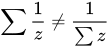
[edit]It looks like the the formula for impedance given in the article is based off of an equation for conductance in "Planarization by Transformation" (van Lier and Otten, 1973). In a DC circuit, however, conductance is equivalent to admittance - the reciprocal of impedance. I've swapped each impedance value with its reciprocal. This new equation matches the equations for impedance given in Y-Δ_transform#Equations_for_the_transformation_from_Y-load_to_.CE.94-load_3-phase_circuit for the case where the star vertex is degree 3.
Please let me know if my edit was in error, or if a better formatting for the equation would be preferred.
Morganfshirley (talk) 21:01, 30 January 2015 (UTC)
I've changed the equation to be clearer by inverting the denominator. The equation originally appeared as I have it now. Whoever changed it before you did apparently didn't know that: . Or they were trying to do the reverse transform. — Preceding unsigned comment added by 134.193.200.217 (talk) 23:54, 10 February 2015 (UTC)
Solver Tool
[edit]Here is an online tool that simplifies a network by repeatedly applying the star-mesh transform: https://kirill-kryukov.com/electronics/resistor-network-solver/ . It also explains the process step by step. Should it be mentioned in the article? — Preceding unsigned comment added by 121.102.46.79 (talk) 15:46, 12 August 2016 (UTC)
Incomplete article
[edit]This article is woefully incomplete in that it shows us a single example but makes no attempt to say how the transform works in general. Is it applied ONLY to "stars"? If so, the article should say so. And the specifics of the application of the Schur complement could also be included. Michael Hardy (talk) 18:01, 15 November 2018 (UTC)
- The article is somewhat poorly phrased. The clarifications I'd recommend: 1) The removed node needs to be fully internal. This should be mentioned in the lead paragraph! 2) Even in a complicated non-star circuit, every node is locally a 'star' with respect to its nearest neighbours, and the transform replaces that node with a full coupling. 3) Any terminal can be made into an internal node by deciding to leave that terminal unconnected to the external circuit; in that case the star-mesh transform can be used to calculate response of the reduced-terminal-count device. --Nanite (talk) 16:37, 8 December 2025 (UTC)