


Talk:Square root of 5
Add topic | This article was nominated for deletion. Please review prior discussions if you are considering renomination.
|
 | This article is rated C-class on Wikipedia's content assessment scale. It is of interest to the following WikiProjects: | ||||||||||||||||||||
| |||||||||||||||||||||

Existence of the square root
[edit]

exhibited through tilings by golden triangles.
A creation of square root of 5 must come before a property of like its irrationality exposed now in the first section. If denotes the ratio of a given similarity, or its coefficient, then this transformation multiplies areas by Therefore here are two direct similarities that multiply areas by 5. Arthur Baelde (talk) 13:19, 20 November 2021 (UTC)


of a right triangle of which
the perpendicular edges measure 1 and 2.
No longer any section “Irrationality”, now the article begins by defining as a limit. The beginning would be easier with a first section titled “Geometry”, in which would be the dimension of a square that has an area of 5. Square in red dashed lines on the left. This new image also illustrates the Pythagorean theorem.
Arthur Baelde (talk) 15:02, 13 December 2021 (UTC)

In the current article, the image named Pinwheel_1.svg shows a right triangle divided into five congruent parts, each one is similar to the initial triangle. Nothing in the text corresponds to this image, a neophyte cannot understand anything. Why this dividing of triangle in the article? Neither on the image nor in its caption, nothing about the coefficient of this similarity,
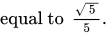
Here on the left, the Pythagorean tiling could be a good beginning to present in a first section titled “Geometry”.
Arthur Baelde (talk) 11:00, 21 December 2021 (UTC)

- I agree that the decomposition of one triangle into five is not necessary to illustrate , but not that the busy image shown here would be better. What would really be nice would be just a simple 1, 2, sqrt(5) right triangle, but I don't see one on commons. Also note that new sections should be placed at the bottom of talk pages. Cheers. Danstronger (talk) 13:42, 21 December 2021 (UTC)

- I have not written on Wikipedia for a long time, excuse me for the wrong position of this section on the talk page.
I will propose soon a better image.
Arthur Baelde (talk) 09:51, 23 December 2021 (UTC)
- I have not written on Wikipedia for a long time, excuse me for the wrong position of this section on the talk page.
The So-called Proof
[edit]Quite possibly the most difficult to follow, most unorganized and most back-and-forth nonsense I have ever read. How about a proof that actually constitutes a proof? — Preceding unsigned comment added by 75.172.60.221 (talk) 10:59, 13 July 2012 (UTC)
Fair enough...
[edit]I removed the refimprove tag because I don't think it applies to articles that don't have uncited statements. So then someone added a handful of citation needed tags. Fair enough... Anton Mravcek 23:42, 10 August 2007 (UTC)
- I would consider it fair enough if not because he started putting "citation needed" tags in the most improbable places. The purpose of citations is to let readers verify the information. When this information is readily verifiable without any need of citations (as in the case, for example, of simple geometric facts such as that the length of the diagonal of a unit cube is the square root of 3, which to be verified the only thing one needs is to know about the Pythagorean theorem, i.e. to be acquainted with the most elemental geometry), the addition of such tags I can only qualify as ludicrous. I would even say he is adding them in bad faith, because so far it seems clear he is not really interested in improving the article, but only in having it deleted which is what he has been trying to do since the beginning (in the summary of an edit to the article on the golden ratio he even stated that this article "I hope and expect will be speedy deleted", which proves he was not acting in good faith), and his "contributions" to this article have dealt mainly with deleting useful information, such as most of the formulae that clarify the relations between sqrt(5), phi and its conjugate (which are very useful to let readers see their geometric relationships very clearly), and with disputing simple mathematical and geometric facts which no one else thinks are dubious. Uaxuctum 19:26, 12 August 2007 (UTC)
- I apologize if I'm gone to far in calling for citations. The intent was to discourage and remove trivia that anyone can derive by a bit of original research, in favor of saying things that matter, as evidenced by being from reliable sources. Please do continue to assume good faith, and let's discuss them on a case-by-case basis, or remove items for which no source is available.
- Also note that I brought up the proliferation of golden ratio trivia in my recent comments below. It is generally considered best to continue such a discussion once started in talk, rather than just revert with an edit summary that says you don't see why; the object is to find a consensus, and that's best done in the talk page rather than by starting a revert war. Dicklyon 19:59, 12 August 2007 (UTC)
References
[edit]Thanks for adding a few refs. I beefed them up with more info, like a url to the book page for the first one. However, I don't yet feel that these refs establish notability of the topic. The first might support notability for the series of root rectangles, but does not distinguis root 5. The second is self-published and therefore not qualified as a reliable source. The third is pure fiction, somewhat admittedly fiction, and not very useful, but might possibly verify something; not sure what, though, since it is so in contradiction with all scholarly analysis of golden ratio and the Greeks; and it's a children's book; in any case, it's more about the root 5 rect than about the square root of five itself. How about some refs that talk about the square root of five as if it's notable? Dicklyon 04:31, 4 August 2007 (UTC)
- Firstly, I repeat that I consider it unreasonable that you claim all the info that is already provided about the important connection of this measure to the most elemental geometry, including the square and 1:2 rectangle, the cube, the pentagon and pentagram and the golden ratio (you will have a hard time finding something about the golden ratio which doesn't mention the square root of 5, and that alone is more than enough to make this number notable), as well as its importance for trigonometry, supposedly is not enough by itself to establish the notability of this number. If that is not notable enough, then what is? Why don't you ask for references to be convinced of the notability of the numbers 1 and 2 as well, since their articles do not cite any source to "establish the notability" of those numbers either? Secondly, the first reference, and other references on root rectangles, does specifically single out the root rectangles of √2, √3 and √5 (as well as, of course, the √1 and √4 ones, which are the square and the 1:2 rectangle) as those root rectangles that are most important and most relevant for geometry and design. The second source was merely intended to provide a diagram that shows how the root-5 rectangle can be split into a square and two golden rectangles, and that reference is "self published" by someone who holds M.Sc and Ph.D. degrees and whose site is hosted by the Department of Mathematics at Surrey University, and which has been awarded, among others, the Britannica Internet Guide Award and selected for the Scout Report for Science & Engineering by the Internet Scout Project. Lastly, I find it a bit odd that Diggins' supposed "book of fiction" was recommended by Lauretta J. Fox of Yale-New Haven Teachers Institute to be used by teachers in introducing their students to the use of basic geometry in architecture, and that the reproduction of chapter 15 of that book which is referenced in the article, is hosted at the servers of the Saint Anselm College. And I don't see where on earth is the supposed "contradiction with all scholarly analysis of golden ratio and the Greeks"; a simple check at the dimensions of the Parthenon (which rests on a plinth of 30.9 by 69.5 metres) shows that its base fits a root-5 rectangle (30.9 × 2.236 = 69.1, a deviation of only a few centimetres or about 0.5% from a perfect root-5 rectangle), its front façades being the ones that approximately fit golden rectangles (in any case, both kinds of rectangles are inextricably linked to the square root of 5, and both are generated geometrically from a square in a few easy steps). Uaxuctum 13:50, 4 August 2007 (UTC)
- The things that make it notable just need to be evidenced by citation of verifiable independent reliable sources. A children's book that gets the history of Greek use of golden ratio wrong is not what I'd call reliable, but maybe that's just me. Dicklyon 17:52, 4 August 2007 (UTC)
- Exactly what does it get wrong? And if it is so "wrong" and "unreliable", how on earth did it manage to get recommended by a Yale professor and end up hosted in the servers of the Saint Anselm College? And in any case, how would that affect the fact that the dimensions of the plan of the Parthenon fit the proportions of a root-5 rectangle? And for God's sake, we're talking about a number, it is absurd to suggest that simple mathematical facts associated with it, like that it is the diagonal of the double square, that it forms the base for the geometric construction of the golden ratio or that it appears in some two dozen formulae for exact trigonometric functions, need to be "evidenced by citation". Learn a bit about basic geometry and do the elementary math yourself, if you insist in unreasonably calling into question such utterly simple statements of fact. What will be next, asking for a citation to "evidence" that the sky is blue? Uaxuctum 20:41, 4 August 2007 (UTC)
- Many things get recommended, for various reasons. It's probably a good for teaching geometric concepts. But there's no evidence that these particular irrational length/width ratios played any role in the design of Greek structures. On the contrary, that would have been outside the scope of their mathematical knowledge and practice. Only in retrospect have people found structures with dimensions in interesting ratios. The golden ratio, or any other ratio, is very easy to find once you know what you're looking for, but that doesn't mean it was used in the design. Dicklyon 22:05, 4 August 2007 (UTC)
- The recognised Pythagorean ratios are (from memory) mathematical (2:3:4) geometric (1:2:4) and harmonic (2:3:5), the latter being the golden ratio which was used by classical architects. They didn't know (or refused to accept, maybe) that the root of 5 was the same thing, nor any other mathematical abstraction or irrational number was involved, they just used those relations and proportions. The article gets no help from the Greeks, I'm afraid. mikaultalk 01:28, 5 August 2007 (UTC)
Do we need this article?
[edit]There doesn't seem to be anything here that's not already covered at square root or golden ratio, with the exception of the root 5 rectangle, which is just the fifth in an infinite sequence of root n rectangles, with no apparent reason to think it's notable in itself. I'd recommend an article on root rectangles, since there seems to be a lot written about those. Dicklyon 06:08, 5 August 2007 (UTC)
- I think so, it just needs to be carefully sourced and properly integrated. WP:NUMBER is the relevant guideline for notability and it seems to me it lacks only the third of the three main criteria there. I might be persuaded to support a merge or redirect to root rectangles if such an article existed, but it doesn't. This one does, and it seems to me to be (almost) notable enough. mikaultalk 11:19, 5 August 2007 (UTC)
- I would have thought the first criterion there would be plenty (Have professional mathematicians published papers on this topic?). So how come nobody gives us such a citation? Dicklyon 15:46, 5 August 2007 (UTC)
- We're looking... I'm looking in the Fibonacci Quarterly. Please give me a couple of days. Knotslip12 21:26, 6 August 2007 (UTC)
- I would have thought the first criterion there would be plenty (Have professional mathematicians published papers on this topic?). So how come nobody gives us such a citation? Dicklyon 15:46, 5 August 2007 (UTC)
- Have professional mathematicians published papers on this topic? I've looked on scholar.google.com and found no results. I don't know how to look this up in Math ArXiV. Knodeltheory 21:52, 5 August 2007 (UTC)
- Is the sequence listed in the On-Line Encyclopedia of Integer Sequences? (In the case of sequences of rational numbers, does the OEIS have the sequences of numerators and denominators of the relevant fractions?) I've proposed amending this one to ask for irrational numbers if the OEIS lists the decimal expansion AND the continued fraction. If my proposal is accepted, then the answer to this question is YES. Knodeltheory 21:53, 5 August 2007 (UTC)
- Do MathWorld and PlanetMath have articles on this topic? NO. MathWorld has articles on the square roots of 2 and 3, but not 5. PlanetMath does not have an article on this number but does list it at . Knodeltheory 21:52, 5 August 2007 (UTC) UPDATE: PlanetMath now has an entry on this number. Anton Mravcek 21:45, 11 August 2007 (UTC)
- That new article by mathnerd at PlanetMath (his only contribution, it appears) does make it clear way paying attention to a wiki as a source is unworkable. It's really unfortunate that this math cite has now been crapped up with the statistics nonsense that someone found where the number 5 in a problem (for 5 work days in a week) leads to sqrt(5) in the answer; this is unbelievably lame nonsense; anyone mind if I take it out again? Dicklyon 22:02, 11 August 2007 (UTC)
This article is important in terms of sqrt5's relation to compass and ruler constructibility. besides the replication of square (sqrt2) and hexagon (sqrt3) throughout the integers (construction of figures built on multiples thereof) the fact that there is a curious gap from the hexagon to the heptadecagon in terms of original constructible figures is highly notable ito of the relation of sqrts to Fermat primes. As a matter of fact, it makes sqrts 2,3,5,17,257,... unique among sqrts in the field of geometry and as such earns each of them full rights to their own pages apart form other pages on root rectangles, square roots, golden ratio, irrationals, incommensurables, etc. i have not contributed to this page, so don't take this as an intent to preserve my own work here. i do find it deserving of its own place based on this argument. --Euanthes (talk) 20:19, 26 February 2008 (UTC)
- The problem is that we need sources for that. If you know any, please suggest or be bold. Brusegadi (talk) 05:18, 27 February 2008 (UTC)
Should this article be deleted?
[edit]I do not think the page should be deleted. At least not speedly, I think it deserves some discussion since the number appears in many things.Brusegadi 22:37, 3 August 2007 (UTC)
- I do not understand the nomination either, and I actually think the claim that "notability is not asserted" is plainly false, since the article does mention several algebraic and geometric aspects that make this number notable. Together with √2, √3, φ, π and e, this is one of the most elemental and important irrationals, being intimately related to the golden ratio and to several of the most geometrically simple shapes (square, cube), as well as appearing in lots of important formulae such as those for the exact trigonometric constants. If this number is not considered notable, then on what grounds are the square root of 2 and the square root of 3 considered so? Besides, an "unreferenced" tag has also been placed, but everything that is currently stated in the article can be verified immediately simply from knowledge of elemental geometry and using well-known mathematical formulae such as the Pythagorean theorem. Sure the addition of more info and references would be very nice, but the "unreferenced" tag makes it seem as if what the article currently says is dubious or disputed, which most definitely is not but is the mere pointing out of very elemental algebraic and geometric relations. Uaxuctum 22:56, 3 August 2007 (UTC)
- What's hard to understand? The article doesn't include evidence of notability, and such articles are subject to deletion. Please read WP:Notability. The edit summary "just the fact that it appears in the golden ration makes it notable enough. I recall this number is important" completely misses the point; it's not your opinon or recollection that matter, but what evidence is cited in the article. Mere frequent appearance is not relevant. You need to cite reliable secondary sources that talk about the square root of five as an important topic of its own. Dicklyon 23:20, 3 August 2007 (UTC)
- I was not using my recollection of the importance of the number as a reason for it to stay, I was using it as a reason for it to not be speedly deleted; which is different. The difference is that one of them gives us time to discuss without just throwing a potentially useful article away. Basically, I thought that the article should be discussed, like we are doing now. When I get back home I will look for my number theory books and see if this number is any more important than say, the sqrt of 223 (both irrational by the way...) Brusegadi 23:55, 3 August 2007 (UTC)
I've gone ahead and nominated this article for deletion, since nobody seems to be able to come up with any secondary sources supporting the idea that this particular square root is "notable" in the wikipedia sense. Dicklyon 22:29, 11 August 2007 (UTC)
- It doesn't look like WP:NOTE is going to be taken seriously, so I guess the article stays; so I've been working on improving it. For example, the stuff on golden ratio, one of the original reasons for the article, I think, had grown to horrendous proportions, as golden ratio stuff tends to do. So I pruned it. And I fixed the ref styles into one consistent style. And a few other things. Dicklyon 17:42, 12 August 2007 (UTC)
Golden ratio trivia
[edit]Please see immediately above where I said "the stuff on golden ratio, one of the original reasons for the article, I think, had grown to horrendous proportions, as golden ratio stuff tends to do. So I pruned it." If you disagree with a topic that active in a talk page, bring up your objections here, instead of just reverting and objecting in the edit summary. That way, we can work toward a consensus. Dicklyon 20:14, 12 August 2007 (UTC)
- I don't see why letting readers clearly see the interrelations between this quantity and the golden ration and its conjugate qualifies as unnecessary trivia, and I fail to see where this section has "grown to horrendous proportions" when in fact it was almost telegraphic and your edits have further reduced it to the absolute minimal expression. Those formulae are useful, especially to understand their geometric relations (such as the very clarifying one that sqrt(5) = phi + Phi); sure, the readers could work them out for themselves from the only one provided in your version, but the purpose of an encyclopedia article is to be informative, not to conceal or leave potentially useful or clarifying information unstated. Uaxuctum 20:39, 12 August 2007 (UTC)
- Thanks for responding. My objection was of course not to "letting readers clearly see" something, but rather to what appeared to be a typical golden ratio algebra fest. The golden ratio has a ton of fun relationships, which are pretty much discussed in hundreds of articles about the golden ratio, and hence are repeated in the wikipedia article on it. I don't think those same manipulations are needed in an article on the square root of 5, but if you can find a source for saying that the square root of 5 can be written in terms of the golden ratio in all those ways, then by all means include them and reference it. The present version is just too much original research, that is, algebra that one can do oneself but has not been pubished, as far as I can tell. Dicklyon 22:32, 12 August 2007 (UTC)
\frac versus \cfrac
[edit]Compare and contrast:
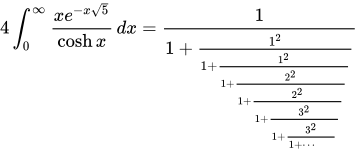
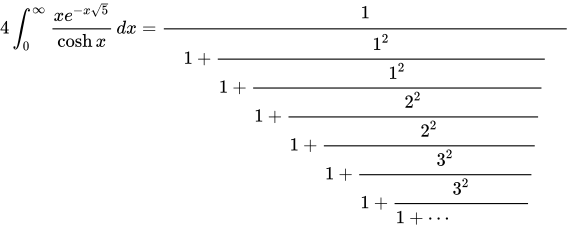
- For Ramanujan's identities, cfrac is nicer because I can see the exponents more clearly at every level. For the Docuan table, I think frac is better because it takes up less space, and when the continued fraction just keeps repeating the same denominator, it's OK if I can't see the smaller levels so good. But that's just my opinion. PrimeFan 22:38, 15 August 2007 (UTC)
Here's a more compact form of the above, also using \frac. Comments?

I've never liked that form. Compactness is its one virtue, and that seems like something for use in circumstances of poverty of space to write in. The less compact form conveys the meaning to people who've never seen continued fractions before, and I think that's needed here. Michael Hardy (talk) 20:07, 25 May 2009 (UTC)
Unique factorization domains
[edit]Is it the case that 5 is the smallest integer n such that the integral domain Z[√-n] fails to be a unique factorization domain? Certainly Z[√-5] is a common example of a domain for which unique factorization fails to hold, and this might be worth mentioning in the article. -- Dominus 23:12, 14 August 2007 (UTC)
- No. Z[√-3] is not a UFD: 2*2=(1+√-3)(1-√-3). Algebraist 19:44, 24 May 2008 (UTC)
Music
[edit]Could someone please explain, or better yet clarify in the article, the following:
- "He then applied the square root of five within the golden ratio ... as a way to select the relative length of the two parts of his piece." More specifically, what does "the square root of five within the golden ratio" mean? How did Wuorinen "apply" it to proportion the length(s) of "the two parts of his piece"? What "two parts of his piece"? (E.g., 1st and 2nd movement of a 2-movement work? Theme A and theme B of a sonata form?)
- "In doing so, he took the bite and harsh dissonance normally accompanying of 12-tone music." Does took in this statement mean he eliminated or reduced "the bite and harsh dissonance"? How did applying some proportion to the lengths of 2 subdivisions of the piece affect its harmonic character?
- Since the article is discussing a particular composition by Wuorinen, it is essential to name the piece.
If someone can send me a copy of the review, I can try to make some sense of it. Thanks. Finell (Talk) 00:46, 15 August 2007 (UTC)
- I had asked here for the guy who posted that to let me know what it says; or just leave it out. He didn't respond, so I take it that leave it out is OK for now. I'll take it out and we can see if he cares. Dicklyon 00:56, 15 August 2007 (UTC)
- From the context, it sounds like a review of a performance of a composition by Wuorinen. There is probably something worthwhile there, but it was not well summarized in the article. If there is something, it probably relates as much or more to φ than to √5. If I had easy access to the source, I would get it myself--but I don't. Finell (Talk) 02:26, 15 August 2007 (UTC)
Only "one million digits"?
[edit]Since the Golden ratio is known to billions of digits (at least 17 billion per that article though the Mathematical constant article suggests it's actually 100 billion), shouldn't the Square root of 5 also be known to the same billions of digits? After all:
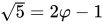
Glenn L (talk) 19:46, 25 May 2009 (UTC)
- Seems plausible, since multiplying by 2 seems pretty simple, and the subtraction of 1 effects only the one digit before the decimal point. Michael Hardy (talk) 20:09, 25 May 2009 (UTC)
- Indeed, it would be trivial to take 17 billion digits of phi and make 17 billion digits of root 5. And if someone would report doing so, in a reliable source, there's no reason we wouldn't include that fact. Dicklyon (talk) 04:21, 26 May 2009 (UTC)
Removal of infobox
[edit]Based upon a discussion at Wikipedia talk:WikiProject Mathematics#"Infoboxes" on number articles, I've removed the infobox from the article. If anyone disagrees, could you please join the discussion there. Thanks, Paul August ☎ 14:58, 18 October 2009 (UTC)
- I have suggested centralizing this discussion to Wikipedia_talk:WikiProject_Mathematics#Irrational_numbers_infobox and Wikipedia_talk:WikiProject_Mathematics#Infobox_with_various_expansions as it refers to an infobox occurring in several articles. Please go there to build consensus on this edit. RobHar (talk) 19:34, 18 October 2009 (UTC)
Geometry to begin
[edit]Here is the beginning of the current section titled "Geometry".
Geometrically, √5 corresponds to the diagonal of a rectangle whose sides are of length 1 and 2, as is evident from the Pythagorean theorem. Such a rectangle can be obtained by halving a square, or by placing two equal squares side by side.
That would be obvious faced with a sketch of rectangle divided into two congruent triangles. I propose to insert in the article such an image that will illustrate also the Pythagorean theorem. Admittedly you don’t see my new image yet. Thus you can assess the situation of a reader of the current article.
Arthur Baelde (talk) 09:52, 4 January 2022 (UTC)
As well as √5, from an historical point of view, began to exist in geometry, neophytes also conceive √5 first in geometry, more easily than as a limit like in the current first section, titled “Continued fraction”. So I propose to move the current section titled “Geometry” at the beginning of article, before improving this new first section. Do you agree?
Arthur Baelde (talk) 12:56, 5 January 2022 (UTC)
A rather old version of the section titled “Geometry”, as edited at 15:38, 27 December 2012, far in the article like today, included already the incomprehensible image named Pinwheel_1.svg.
Far in order to be hidden?
Arthur Baelde (talk) 09:47, 6 January 2022 (UTC)
- I compressed the continued fraction stuff a bit, but I think the current order is logical enough. At least the connection to the golden ratio (which is a big part of the justification for this page's existence) should come before geometry. It doesn't matter if that pinwheel image has been on the page a long time. If you have a better one, we should replace it. Danstronger (talk) 13:51, 7 January 2022 (UTC)
- “Rational approximations” is a better title than “Continued fraction”. But the word “convergent” is too difficult for the beginning of section, and the expression “continued fraction” should be a link immediatly at its first occurrence.
- For me the relation between the golden ratio and √5 has to be exposed in geometry, before any concept of limit. But why would we have to justify the existence of article? The current second and fourth sections should be two subsections of a first section titled “Geometry”.
Arthur Baelde (talk) 16:08, 7 January 2022 (UTC)
- For me the relation between the golden ratio and √5 has to be exposed in geometry, before any concept of limit. But why would we have to justify the existence of article? The current second and fourth sections should be two subsections of a first section titled “Geometry”.
- Pardon me, your first occurrence of “Continued fraction” is indeed a link.
Arthur Baelde (talk) 10:12, 8 January 2022 (UTC)- The golden ratio is not really a subtopic of geometry, as the ratio has many properties that are not geometric. For whatever reason, trigonometry is not generally considered a subfield of geometry. See sections above on this talk page that discuss whether or not this page should even exist. Does sqrt(5) really have significant converage in reliable sources? If everything here could basically be said about the square root of any number, we are wading into "indiscriminate collection of information" territory. I'm not really saying we should delete this page (I tend to lean towards delete, and I think it's borderline, so I don't think a deletion discussion would likely succeed), just explaining why the connection to golden ratio stuff is pretty important to this wikipedia page. Danstronger (talk) 17:01, 8 January 2022 (UTC)
- Pardon me, your first occurrence of “Continued fraction” is indeed a link.
Ramanujan identities
[edit]@Allan Nonymous removed the following material:
Identities of Ramanujan
The square root of 5 appears in various identities discovered by Srinivasa Ramanujan involving continued fractions.[1][2]
For example, this case of the Rogers–Ramanujan continued fraction:
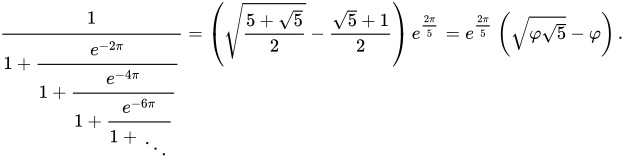
![{\displaystyle {\cfrac {1}{1+{\cfrac {e^{-2\pi {\sqrt {5}}}}{1+{\cfrac {e^{-4\pi {\sqrt {5}}}}{1+{\cfrac {e^{-6\pi {\sqrt {5}}}}{1+{{} \atop \displaystyle \ddots }}}}}}}}}=\left({{\sqrt {5}} \over 1+{\sqrt[{5}]{5^{\frac {3}{4}}(\varphi -1)^{\frac {5}{2}}-1}}}-\varphi \right)e^{\frac {2\pi }{\sqrt {5}}}.}](https://wikimedia.org/api/rest_v1/media/math/render/svg/0ad3920d4a06f5410085a00c763762a581b84cf9)
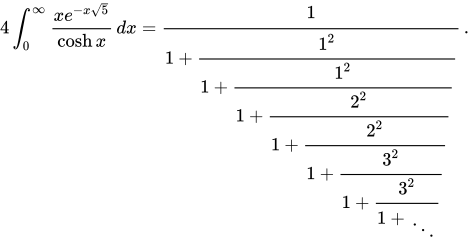
with the edit summary "Examples: cool but not supported by WP:NUM/G.". I don't really know what that is supposed to mean, but I agree that these examples seem like a bit of a stretch. Does anyone want to argue for their inclusion?
It seems like this material was previously worked on by Michael Hardy and Jakob.scholbach (I might be missing someone though). –jacobolus (t) 18:17, 23 July 2025 (UTC)
No sign of notability in Square root of 5#Rational approximations
[edit]Per WP:NUM/G, WP:NUM/ROUTINE and WP:NUM/ORSYNTH facts, such as the ones included in this section, should not be included. The almost complete lack of sourcing (pointing only to examples of an undegrad problem set) seems to bear out the lack of notability here. Allan Nonymous (talk) 18:33, 23 July 2025 (UTC)
- The continued fraction representation of an irrational number is an elementary topic of core importance. You will find such a section in nearly every wikipedia page about such a number (e.g. e § Representations, π § Continued fractions, √2 § Continued fraction), ζ(3) § Continued fraction, ...). If your linked pages don't cover that, then they are overly focused on integers and not relevant here. Solutions of Pell's equation (including this one specifically) has been of great mathematical interest stretching back 2 millennia. You can find coverage about this mentioning √5 specifically in literally thousands of reliable sources. The OEIS pages are a good place to start. –jacobolus (t) 19:07, 23 July 2025 (UTC)
- Yes, but more complex square roots likely fall under WP:NUM/ROUTINE. Allan Nonymous (talk) 21:52, 23 July 2025 (UTC)
- I looked at Wikipedia:WikiProject Numbers/Guidelines: There's no mention of the word "irrational". Feel free to remove non-integer numbers from Wikipedia:WikiProject Numbers if you (collectively, as a WikiProject) think they are out of scope. Or perhaps add a note at the top explaining that the WikiProject Numbers guidelines are not relevant to non-integers. –jacobolus (t) 19:16, 23 July 2025 (UTC)
- WP:NUM specifically includes irrational numbers, while most of the guidelines are focused on integers. They also apply to irrational numbers. Allan Nonymous (talk) 21:48, 23 July 2025 (UTC)
- My point is, if you believe your criteria to disallow inclusion of the most obvious basic topics about an irrational number, then those criteria are clearly broken/unsuitable for the job, so they should be ignored in this context. –jacobolus (t) 23:40, 23 July 2025 (UTC)
- I'm not against the inclusion of the continued fraction, it more than qualifies for inclusion as a WP:NUM/SIMPLE fact, the only reason I removed it is because it is redundant with the infobox. My bigger problem are the details, most notably the Pell's equations and Babylonian Method sections. If anything the convergents should probably get a table. Allan Nonymous (talk) 17:59, 24 July 2025 (UTC)
- Pell's equation is one of the first things you will find in any number theory book (or history of mathematics book for that matter), and has been the subject of huge amounts of research. It's inevitably going to be mentioned in any discussion of a quadratic integer. Here's an example of methods related to Pell's equation being used to find approximations to in a 12th century manuscript:
- Here are some examples where the "Babylonian method" (a.k.a. "Heron's method") is used to calculate the square root of 5:
- –jacobolus (t) 18:26, 24 July 2025 (UTC)
- Again, the big issue here is not that Pell's equation, or the Babylonian method aren't notable, they certainly are. We have whole articles backing that up. The problem is that there is no reason that using any of these on the square root of 5 specifically are specifically notable, and not in an "example problem" sort of way. Why can't I just add this fact to the square root of 7, or 92, or 45391? There are an infinite number of square roots and an infinite number of facts about them. The number project guidelines are here to determine which facts are worth including on specific number articles, as part of an effort to make the articles readable, with limited exceptions for fundamentally practical facts (like times tables). In this case, there is a fair case for the inclusion of rational approximations calculated using continuing fractions, but in depth details of the methods are unnecessary on this page. Perhaps the only source that would establish the level of notability for inclusion here the 12th century manuscript, but even then a "the square root of 5 was used as an example by..." would suffice. Allan Nonymous (talk) 15:31, 26 July 2025 (UTC)
- The article about the square root of 7 could certainly also discuss the relevant Pell's equations, . These have also been explicitly studied (though not quite as much as ), and are directly relevant to that topic. Feel free to add such material.
- You're going to have a tough time finding any reliable-source backed material about the square root of 92 or the square root of 45391 (I can't even find this one mentioned anywhere). If you make such articles they're probably going to get deleted. But if you did have such articles, the fundamental solutions of the relevant Pell's equations would be one of the details worth mentioning there, in just the same way that it's worth mentioning the prime factorization of some arbitrary integer.
- The reason a discussion of Pell's equation is worthwhile at this article is because it is one of the main things that scholars are specifically interested about in relation to the square root of 5, closely related to both theoretical research about and practical applications of . –jacobolus (t) 16:34, 26 July 2025 (UTC)
- My issue here is the lack of evidence that if it is a matter of scholarly interest, we would expect to see modern mathematical articles covering specifically the solution to the pell equation in question and so far, the only source I have found appears to be an undergraduate problem set. Neither of these establish scholarly interest in the topic. Allan Nonymous (talk) 09:39, 27 July 2025 (UTC)
- Take a look at the sources in Golden field. –jacobolus (t) 15:51, 27 July 2025 (UTC)
- This is about the rational approximations section of the article which, as of this moment still lacks adequate sourcing. Allan Nonymous (talk) 18:08, 30 July 2025 (UTC)
- Are you referring to as an undergraduate problem set? That's an expository paper from an established mathematician; there are only two exercises and they're examples of problems that can be solved using the same methods. Sesquilinear (talk) 21:22, 31 July 2025 (UTC)
- Here's one example of such a modern mathematical article:
- https://www.fq.math.ca/Scanned/37-4/filipponi1.pdf
- If we hunt we can find plenty more, though few of them are likely to be worth citing from this article, since they tend to cover niche investigations.
- I think the fundamental problem you have is that there's no extensive book or paper about the number √5 per se. So you'll find relevant basic material covered among a more general class of examples discussed in general, but you aren't going to easily find people repeating tons of basic material about it; in more specific research literature aimed at an expert audience, that material is usually just taken for granted, part of the background knowledge readers are expected to know. Making an encyclopedic article about a topic like √5 thus requires piecing together material from sources addressing it as an example, particular case, side-topic to a work about something else, etc.
- But Wikipedia's verifiability policy only demands that we give reliable sources for particular factual claims (as we do here). For deciding which topics to include in any particular article, we must use some editor discretion, and seek consensus (not just delete stuff based on one person's preference). –jacobolus (t) 22:08, 31 July 2025 (UTC)
- Take a look at the sources in Golden field. –jacobolus (t) 15:51, 27 July 2025 (UTC)
- My issue here is the lack of evidence that if it is a matter of scholarly interest, we would expect to see modern mathematical articles covering specifically the solution to the pell equation in question and so far, the only source I have found appears to be an undergraduate problem set. Neither of these establish scholarly interest in the topic. Allan Nonymous (talk) 09:39, 27 July 2025 (UTC)
- Again, the big issue here is not that Pell's equation, or the Babylonian method aren't notable, they certainly are. We have whole articles backing that up. The problem is that there is no reason that using any of these on the square root of 5 specifically are specifically notable, and not in an "example problem" sort of way. Why can't I just add this fact to the square root of 7, or 92, or 45391? There are an infinite number of square roots and an infinite number of facts about them. The number project guidelines are here to determine which facts are worth including on specific number articles, as part of an effort to make the articles readable, with limited exceptions for fundamentally practical facts (like times tables). In this case, there is a fair case for the inclusion of rational approximations calculated using continuing fractions, but in depth details of the methods are unnecessary on this page. Perhaps the only source that would establish the level of notability for inclusion here the 12th century manuscript, but even then a "the square root of 5 was used as an example by..." would suffice. Allan Nonymous (talk) 15:31, 26 July 2025 (UTC)
- I'm not against the inclusion of the continued fraction, it more than qualifies for inclusion as a WP:NUM/SIMPLE fact, the only reason I removed it is because it is redundant with the infobox. My bigger problem are the details, most notably the Pell's equations and Babylonian Method sections. If anything the convergents should probably get a table. Allan Nonymous (talk) 17:59, 24 July 2025 (UTC)
- My point is, if you believe your criteria to disallow inclusion of the most obvious basic topics about an irrational number, then those criteria are clearly broken/unsuitable for the job, so they should be ignored in this context. –jacobolus (t) 23:40, 23 July 2025 (UTC)
- WP:NUM specifically includes irrational numbers, while most of the guidelines are focused on integers. They also apply to irrational numbers. Allan Nonymous (talk) 21:48, 23 July 2025 (UTC)
- @Allan Nonymous Can you explain why you removed the explicit continued fraction? That seems like a harmful change. Edit: I guess you thought it was fine to leave it only in the infobox? That is a misunderstanding of infoboxes:
"The purpose of an infobox is to summarize, but not supplant, the key facts that appear in an article. Barring the specific exceptions listed below, an article should remain complete with its infobox ignored."
(from Manual of Style/Infoboxes § Purpose). –jacobolus (t) 18:48, 24 July 2025 (UTC)- I added some more prose to motivate and flesh out this section. Does that help? We could probably be more explicit about the history, though we'd have to be careful not to overdo it and derail the narrative. –jacobolus (t) 22:00, 24 July 2025 (UTC)
- Adding more prose actually doesn't really accomplish anything, if anything it makes it less justifiable for inclusion. What really are missing are individual sources that show notability (not verifiability) of methods for calculating the square root of 5, specifically the methods used (i.e. an article covering the use of the Babylonian Method for the square root of 5 either specifically, or in a section). OEIS specifically does not establish such notability per Wikipedia:NUM/OEIS. That being said, there is a strong case that a short template with a table of approximations for square roots probably should belong on every square root article per Wikipedia:NUM/SIMPLE. In addition, the general methods for approximating square roots probably should be moved to Square root algorithms. Allan Nonymous (talk) 21:42, 31 July 2025 (UTC)
- We do discuss the so-called Babylonian method at Square root algorithm. Ideally it would even be its own article (possibly under the title Heron's method), as there's plenty to say about the method and its history and relations to other topics. We also have a separate article about Newton's method more generally.
- But there's no stricture against ever repeating ourselves in more than one Wikipedia article. Even if the appropriate place for an extended discussion of some topic is article X, it is often extremely helpful (see Wikipedia:Make technical articles understandable) to include anywhere from a quick parenthetical gloss to a few sentences (or occasionally more) of summary in the context of some other article Y. This makes articles much easier to read and more broadly accessible, because we can explain enough to address a broad audience instead of making undue assumptions about readers' background.
- We should also not mix the concept of "notability" of whole articles per se (the topic of Wikipedia:Notability), with the relevance of each particular fact or sub-topic mentioned on a page. These have a different standard. –jacobolus (t) 00:59, 1 August 2025 (UTC)
- Adding more prose actually doesn't really accomplish anything, if anything it makes it less justifiable for inclusion. What really are missing are individual sources that show notability (not verifiability) of methods for calculating the square root of 5, specifically the methods used (i.e. an article covering the use of the Babylonian Method for the square root of 5 either specifically, or in a section). OEIS specifically does not establish such notability per Wikipedia:NUM/OEIS. That being said, there is a strong case that a short template with a table of approximations for square roots probably should belong on every square root article per Wikipedia:NUM/SIMPLE. In addition, the general methods for approximating square roots probably should be moved to Square root algorithms. Allan Nonymous (talk) 21:42, 31 July 2025 (UTC)
- I added some more prose to motivate and flesh out this section. Does that help? We could probably be more explicit about the history, though we'd have to be careful not to overdo it and derail the narrative. –jacobolus (t) 22:00, 24 July 2025 (UTC)


"2.2360679774997896964091736687312762354406183596115257242708972454105209256378048994144144083787822749695081761507737835042532677244470738635863601215334527088667781731918791658112766453226398565805357613504175337850034233924140644420864325390972525926272" listed at Redirects for discussion
[edit] The redirect 2.2360679774997896964091736687312762354406183596115257242708972454105209256378048994144144083787822749695081761507737835042532677244470738635863601215334527088667781731918791658112766453226398565805357613504175337850034233924140644420864325390972525926272 has been listed at redirects for discussion to determine whether its use and function meets the redirect guidelines. Readers of this page are welcome to comment on this redirect at Wikipedia:Redirects for discussion/Log/2025 September 20 § 2.2360679774997896964091736687312762354406183596115257242708972454105209256378048994144144083787822749695081761507737835042532677244470738635863601215334527088667781731918791658112766453226398565805357613504175337850034233924140644420864325390972525926272 until a consensus is reached. ArthananWarcraft (talk) 04:45, 20 September 2025 (UTC)