


Talk:Solar azimuth angle
Add topic | This article is rated Start-class on Wikipedia's content assessment scale. It is of interest to the following WikiProjects: | |||||||||||||||||||||||
| ||||||||||||||||||||||||

.jpg)

I added another formula for the azimuth that is popular, and cited by Seinfeld and Pandis in Atmospheric Chemistry and Physics. I also clarified the conventions for azimuth, although I had some difficulty with the wording, so if anyone wants to take a stab at clarifying that please go ahead. I addressed the serious shortcomings of using inverse sine to find the azimuth angle since it is has many solutions, and most calculators and spreadsheets will only return solutions between -90 and 90 degrees. Finally I added a link to the NREL sun position calculator which I think is an excellent standard. --Mikofski 19:45, 22 August 2007 (UTC)
Measured from north or south?
[edit]The first paragraph says,
- It is most often defined as the angle from due north in a clockwise direction.
The paragraph before the last two formulas says,
- the azimuth angle ... should be interpreted as the angle east of south
Is the latter saying "measured from north to a direction east of south?" If so, the description seems awkward.
If all angles are clockwise from north, why not say "between 0° and 180°" instead of "east of south" which may be read as "measured east from due south?"
Some do measure azimuth from south:
- http://www.esru.strath.ac.uk/Documents/PhD/madhlopa.pdf
- the solar azimuth angle is measured from south to the horizontal projection of the sun’s rays on a horizontal plane, and it is negative in the east of south and positive in the west of south (Duffie and Beckman, 2006).
For those accustomed to this convention, "the angle east of south" could easily be read as "measured east from due south" -Ac44ck (talk) 06:36, 13 September 2010 (UTC)
There are two main conventions
[edit]This causes a lot of confusion, because not only does it affect the numerical value assigned to the solar azimuth, but also the formulas used to calculate that value. The conventions are predominant in specific fields.
Sailor's Convention
[edit]This is the traditional convention, that states that the solar azimuth is measured counter-clockwise from south. EG: if you are looking north, then your view has an azimuth of 180° or -180°. If you are looking east, your view's azimuth is 90°, and a westward view would be -90°. Yes, this convention defines the range from -180° to 180°. This is the convention used by Seinfeld and Pandis in Atmospheric Chemistry and Physics, from Air Pollution to Climate Change, which is listed as a reference. I assume it is also the convention in Sukhatme's Solar Energy: Principles of Thermal Collection and Storage.
Solar Energy Convention
[edit]Solar energy and photovoltaic professionals will adhere to the due north clockwise convention, which is unfortunately left-handed and northern hemisphere centric. This is the convention used by NREL (aka SERI) in their 2 solar position calculators, SPA and SOLPOS, which are both linked to from this wiki post. In this convention, east is still 90° and west is still 270°, but south is now 180°, and north is zero. This is the method I am most familiar with.
Duffie Convention
[edit]Because 2 conventions aren't enough, Duffie has his own, he says that an angle east of south should be negative. This is the only place I've seen this proposed, and it just adds confusion, because this text is so widely used by students. Too bad. --Mikofski (talk) 21:06, 7 May 2013 (UTC)
- What you call "Solar Energy Convention" is the convention adopted in the ISO 19115 standards for geographic information (ISO 19115-1:2014 Geographic information — MetadataPart 1: Fundamentals). It is also that used in meteorology and other domains. This is that I use in my work in solar radiation / Atmosphere physics / solar energy.
- However, you should call it another name, removing "Solar Energy" since you wrote that a popular book in solar energy used another convention. The European Solar Radiation Atlas (ESRA) published in 2000 and also devoted to engineers and students in solar energy engineering, uses the following convention which is likely that proposed by Duffie : in the northern hemisphere, south is zero and the azimuth is positive toward the west (90°), 180° or -180° northward and negative towards the east (-90°). In this way, it behaves similarly to the hour angle which is positive during the afternoon (west) and negative during the morning (east). In the southern hemisphere, the azimuth is counted from the north and is positive westward (90°). It is 180° or -180° southward and -90° eastward. I believe that this convention eased the calculation of the azimuth because it behaves like the hour angle. Lucien Wald (talk) 01:06, 24 March 2026 (UTC)
Are formulas correct?
[edit]I got a problem in implementing the formula giving the azimuth of the Sun. I cross-checked with the reference Number 4 (Radi) where the azimuth is given by an Arc tangent and not by an arc sine or arc cosine as stated in the article. Other references in the journal Solar Energy are consistent with Radi paper. The functions asin and acos are defined from [-1,1] -> R. However, it is possible that . Then the input value to these functions is close to infinity which is impossible. Since I am a relatively a newbie in the English version of Wikipedia, I do not dare to touch these formulas. I am mainly a French contributer. Malosse (talk) 14:27, 6 November 2015 (UTC)

I think that the simple formula given for solar azimuth may be incorrect. The denominator should be cos of the solar elevation not the zenith angle. (Alternatively, it should be sin (not cos) of the zenith angle, which amounts to the same thing.)193.240.16.2 (talk) 15:29, 18 November 2015 (UTC)mark pi b
I also have reason to believe the formulas may be incorrect. In this formula:
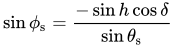
The expression sin h is dubious. The hour angle is measured from noon, so hour angles of 75 degrees (7 am) and 105 degrees (5 am) produce the same result because sin h gives the same result in both cases (about 0.966). cos h may be intended here. The formula also lacks a citation so it is not easy to check it against primary sources. B.D.Mills (T, C) 23:08, 19 January 2016 (UTC)
I derived a Sun position vector in horizontal coordinates and found the present formulas consistent with it. The second formula is equivalent to the first but does not add explanatory value in my opinion. A single formula using would eliminate . Mgarraha (talk) 16:39, 12 September 2016 (UTC)



My experience implementing these has also been that the formulas are incorrect. It's also unclear how the formulas differ: how is the first one able to ignore latitude while the second two include latitude? Given all the confusion around these for the past few years, I'm going to remove them unless someone can prove that they're correct. --Njk (talk) 19:31, 27 February 2019 (UTC)
Hmmm, nevermind. The second function is actually working for me. See: https://astronomy.stackexchange.com/questions/29782/how-do-i-calculate-the-suns-azimuth-based-on-zenith-hour-angle-declination-a/29784#29784 --Njk (talk) 22:06, 27 February 2019 (UTC)
External links modified (January 2018)
[edit]Hello fellow Wikipedians,
I have just modified 4 external links on Solar azimuth angle. Please take a moment to review my edit. If you have any questions, or need the bot to ignore the links, or the page altogether, please visit this simple FaQ for additional information. I made the following changes:
- Added archive https://web.archive.org/web/20061208171818/http://www.ecy.wa.gov/programs/eap/models/twilight.zip to http://www.ecy.wa.gov/programs/eap/models/twilight.zip
- Added archive https://web.archive.org/web/20070525051436/http://www.ecy.wa.gov/programs/eap/models.html to http://www.ecy.wa.gov/programs/eap/models.html
- Added archive https://web.archive.org/web/20070525051436/http://www.ecy.wa.gov/programs/eap/models.html to http://www.ecy.wa.gov/programs/eap/models.html
- Added archive https://web.archive.org/web/20130501041741/http://pveducation.org/pvcdrom/properties-of-sunlight/azimuth-angle to http://pveducation.org/pvcdrom/properties-of-sunlight/azimuth-angle
When you have finished reviewing my changes, you may follow the instructions on the template below to fix any issues with the URLs.
This message was posted before February 2018. After February 2018, "External links modified" talk page sections are no longer generated or monitored by InternetArchiveBot. No special action is required regarding these talk page notices, other than regular verification using the archive tool instructions below. Editors have permission to delete these "External links modified" talk page sections if they want to de-clutter talk pages, but see the RfC before doing mass systematic removals. This message is updated dynamically through the template {{source check}} (last update: 5 June 2024).
- If you have discovered URLs which were erroneously considered dead by the bot, you can report them with this tool.
- If you found an error with any archives or the URLs themselves, you can fix them with this tool.
Cheers.—InternetArchiveBot (Report bug) 10:21, 23 January 2018 (UTC)
Additional conditions for putting the result in right quadrant
[edit]If one cares to post these formulas here, won't it be nice and more meaningful to provide additional conditions for putting the result from arcsin/arccos in the right quadrant? Otherwise, these formulas remain useless. Also, it'd be nice to show more clearly why the two cosine formulas are identical and why they are just "approximations". --Roland (talk) 22:40, 4 December 2019 (UTC)
The formula based on the subsolar point and the function
[edit]
I added this new section based on a new publication. This formula is different from the conventional trigonometric ones, and it does not need any circumstantial treatment. An unambiguous answer is obtained by a single use of the function. The formula is derived using vector analysis rather than spherical trigonometry.--Roland (talk) 21:05, 12 May 2021 (UTC)
Inconsistency between the page "azimuth" and this page
[edit]Azimuth is itself an angle. See Azimuth page. Hence, using "solar azimuth" is better than "solar azimuth angle".
The Azimuth page also provides clear description on how this angle is defined with respect to true North. It is a better description that the various choices presented in this page. In solar energy, several authors found convenient to define the azimuth wrt the South in the Northern hemisphere and to the North in the Southern hemisphere, i.e. alaways in the direction of the Equator, for tractability in computations. It is a nightmare. In satellite business, I've seen azimuths counted from the West. Lucien Wald (talk) 00:27, 24 March 2026 (UTC)