


Talk:Selberg class
Add topic | This article is rated C-class on Wikipedia's content assessment scale. It is of interest to the following WikiProjects: | ||||||||||
| |||||||||||

Comments
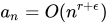
[edit]I'm confused about the need for an ε in condition ii). Should this not be " for some fixed positive real number r and any ε>0"?
Is (iii) right? It looks backwards to me.
I'm used to seeing phi(z) = gamma factor times original Dirichlet series, then the functional equation is phi(z) = <some number of absolute value 1> times the complex conjugate of phi(1 - complex conjugate of z) Virginia-American (talk) 02:48, 25 February 2008 (UTC)
The second reference (Conrey & Ghosh) state it the way I would expect. I will edit the article Virginia-American (talk) 03:21, 25 February 2008 (UTC)
The sentence "The condition that is important, as the case includes the Dirichlet eta-function, which violates the Riemann hypothesis." is not true: the Dirichlet eta does not violate RH, it just doesn't have a pole at . The function violates RH as noted in paper [2]. — Preceding unsigned comment added by 95.168.124.177 (talk) 12:25, 9 November 2018 (UTC)


Examples
[edit]The statement about Fχ can't be right if χ is nontrivial. Take for example , which is in the Selberg class. Then is the Dirichlet L-function of an imprimitive principal character, and therefore not in the Selberg class.—Emil J. 23:41, 11 June 2014 (UTC)


- I checked Selberg’s paper. The definition of Fχ is correct, however, he does not say that Fχ is S. He says that if Fχ is in S, then something happens (conjecturally).—Emil J. 16:23, 12 June 2014 (UTC)