


Talk:Schmidt decomposition
Add topic | This article is rated Start-class on Wikipedia's content assessment scale. It is of interest to the following WikiProjects: | ||||||||||
| |||||||||||
.jpg)

I haven't changed it because I'm not sure, but I guess that in the following paragraph should be . So:


The Schmidt decomposition is essentially a restatement of the singular value decomposition in a different context. Fix orthonormal bases and . We can identify an elementary tensor with the matrix , where is the transpose of . A general element of the tensor product




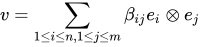
Should be:
The Schmidt decomposition is essentially a restatement of the singular value decomposition in a different context.
Fix orthonormal bases and .
We can identify an elementary tensor with the matrix ,
where is the transpose of . A general element of the tensor product


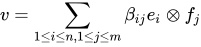
Please have a look and change it if I'm rigth or correct me here if I'm wrong. 130.102.2.60 03:34, 12 April 2007 (UTC)
- yes, you're right. thanks for pointing it out. Mct mht 07:14, 12 April 2007 (UTC)
quibbles
[edit]Why call it a statement and not a theorem, lemma, or proposition?
In the statement you use , while at the end of the proof you use . It might not be clear to all readers that the in the statement are equal to the in the proof. It may be worthwhile to keep the separate variables names to maintain the distinction between singular values and Schmidt coefficients, however, at some point it should be made explicit that .


It seems to me that the Schmidt rank should be defined as the number of nonzero Schmidt coefficients, otherwise the Schmidt rank is always m, in which case the definition is unnecessary. Furthermore, it would imply that every v is an entangled state, which is clearly not true.
In the last paragraph in the section on Schmidt rank and entanglement, the symbol v is used in two different ways, once as an element of and once in an expression involving the tensor product of two vectors.

Mathmoose 14:23, 21 July 2007 (UTC)
- well, all valid points (modulo "come on, man..." :-) ). wanna go ahead and make the changes you propose? Mct mht 03:59, 25 July 2007 (UTC)
Sure. How do I do that, or where do I found out how to do that? (It's my first contribution to Wikipedia.)
Mathmoose 23:11, 31 July 2007 (UTC)
- on the article, do you see the "edit this page" button on top? double click that and edit away. :-) Mct mht 03:07, 1 August 2007 (UTC)
I can see the button, but when I click it, it takes me to the discussion window, that very same window than I am entering this message in.
Mathmoose 22:36, 5 August 2007 (UTC)
- hm, that can't be right. you sure you're on this page when you click it? Mct mht 22:39, 5 August 2007 (UTC)
That does it! I should have read your instructions as carefully as I read the article.
Section on plasticity
[edit]The entire section on plasticity seems out of place. It is poorly explained in the context of the Schmidt decomposition and seems in need of a strong overhaul, removal, or to be moved to a more appropriate page. JoseyS (talk) 08:11, 27 December 2017 (UTC)
Another person agrees with this. As such I'm going to go ahead and remove it. I think it is out of place.
Statement of theorem seems awkward
[edit]I'm learning about this for the first time, and the statement of the theorem feels out of order to me. Maybe I am misinterpreting it.
It currently says
Let and be Hilbert spaces of dimensions n and m respectively. Assume . For any vector in the tensor product , there exist orthonormal sets and such that , where the scalars are real, non-negative, and, as a (multi-)set, uniquely determined by .




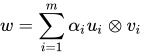
Again, I'm learning this for the first time, but this statement seems weird. Because it starts with "for any vector ", it sounds like the orthonormal sets depend on . But then this would be trivial, since one could just write for , and , complete (resp. ) to a basis of (resp. an dimensional subspace of ) and perform Gram-Schmidt starting from and separately to fill out an orthonormal set. Then you would have ,, . The rest of the are then zero. Of course this isn't constructive.


I expect what is meant is that given and , there exists these orthonormal sets such that any can be written in this way for some set of . So I suggest the following edit. Basically replaces "for all [], there exists ()" with "there exists () such that for all []". Is it reasonable, or am I missing something?
Let and be Hilbert spaces of dimensions n and m respectively. Assume . There exist orthonormal sets and such that any vector in the tensor product can be written , where the scalars are real, non-negative, and, as a (multi-)set, uniquely determined by .
Thanks. Fish sounds (talk) 20:51, 30 July 2020 (UTC)Fish sounds