


Talk:Reflection phase change
Add topic| This is the talk page for discussing improvements to the Reflection phase change article. This is not a forum for general discussion of the subject of the article. |
Article policies
|
| Find sources: Google (books · news · scholar · free images · WP refs) · FENS · JSTOR · TWL |
 | This article is rated Start-class on Wikipedia's content assessment scale. It is of interest to the following WikiProjects: | ||||||||||
| |||||||||||
.jpg)

Phase shifts other than 180 degrees
[edit]I believe the 180 degree phase shift is actually an approximation. If you use the full complex refractive index (absorption included)you get phase shifts such as 160 degrees. See http://www.opticsinfobase.org/josa/abstract.cfm?uri=josa-54-5-612 — Preceding unsigned comment added by 131.111.185.3 (talk) 14:18, 5 March 2015 (UTC)
- Yes, the same result is evident from the transmission line case if complex values for impedance are considered. SpinningSpark 11:58, 30 January 2022 (UTC)
Application to transmission lines
[edit]The reflection coefficient for transmission lines in terms of characteristic impedance is given by,
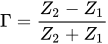
where the subscripts refer to the first and second medium respectively. From,
- and


for a lossless line, where L and C are respectively the inductance and capacitance per unit length, the reflection coefficient in terms of velocities is,

which implies that the phase inversion occurs at,

and not at,

This can equally be stated in terms of capacitance or permeability/permittivity. Can anyone shed any light on this? SpinningSpark 12:13, 30 January 2022 (UTC)