


Talk:RICE chart
Add topic | This article is rated Start-class on Wikipedia's content assessment scale. It is of interest to the following WikiProjects: | ||||||||||
| |||||||||||

Needs some qualifiers
[edit]There's no mention of the restricted applicability of this method for calculating pH. There's an underlying assumption that [H+] >> [OH-]. Another way of saying this is that this only applies to solutions whose pH is much less than 7. Klortho (talk) 05:34, 13 March 2011 (UTC)
SOMEONE DO SOMETHING ABOUT THIS PAGE
[edit]Someone who knows HTML needs to create an ICE table to demonstrate to others what exactly is an ICE table... --XH 20:55, 20 January 2007 (UTC)User:Xinyu
I've now done this, basically by paraphrasing the material below. I hope LestatdeLioncourt does not mind. Petergans 19:05, 17 May 2007 (UTC)
pH value from dissociation constant
[edit]The following was from the March 12 Science Reference Desk.
- This is based on a homework question with specific values, but I am asking only for general formula.
If I know the acid dissociation constant (pKa) and the concentration of a weak acid, how would I find the pH? How do I find the pH after adding a certain volume of a strong base? − Twas Now ( talk • contribs • e-mail ) 00:58, 12 March 2007 (UTC)
Take a look at Henderson-Hasselbalch equation
![{\displaystyle {\textrm {pH}}={\textrm {pK}}_{a}+\log _{10}{\frac {[{\textrm {A}}^{-}]}{[{\textrm {HA}}]}}}](https://wikimedia.org/api/rest_v1/media/math/render/svg/45458f7b6f5af0fc3ad5936083c4c8d56483eefe)
From the pKa page the ionised acid and H+ concentration will be the same, so you end up with pH+pH=-log10(concentration of a weak acid)+pKa.
![{\displaystyle {\textrm {pH}}=({\textrm {pK}}_{a}-\log _{10}{[{\textrm {HA}}]})/2}](https://wikimedia.org/api/rest_v1/media/math/render/svg/b9e97119bc6ae03e221148ee876c95a2ce56048b)
- Thanks. I guess what confuses me is how do I determine [HA] and [A-] for a given weak acid (and its conjugate base)? − Twas Now ( talk • contribs • e-mail ) 03:09, 12 March 2007 (UTC)
It's really very simple. All you need to do is set up an ICE table for the ionization equilibrium of the acid, i.e. HA ⇌ A- + H+ :
| [HA] | [A-] | [H+] | |
| I | c0 | 0 | 0 |
| C | -x | +x | +x |
| E | c0 - x | x | x |
Because , and you can tell from the table that when the ionization is over [H+] = x, then . So, your job is to find x.
![{\displaystyle pH=-\log {[H^{+}]}}](https://wikimedia.org/api/rest_v1/media/math/render/svg/9b645e3f629e3207e82eaac8bfe92939ba25e7c9)

The equilibrium constant expression for the ionization is:
![{\displaystyle K_{a}={\frac {[H^{+}][A^{-}]}{[HA]}}}](https://wikimedia.org/api/rest_v1/media/math/render/svg/83ee86c6746a584bd7b209324db405b0563af917)
Substitute the concentrations with the values found in the last row of the ICE table.
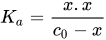
Now plug in the specfic values for c0 and Ka () provided in your question, then solve for x, and you're done!
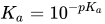
If you do some math, you can quickly figure out that the relation GB provided is only a different (and handier) way of expressing Ka, especially when you're working with buffer solutions.
Now for the second part of your question: when you added a certain quantity of a strong base, the OH- ions you just added will react with some of the H+ in solution. From the OH- - H+ reaction stoichiometry, you can calculate the number of moles of H+ that have disappeared and how many moles are left. Then you can find the new concentration of H+ ions (keep in mind the change in volume) and the new pH. —LestatdeLioncourt 14:45, 12 March 2007 (UTC)
Typesetting
[edit]Terrible (and inconsistent) typesetting in this article. Needs to be fixed. —DIV (1.129.104.52 (talk) 12:02, 18 August 2019 (UTC))