


Talk:Q-function
Add topic | This article is rated Start-class on Wikipedia's content assessment scale. It is of interest to the following WikiProjects: | ||||||||||
| |||||||||||

Some solutions
[edit]Please specify some discrete solution. This will help the reader to check whether some function available in some program may be the function this article is talking about. Tomeasy T C 07:58, 21 July 2009 (UTC)
- I don't understand what you mean by discrete solution. --Zvika (talk) 09:20, 21 July 2009 (UTC)
- The values for, e.g., Q(0) or Q(1) or even Q(0.5). Tomeasy T C 17:56, 21 July 2009 (UTC)
- Ah, that's a good idea. Will do. --Zvika (talk) 04:33, 22 July 2009 (UTC)
- The values for, e.g., Q(0) or Q(1) or even Q(0.5). Tomeasy T C 17:56, 21 July 2009 (UTC)
Bounds
[edit]There is an improved bound for Q(x), given at :

where each partial sum gives either upper or lower bound, depending on the sign of the last summand. The sum itself is divergent however, so it cannot be used to calculate the integral with arbitrary precision.
Another approximation due to Laplace:
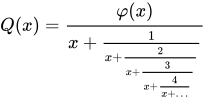
… stpasha » 19:09, 1 October 2009 (UTC)
- Sounds interesting and worthy of inclusion, if you can find a RS for it. --Zvika (talk) 18:19, 3 October 2009 (UTC)
- I just noticed that the bounds given in the article correspond to Laplace’s continuous fraction terminated at k=0 and k=1 respectively:
- But you're right, a reliable source which attributes second formula to Laplace would be nice to have. … stpasha » 18:45, 3 October 2009 (UTC)
- I just noticed that the bounds given in the article correspond to Laplace’s continuous fraction terminated at k=0 and k=1 respectively:

eta?!
[edit]In the second paragraph of the article, shouldn't the eta be a mu? -- UKoch (talk) 15:11, 24 February 2014 (UTC)
- Yes, it should be a mu, and should be , to be consistent with the notation on the Normal Distribution page. I will fix this. David C Bailey (talk) 08:06, 21 November 2014 (UTC)
- Thanks! -- UKoch (talk) 17:57, 23 November 2014 (UTC)


External links modified
[edit]Hello fellow Wikipedians,
I have just modified one external link on Q-function. Please take a moment to review my edit. If you have any questions, or need the bot to ignore the links, or the page altogether, please visit this simple FaQ for additional information. I made the following changes:
- Added archive http://web.archive.org/web/20090325160012/http://www.eng.tau.ac.il/~jo/academic/Q.pdf to http://www.eng.tau.ac.il/~jo/academic/Q.pdf
When you have finished reviewing my changes, please set the checked parameter below to true or failed to let others know (documentation at {{Sourcecheck}}).
This message was posted before February 2018. After February 2018, "External links modified" talk page sections are no longer generated or monitored by InternetArchiveBot. No special action is required regarding these talk page notices, other than regular verification using the archive tool instructions below. Editors have permission to delete these "External links modified" talk page sections if they want to de-clutter talk pages, but see the RfC before doing mass systematic removals. This message is updated dynamically through the template {{source check}} (last update: 5 June 2024).
- If you have discovered URLs which were erroneously considered dead by the bot, you can report them with this tool.
- If you found an error with any archives or the URLs themselves, you can fix them with this tool.
Cheers.—InternetArchiveBot (Report bug) 16:15, 21 July 2016 (UTC)
Q-function vs. Quantile function (Q vs 1-Q)
[edit]It might be worth noting (to prevent confusion) that the function Q defined in this article is actually the complementary of the function Q defined in https://en.wikipedia.org/wiki/Quantile_function#Definition, right? (I'm not a mathematician though.) 84.253.60.105 (talk) 17:30, 11 February 2022 (UTC)