


Talk:Polytrope
Add topic | This article is rated Start-class on Wikipedia's content assessment scale. It is of interest to the following WikiProjects: | ||||||||||
| |||||||||||
.jpg)

Polytropic processes
[edit]It appears that this concept is related to polytropic processes in thermodynamics. It would be an interesting addition to one or both articles to expand on this relationship. David Hollman (Talk) 21:49, 14 September 2010 (UTC)
Formula correct?
[edit]The equation appears to me as a contradiction to (see Polytropic process). Since the second equation becomes , and thus, in my opionion, the first equation should simply be . Or is the n here different from the one in the related article?--SiriusB (talk) 11:36, 6 January 2011 (UTC)
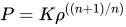


You're right: means different things in the articles. It seems to be noted in Polytropic process under Notation. Warrickball (talk) 20:05, 23 March 2011 (UTC)

RGB stars do not have fully convective cores
[edit]In the “examples” section, it is stated that red giants have fully convective cores. But that is not the case. Stars on the red giant branch have convective envelopes and inert helium cores. 2A04:CEC0:10CE:E38A:CDD5:60FB:4322:1C5C (talk) 08:20, 9 March 2023 (UTC)