


Talk:Perfect field
Add topic | This article is rated Start-class on Wikipedia's content assessment scale. It is of interest to the following WikiProjects: | ||||||||||
| |||||||||||

Perfect closure?
[edit]The article contained the paragraph
- The first condition says that, in characteristic p, a field adjoined with all p-th roots (usually denoted by ) is perfect; it is called the perfect closure, denoted by . Equivalently, the perfect closure is a maximal purely inseparable subextension.
[Commented out: Let be an algebraic extension, and separable closure (a maximal separable subextension). While and are purely inseparable, need not be separable. On the other hands, one has:]If is a normal finite extension, then .[Reference:Cohn, Theorem 11.4.10]


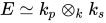
The second part doesn't make sense to me. "Equivalently, the perfect closure is a maximal purely inseparable subextension." A subextension of what? All we have at this stage is a field k. Maybe a maximal purely inseparable subextension of the algebraic closure of k? The formula cannot possibly be true: E=k with k an imperfect field is a counter example, because kp is bigger than k in that case.
I removed everything beginning with "Equivalently...". Please restore if it can be clarified. AxelBoldt (talk) 20:28, 15 December 2011 (UTC)
- It's actually not incorrect; you have to interpret in a right way. The problem is the paragraph doesn't make a careful distinction of absolute closure and relative closure. -- Taku (talk) 15:18, 11 March 2012 (UTC)
reals
[edit]It would be nice to reference the reals as perfect [or not].Chris2crawford (talk) 12:26, 1 October 2015 (UTC)
"Quora perfect"
[edit]The paragraph beginning "There is another definition for perfect fields in Quora that is defined only for Galois fields." read to me like nonsense. Galois fields, linked in the article, are nothing other than finite fields, but the examples given are number fields. It also then talks about ideals of the field..... This paragraph reads like AI-generated junk. In any case, no reference is given. I'm deleting this, and anyone who thinks it's resurrectable can deal with it. — Preceding unsigned comment added by 203.214.156.113 (talk) 22:14, 8 September 2024 (UTC)
What is a "rational polynomial"?
[edit]The section Examples contains this sentence:
"An example of an imperfect field is the field of rational polynomials in an unknown element ."
I am aware that "rational polynomial" is a technical term that some mathematicians use. But it is not familiar to most mathematicians, no less people with less of a mathematical background. But even mathematicians who use this term are split into those who understand it to mean one thing and those who understand it to mean a different thing.
I hope that someone knowledgeable about this subject can replace this sentence with one that uses a more common terminology, finally making it clear what is meant here.
2601:204:F181:9410:8092:652B:1DB3:C659 (talk) 21:01, 17 September 2025 (UTC)