


Talk:Partisan (weapon)
Add topic | This article is rated Stub-class on Wikipedia's content assessment scale. It is of interest to the following WikiProjects: | |||||||||||||||||||||||||
| ||||||||||||||||||||||||||


Untitled
[edit]Does anyone have a good picture(s) of partisans? 71.114.0.94
I think the claim that it become quickly obsolete is incorrect. Other pole arms like the pike were used in conjunction with fire arms for at least 200 years. —Preceding unsigned comment added by 68.7.97.221 (talk) 13:52, 30 May 2009 (UTC)
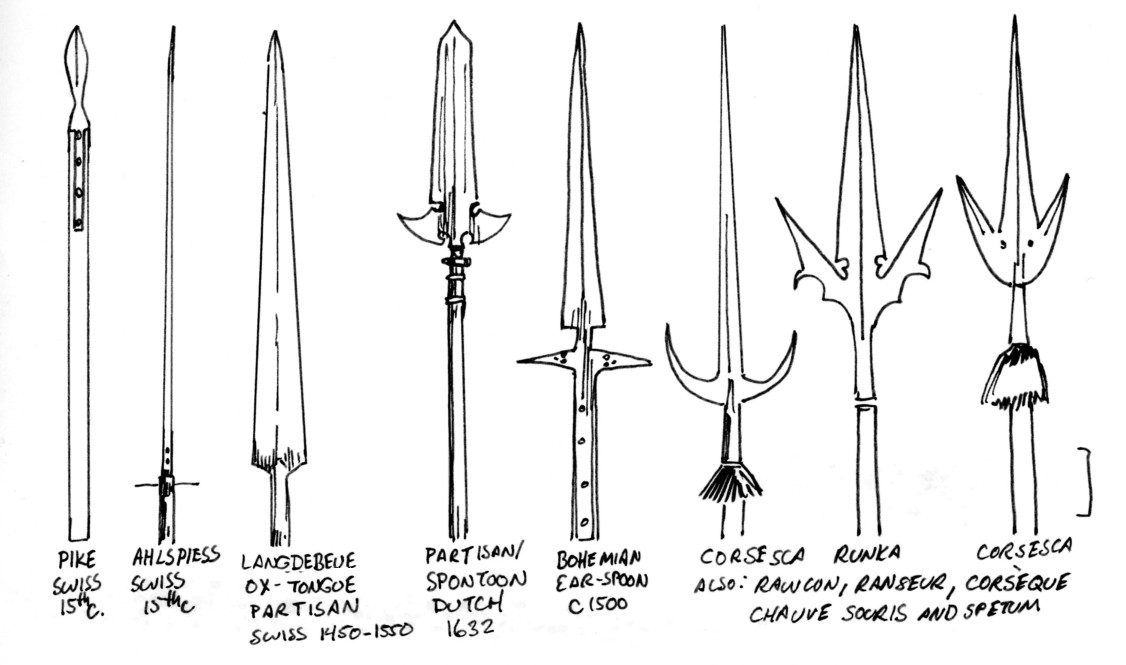
Handy guide to knowing your pole-arm!
[edit]REALLY need a public domain version of this: http://surbrook.devermore.net/herosource/fantasy_hero/armor/polearms2.jpg Theblindsage (talk) 09:08, 22 March 2012 (UTC)
Partisans were not designed for parrying swords
[edit]The claim that says that the wings on the partisan were used for parrying swords is not mentioned in the citation that is next to it and is factually incorrect. While their are some records talking about how a partisan like spear could be used to bind other polearms, you would be at too much of a leverage disadvantage to be able to use it to bind shorter weapons like swords.
That said, weapon binding was always a secondary feature. The Partisan was an evolution of the winged spear. In 8th century Norway, there was an expression that roughly translates to "to put yourself on a spear" which described a common problem where an enemy solider once impaled could be driven down the length of the spear and still be alive enough to kill you with a shorter weapon like a sword or axe. This issue was especially common due to the growing popularity of heavy cavalry in Europe.
The winged spear was designed to stop this over penetration allowing you to hold an enemy at bay even after you run them through. The Partisan was a modification of the winged spear that turned the traditional cross guard into blades. This design would have been in many ways harder to bind another weapon, but may have been preferred because it would reduce hand-shock and allow deadly wounds even on a near miss. 2600:6C63:437E:EBA7:7040:F2CE:F86C:CB11 (talk) 17:13, 18 July 2025 (UTC)
The photo shows an exhibit of Polish partisan.
[edit]Everything indicates that the photograph shows an example of Polish weaponry kept in a Swedish museum. On the blade there is an image with a Latin inscription: “Ioannes Casimirus.” This refers to the Polish king John II Casimir Vasa (1609–1672). In 1655, a war was being fought between Poland and Sweden, so it is difficult to suppose that a Swedish soldier would have been armed with a weapon bearing the image of the enemy king. ~2026-27253-77 (talk) 06:39, 5 May 2026 (UTC)