


Talk:Order of integration
Add topic | This article is rated Start-class on Wikipedia's content assessment scale. It is of interest to the following WikiProjects: | ||||||||||
| |||||||||||

SOME QUESTIONS
[edit]1. In the article it reads "all stationary processes are I(0), but not all I(0) processes are stationary" without any citation.
Please give an example of non-stationary I(0) series?
2. In the article, the definition of "Order of integration" is reported as "the minimum number of differences required to obtain a covariance stationary series".
In most of the books, the definition of "Order of integration" is "the number of differences making the series stationary".
When "order of integration" is viewed as "the number of differences making the series stationary", then does the stationarity in "...making the series stationary" also include trend-stationarity?
3. Yt = a + bt + Vt (Vt: white noice) is a trend-stationary series. What is the order of integration of a trend-stationary series (in fact, they are non-stationary as everybody knows).Alexyflemming (talk) 11:42, 16 April 2014 (UTC)
Answers?Alexyflemming (talk) 12:15, 16 April 2014 (UTC)
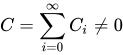
4. In the article, "In particular, if a series is integrated of order 0, then is stationary." This maybe not be true. The process is always stationary, and when , it is also an process; see page 35 in Johasen (1995).




5. The definition of order integration maybe not be correct. "A stochastic process which satisfies that is called if ." See Defintion 3.2 in Johasen (1995). "A stochastic process is called integrated of order , , if is ." See Defintion 3.3 in Johasen (1995).

![{\displaystyle Y_{t}-E[Y_{t}]=\sum _{i=0}^{\infty }C_{t}\epsilon _{t-i}}](https://wikimedia.org/api/rest_v1/media/math/render/svg/c4ac3d66947d00d9e1bd241b173d38795b562ba5)




Intutions
[edit]- As far as I guess, in the definition of order of integration "the number of differences making the series stationary", the stationarity also includes trend-stationarity! Because, there are very sources using the phrase "trend-stationary I(0)". I do not think that they mean Yt=Vt (a=0, b=0, a+b*t=0+0t=0; this way of obvious trend-stationary). Even the really trend-stationary (Yt = a + b*t + Vt; a<>0, b<>0) is termed as I(0)! Alexyflemming (talk) 07:45, 17 April 2014 (UTC)
- Some sources requires Yt in the def'n of prder of integration to be "non-deterministic". Alexyflemming (talk) 11:03, 20 April 2014 (UTC)
- Since, trend is not necessarily linear (there are polynomial (quadratic, cubic,..), exponential, other trends as well).
The quadratic trend cannot be made "mean stationary" with only 1 differencing, it requires 2 times differencing.
- Since there is no universally accepted def'n of trend, speaking about it is rather cumbersome. Alexyflemming (talk) 11:03, 20 April 2014 (UTC)