


Talk:Open mapping theorem (functional analysis)
Add topic | This article is rated Start-class on Wikipedia's content assessment scale. It is of interest to the following WikiProjects: | ||||||||||
| |||||||||||

Proof error
[edit]There seems to be a minor error in the source (Rudin) for the proof which has been reproduced both here and on PlanetMath. Specifically, "...where δ = r / (2k). It follows that for any y ∈ Y and any ε > 0, there is an x ∈ X with:
- and "
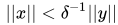

does not follow. To establish the first inequality one needs while getting the second inequality takes . However, one may let δ = r / (4k) and get both inequalities for . The result may be extended to arbitrary y by multiplying both inequalities by an appropriate scalar (actually, epsilon needs to be divided by that scalar, but that's fine since it's arbitrary).


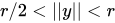
Just in case I'm missing something that makes the original work out, I haven't edited the proof yet. If that something exists, it should be added to the article in the interest of clarity. 208.107.152.253 (talk) 08:16, 11 March 2012 (UTC)
Does ^\circ mean interior?
[edit]I wasn't sure so I didn't make the change, but I feel like at some point that notation should be explained, since it's not exactly very common. At first I thought it meant set complement, and it really confused me. Can someone who knows confirm/make the change? — Preceding unsigned comment added by 71.116.244.171 (talk) 20:47, 19 October 2014 (UTC)