


Talk:Omega constant
Add topic | This article is rated Start-class on Wikipedia's content assessment scale. It is of interest to the following WikiProjects: | ||||||||||
| |||||||||||

letter The fact that it is called the omega function makes me think someone mistook the letter ω, a vowel, for the letter w, because of visual similarity. Is that what happened? Michael Hardy 20:42, 12 Feb 2004 (UTC)
Comparison to the golden ratio
[edit]"It has properties that are akin to those of the golden ratio, in that

or equivalently,
- "
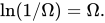
I'm not sure I can see any similarity to the golden ration here. Should this be obvious? :/ Woscafrench (talk) 01:00, 26 November 2007 (UTC)
- One way to express the similarity in exact terms is as follows: if we replace f(x)=e^x with its linear approximation f(x)=x-1 then the solution to the equation f(x)=1/x would be golden ratio. Grue 15:36, 26 November 2007 (UTC)
I also doubt that sentence. No one can explain this better; it is just a point of view. I already removed it. --Octra Bond (talk) 02:29, 3 November 2009 (UTC)
The Omega constant to larger approximation?
[edit]I used Windows calculator to evaluate the Omega constant. The value of Omega is:
0.56714329040978387299
99686622103555497485
40291138701110223886
36460700559427176005
70163043896301071636
09769866542711127501
81294450722431215290
864337423...
"due to Victor Adamchik"
[edit]Reference for part "due to Victor Adamchik"? — Preceding unsigned comment added by Reddwarf2956 (talk • contribs) 22:52, 13 December 2012 (UTC)
Interesting property of the Omega constant
[edit]Let k = 1/Ω, that is, the reciprocal of the Omega constant. Then it holds that:
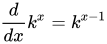
That is, it imitates the power rule of derivatives (even though it's not a polynomial, but an exponential function with base k) in reducing the exponent by 1. The reciprocal Omega constant is the unique exponential base for which this is true.
Proof:

But since , it follows that , and therefore . Substituting into the above equation, we have:

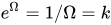


as claimed.—69.172.154.75 (talk) 04:53, 27 September 2015 (UTC)
Question
[edit]I was asking myself if Ω is the the absolute value of the solution to
x+ex = 0
I've found it with the approximative form thanks to the comparison between y=x and y=-e^x. If I'm not wrong, we can add it to the principal page. — Preceding unsigned comment added by 87.0.114.210 (talk) 14:35, 15 January 2017 (UTC)
- It’s possible to prove this algebraically as well.
- 107.9.36.50 (talk) 21:11, 15 July 2025 (UTC)


Other property
[edit](1/omega)^(1/omega)=e — Preceding unsigned comment added by 191.111.6.32 (talk) 22:07, 31 May 2022 (UTC)
- Yes, but not surprising (ie pretty simple to deduce) and nor more snappy. Unless this is especially useful for something (best shown with a souce), I don't think it needs to be mentioned in the article.
- I do think the continued fraction of omega would be more interesting. Xario (talk) 12:34, 2 December 2023 (UTC)
OEIS Sequences A370490 and A370491
[edit]OEIS Sequences A370490 and A370491 are the denominators and the numerators of an infinite series that converges to the Omega constant. Dacicus Geometricus (talk) 17:10, 6 April 2024 (UTC)
- I want to mention that I am the author of the 2 OEIS sequences. Dacicus Geometricus (talk) 08:17, 7 August 2024 (UTC)