


Talk:N-flake
Add topicLatest comment: 11 years ago by 0x0077BE in topic Terminology?
 | The content of Hexaflake was merged into N-flake. The former page's history now serves to provide attribution for that content in the latter page, and it must not be deleted as long as the latter page exists. For the discussion at that location, see its talk page. |
| This is the talk page for discussing improvements to the N-flake article. This is not a forum for general discussion of the subject of the article. |
Article policies
|
| Find sources: Google (books · news · scholar · free images · WP refs) · FENS · JSTOR · TWL |
 | This article is rated Start-class on Wikipedia's content assessment scale. It is of interest to the following WikiProjects: | |||||||||||||||||||||||
| ||||||||||||||||||||||||


Terminology?
[edit]The only sources that I can find for the word "polyflake" are one other wikipedia page that links back here, and 40-50 apparent mirrors and derivatives of this Wikipedia article. It kinda looks as if the term might have been invented for the article, in which case it probably shouldn't be introduced in bold in the intro, in a way that suggests that it might be a preexisting technical term.
"Sierpinski n-gon" does seem to be a loose descriptive term that sometimes get bandied about occasionally, in the expectation that a fractal-literate readership will be able to guess what's meant.
I'm not sure about "n-flake", though. The term doesn't seem to appear in any of the references cited by the article.
- I'm also finding a few inconsistencies here. For example, there are a few flavors of these things. For example, consider the following 4 hexaflakes:
 Hexaflake with child hexagon edges touching and center polygons, first 4 iterations.
 Hexaflake with child hexagon edges touching and no center polygons, first 4 iterations.
 Hexaflake with child hexagon vertexes touching and center polygons, first 4 iterations.
 Hexaflake with child hexagon vertexes touching and no center polygons, first 4 iterations.


- All of these are nominally "hexaflakes", but they are formed by different procedures. It's not clear how to distinguish between the flavors. For example, the standard procedure for the "hexaflake" (e.g. the first one here) as applied to squares generates just another square, but the "edge-centered" version with center polygons generates the Vicsek fractal:
 Variation on 4-flake, edge-centered with child polygons, first 3 iterations, generates a Vicsek fractal.
 Variation on 4-flake, edge-centered with child polygons, first 4 iterations, generates a Vicsek fractal.
 Variation on 4-flake, edge-centered with child polygons, first 5 iterations, generates a Vicsek fractal.


- However, the "scaling factor" identified on this page is inaccurate when using the "edge centered" version, and instead a different scaling factor is used:
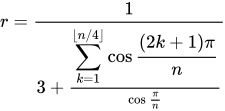
- For n = 4i+6 (for positive integers i), these two scaling factors are the same, but otherwise they are slightly different. Are these other shapes also Sierpinski n-gons? Just the 4i+6 ones? Needs to be clarified. Also, you can always inset a central polygon, but the scaling factor for the central polygon which has it share either an edge or a vertex with each of its neighbors is different from the scaling factor for the edge polygons, compare:
 Octoflake, first 4 iterations without a central polygon, child-polygons sharing a vertex with parent.
 Octoflake, first 4 iterations with a central polygon, child-polygons sharing a vertex with parent.


- This is probably something we want to clarify in the article, assuming we can find some reliable sources that give a clearer definition. 0x0077BE [talk/contrib] 21:57, 29 October 2014 (UTC)