


Talk:Multiprotocol Label Switching
Add topic| This is the talk page for discussing improvements to the Multiprotocol Label Switching article. This is not a forum for general discussion of the subject of the article. |
Article policies
|
| Find sources: Google (books · news · scholar · free images · WP refs) · FENS · JSTOR · TWL |
Archives (index): 1Auto-archiving period: 2 years  |
 | This article is rated C-class on Wikipedia's content assessment scale. It is of interest to the following WikiProjects: | |||||||||||||||||||||||
| ||||||||||||||||||||||||


 | The content of Label edge router was merged into Multiprotocol Label Switching on 2013-11-20. The former page's history now serves to provide attribution for that content in the latter page, and it must not be deleted as long as the latter page exists. For the discussion at that location, see its talk page. |
| The content of Label switch router was merged into Multiprotocol Label Switching on 2013-11-20. The former page's history now serves to provide attribution for that content in the latter page, and it must not be deleted as long as the latter page exists. For the discussion at that location, see its talk page. |
| The content of Label switched path was merged into Multiprotocol Label Switching on 2014-02-17. The former page's history now serves to provide attribution for that content in the latter page, and it must not be deleted as long as the latter page exists. For the discussion at that location, see its talk page. |
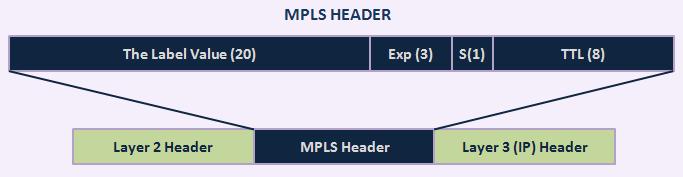
Needs diagram
[edit]Something like http://ipcisco.com/wp-content/uploads/mpls/MPLS_Header_color.JPG. ~KvnG 10:27, 25 June 2013 (UTC)
Label indication
[edit]It's not clear to me from this article how the presence of the label is indicated in the various layer 2 protocols? For example, VLAN tags in ethernet frames are indicated by the value in the TPID field that looks like an ethertype. Anyone got and can add this info for MPLS? Graham.Fountain | Talk 17:54, 12 March 2014 (UTC)
- Okay, I found this information for myself: Ethertype values, 0x8847 and 0x8848. I'll see if I can add this to the article when I get a round tuit. Graham.Fountain | Talk 11:30, 13 March 2014 (UTC)
IP/MPLS instead of MPLS
[edit]Large parts of this article are only specific for IP/MPLS, the MPLS version that is intended for core networks, and is based on dynamical MPLS routing.
The distinction between IP/MPLS and MPLS is lacking.
Another profile of MPLS is called MPLS-TP and is intended for transport networks. This relies on statically provisioned end-to-end paths (LSP and pseudowires) throughout the MPLS network.
Better would be to move large parts of this page to a new page concerning IP/MPLS, and have this MPLS-page to refer to it and to the existing MPLS-TP page.
Is this comparison with ATM right?
[edit]In particular, MPLS dispenses with the cell-switching and signaling-protocol baggage of ATM. MPLS recognizes that small ATM cells are not needed in the core of modern networks, since modern optical networks are so fast (as of 2008, at 40 Gbit/s and beyond) that even full-length 1500 byte packets do not incur significant real-time queuing delays (the need to reduce such delays — e.g., to support voice traffic — was the motivation for the cell nature of ATM).
I thought the size of ATM voice packets was not to reduce the transport queuing delay, but to reduce the queuing delay as the voice packet is generated or used, which is caused by the voice sample rate not the transport rate.
For example, the 64 kb/s sampling rate of the standard G.711 voice codec, with packets at 6ms, gives a packet size of 48 bytes, which fits the ATM payload size of 48 octets per cell. This has nothing to do with the transport rate, just the sampling rate and the (old) latency requirements of the PSTN, so mentioning the speed of modern optical networks here is a bit misleading. What is relevant is that the fraction of traffic which is non-PSTN/voice is increasing.
I have no references for this. There are no references in the quoted paragraph either. If someone who is an expert and who knows the references sees my point, perhaps they could edit the quoted paragraph in the article, and put in references even if I am mistaken. JustGonnaFixIt (talk) 17:17, 26 October 2015 (UTC)
Competitor Protocols
[edit]This line: "The major goal of MPLS development was the increase of routing speed. This goal is no longer relevant," appears dubious to me. The whole paragraph has had a cit request for nearly 3 years, and no one has provided any substantiation. It may be that something relevant is being said here, but the paragraph does not explain how a technology such as Application-specific integrated circuits obviates the MPLS goal of routing speed. Am I just missing the point here? Or can this go? -- Sirfurboy (talk) 14:49, 4 December 2019 (UTC)
- Citations: added ✅. Symbol (talk) 17:36, 4 December 2019 (UTC)
- C-Class Telecommunications articles
- High-importance Telecommunications articles
- C-Class Computing articles
- Low-importance Computing articles
- C-Class Computer networking articles
- High-importance Computer networking articles
- C-Class Computer networking articles of High-importance
- All Computer networking articles
- All Computing articles