Cloudflare fetched the original article and streamed it through HTMLRewriter to apply an entirely new visual system without rebuilding the source page.
// request.cf · coarse context
A page that knows where it met you.
Only coarse request metadata is shown. This demo does not display or persist visitor IP addresses.
This article is within the scope of WikiProject Physics, a collaborative effort to improve the coverage of Physics on Wikipedia. If you would like to participate, please visit the project page, where you can join the discussion and see a list of open tasks.PhysicsWikipedia:WikiProject PhysicsTemplate:WikiProject Physicsphysics
This article is within the scope of WikiProject Technology, a collaborative effort to improve the coverage of technology on Wikipedia. If you would like to participate, please visit the project page, where you can join the discussion and see a list of open tasks.TechnologyWikipedia:WikiProject TechnologyTemplate:WikiProject TechnologyTechnology
This article is within the scope of WikiProject Radio, a collaborative effort to improve the coverage of Radio-related subjects on Wikipedia. If you would like to participate, please visit the project page, where you can join the discussion and see a list of open tasks.RadioWikipedia:WikiProject RadioTemplate:WikiProject RadioRadio
This article is part of WikiProject Electronics, an attempt to provide a standard approach to writing articles about electronics on Wikipedia. If you would like to participate, you can choose to edit the article attached to this page, or visit the project page, where you can join the project and see a list of open tasks. Leave messages at the project talk pageElectronicsWikipedia:WikiProject ElectronicsTemplate:WikiProject Electronicselectronic
I made a number of minor style changes, please check. Many are optional.
In the first part (e.g. Fig. 2) can the resonators solid, hollow or either (sure, solid are practical, but hollow ones may bring extra possibilities)?
Can we wikilink "finite element approximations"?
Minor style changes. Mostly ok but I reverted a few: "DC current", while apparently a repetition is, as explained in direct current, acceptable terminology, and even necessary in some instances for clarity; in two places (concerning Kennelly and Maxfield & Harrison) the edit lost the sense of historical perspective (M&H were definitive at the time - not necessarily today). The change of "IF" to "intermediate frequency" at the end of the article was reverted, the abbreviation "IF" is used earlier in the paragraph and the term is given in full and wikilinked at the beginning of the article. "intermediate frequency" (without capitals) is ambiguous and could be taken to mean a frequency band whereas it actually means a specific application and not a specific frequency. Couple of others amended which were ungrammatical. SpinningSpark18:33, 25 December 2009 (UTC)Reply
Yes, I know. It's like EMF, we all know it isn't really a force, but that's the terminology that has become established. Remember, Wikipedia is not here to put the world to rights, just report it as it is. SpinningSpark11:29, 26 December 2009 (UTC)Reply
Hollow resonators. Cavity resonators and hollow transmission line resonators are much used in loudspeaker cabinet design and other audio applications, so obviously they are possible. However, I have no source giving such a design for a mechanical-electronic filter nor have I seen one personally. That's not to say such a thing does not exist. SpinningSpark17:11, 25 December 2009 (UTC)Reply
This is a part which could be expanded, but I won't insist on this.
If not described in a WP article yet, suggest making a note briefly explaining the term. One concern is that "finite element modeling" is very popular in engineering; it has WP article(s), but is irrelevant here. Materialscientist (talk) 03:41, 26 December 2009 (UTC)Reply
"as nickel wires attached at the nodes" - why nickel (uncommon material for wires)?
Don't have a full answer to that, none of my sources directly address the issue. The wires do not have to be nickel but often are. In some designs the magnetostrictive property of nickel is made use of by making the ends of the wires part of the transducer, thus making a small simplification to the design. This is already mentioned in the article, as is the fact that there are better materials than nickel for the transducers. I have one source that states the wires are the same material as the resonators (which would make them nickel-iron in that particular case) but whether that was necessary, convenient, or just a coincidence, it does not say. I note that nickel has a very high Youngs modulus (the main property of interest in terms of equivalent circuit) compared to the common materials for electrical wires, but it is not especially higher than steel so I would have thought that steel wire would be perfectly ok, but as I say, I have no source that discusses it so would not want to write anything in the article at present. SpinningSpark17:06, 25 December 2009 (UTC)Reply
contain some bits of an answer (quick to read even for me:) but I by no means pretend this are the only sources - actually found within minutes on GoogleBooks). What I would like to have in the article is a brief and clear explanation on why these materials (particularly Ni and its alloys) are chosen: magnetostriction, thermal and maybe other reasons. Materialscientist (talk) 03:40, 27 December 2009 (UTC)Reply
Ok, after trawling through a heap of old patents (example) I agree the article may be giving undue emphasis to nickel, so I propose a bit of a rewrite. Most of the books you found are already referenced in the article and what they have to say about nickel is already incorporated. But what has now become clear is that;
Pure nickel is used mostly in older designs
Nickel's major purpose in these designs is its magnetostrictive property
Nickel is only essential for magnetostrictive purposes in the input and output rod. Something else (steel, nickel-iron) can be used for the coupling wires
Nickel-iron alloys are used in the resonators because there is a particular nickel alloy that maximises Q. This would also apply where the coupling rods are expected to resonate
You mentioned thermal properties, I know nickel has a low temperature coefficient of resistance but I don't think that is a consideration here. This is going to be more than a quick edit and may involve some work on the images. I'm not going to be able to work on it right away, can we put the review on hold for a while? SpinningSpark20:32, 27 December 2009 (UTC)Reply
Ok, sorry for the delay, I found it necessary to go on an extended wikibreak. I am back now and I think I have addressed the above concerns. SpinningSpark18:02, 5 April 2010 (UTC)Reply
Removal of nickel in two instances made it not the major wire material here, and the present explanation of it is adequate. That said, I would appreciate a brief note on why steel and nickel-iron. My wild guess is steel is used for superior mechanical properties, and nickel-iron is some compromise for magnetostriction, price, mechanical properties, etc., but I would prefer to have a referenced note. Materialscientist (talk) 01:46, 6 April 2010 (UTC)Reply
I have now added a section on resonators to explore in more detail the materials used. I have also removed mention of particular metals, such as nickel, in the transducers image to make it more generic. By the way, I have now found at least one design that uses nickel wires couplings throughout (not just for the input/output transducers) but probably best not to confuse things now with this oddity. SpinningSpark19:12, 8 April 2010 (UTC)Reply
The last (rather valuable) addition dispersed my remaining doubts. The article is not ideal (meaning extra work would be needed for FAC), but it deserves the GA status. Materialscientist (talk) 09:31, 9 April 2010 (UTC)Reply
Latest comment: 16 years ago10 comments2 people in discussion
Here are some comments as if this were a peer review preparing the article for a FAC run. I will start with a fairly general observation - I think that since this is part of a planned series of articles of articles on filters used in electronics, and since Distributed element filter is both a FA and was also Today's Featured Article recently, I would use that as a model article for this and the others in the series. That does not mean that this article has to slavishly follow the other in every detail and particular, but I would look carefully at the FA and see how this differs from and follows it.
As an example of this, I work on Pennsylvania state park articles and have taken 7 of them to FA with my friend Dincher and others. While each park is different, there is still a basic structure to the articles that they basically all follow, with some differences based on their unique aspects.
I think that if this were more like Ditributed element filter, it would have several advantages. First off, it is a successful model (FA, TFA) so I think in FAC it would be good to say something like "This follows the model of the FA..." or if someone raises a particular issue or point, I think it would help to be able to say that the reason it is done that way is because it is following the model FA. Now on to things a bit more specific:
I am not sure if it just me, but I find it a bit easier to understand how mechanical filters work than I did distributed element filters. So I am not sure if the photograph and sidebar at the top of the article would be useful here or not (I am also not sure if the filters can be photographed or if they are sealed boxes - assume the latter).
I don't think it's just you, mechanical arrangements are a lot easier to grasp for most people than all-electric devices which can only truly be understood through electromagnetic theory. This is the article that I thought could be proposed for TFA, so I was quite surprised when Distributed element filter made it there first. I have not been able to find a free photograph so far, but I have asked for help at the Amateur Radio Wikiproject, where such devices are still in widespread use, and a few other places off-wiki. Even a picture of the assembled unit, such as , would help people get a handle on the thing. At the moment, there is no need for a sidebar in this article. One was introduced into DEF as a way of providing a very detailed description for the lede image, which would have been off-topic in the body of the text as the device is not (just) a DEF. SpinningSpark09:15, 24 July 2010 (UTC)Reply
I think that it would make a lot of sense to have the structure of this article follow the distributed element filter (DEF) article - so some sort of General comments section (not necessarily under that name - see below), followed by History.
To my untrained eye, the Elements section here looks similar to the Basic components section in DEF. so I would have it follow History, then talk about the types of filters possible, ending with the Microelectromechanical filters section, which I think seems very cool. It might also work as well as the equivalen of the General comments section - i.e. keep it where it is.
In general, I think this structure / model works becasue it goes from basic overview (lead perhaps General comments) to History, then on to specfics. I think this allows the general reader, who does not have a great idea of what is involved in the filters, to start easy and get into progressively more detail. I am also guessing most reviewers at FAC would fit into the general reader model, and I even assume that engineering students might find such an approach useful. What I would try to avoid is an article structure that makes sense if you already know about the topic, but is hard slogging from the start if you do not.
If abbreviations are used, make sure to spell them out on first use (I think this applies to far higher than an all-electrical LC circuit. in the lead. At least give some idea what an LC circuit is in the body when it is first mentioned again
Ok, I'll put in some explanation, but LC is not actually an abbreviation for anything. It is so named because L and C are the customary symbols for inductance and capacitance used in formulae. SpinningSpark09:15, 24 July 2010 (UTC)Reply
Elements Missing letter or word? In most designs of electronic filter, only inductor and capacitor elements are used in the body of the filter ... seems like it should either be In most designs of electronic filter[s]... or perhaps In most designs of [an] electronic filter...
Is there a wikilink for compliance - if so I would use it in the note Note: the mechanical quantity compliance can be used instead of stiffness to give a more direct correspondence to capacitance, but stiffness is used in the table as the more familiar quantity.
Needs a comma? Equivalent circuits produced by this scheme are similar but are the dual impedance forms[,] whereby parallel capacitors become series inductors and vice versa and so on.[4] Would etc. work for "and so on"?
Would "In addition to" read more smoothly that "As well as" in As well as their application to electromechanical systems, these analogies are widely used to aid analysis in acoustics.[6]
Would it be better to link lumped element model at the earlier occurrence of "lumped elements" in this section? Your call, but it seems to me that the link might be more helful earlier
Resonators I found this a bit unclear - might be becasue I was thinking about chemistry / metallurgy with all the talk of nickel and iron and alloys before Figures of 1.5 parts per billion (ppb) over the operating temperature range and 1 part per million (ppm) drift with time have been achieved.[17] I think it refers to the resonance (and how constant it is?), but I was not clear.
Would "reason" or "ground" be better than "cause" in This stability with temperature is another cause for using nickel-iron as the resonator material.
Again here I would spell it out Such a material will have a zero coefficient of temperature with resonance frequency around that point by adding something like "(i.e. the frequency remains stable over a wide temperature range for that composition alloy)" at the end
"Wide" might be an exaggeration (as well as imprecise). The zero occurs at one specific temperature only, which (ideally) is set in the middle of the operating temperature range. I will see if I can find some specifications for operating temperature range to make this more definite. SpinningSpark09:15, 24 July 2010 (UTC)Reply
Semi-lumped designs - would it be possible / helpful to give the actual speeds (numbers) for For solid components, this is many times (x15 for nickel-iron) the speed of sound in air but still considerably less than the speed of electromagnetic waves.
In History the dates in parentheses seem a bit odd - any reason not to use ...in YEAR as opposed to the current (YEAR)?
Try to avoid passive voice where possible - an example is The filter theory used by Harrison was the image filter theory of Campbell which was the most advanced theory available at the time. which could be active (and tighter) as something like Harrison used Campbell's image filter theory, which was the most advanced theory available at the time. and avoids using the word theory three times in one sentence.
On rereading this I still think the History section should come earlier in the article, probably right after Elements. By giving examples (phographs, radios and telephones), I think that would help the general reader understand the uses of these filters earlier in the article
By the way, you make very nice illustrations / figures, clear and attractive.
Thank you for the detailed review. I will be working my way through your suggestions in due course. I have added comments to a few that I found troublesome, but in general this looks like good advice which I will be using. Thanks again, SpinningSpark09:15, 24 July 2010 (UTC)Reply
Latest comment: 15 years ago122 comments2 people in discussion
Resolved comments
"Their greatest attraction was the high "quality factor" Q that mechanical resonators could achieve, far higher than an all-electrical LC circuit." I'm somewhat confused by this. When reading through distributed element filter, it seemed apparent that a low Q factor was desired, such as in the phrase "higher fractional bandwidths can be achieved, and Q values as low as 1.4 are possible." Why is a high Q factor now desirable for mechanical filters?
Yes, I was half expecting this to come up in the DEF article reviews, but it never did. High Q is always desirable for resonators. A low Q indicates that the resonator is dissipating energy, which is bad. Ideally, resonators should carry on resonating for ever once set in motion (but of course they never do). For discrete component electrical circuits, the resonators would be LC circuits, that is, an inductor and a capacitor, and the Q is usually limited by the resistance of the inductor windings. But even with an ideal LC resonator, the circuit would still be working into a load resistance. So the whole circuit with one resonator and a load becomes a RLC circuit. The LC part of it by itself may have a Q so high that its losses are insignificant but with the load included the total Q can be much lower. It would, in fact, be designed to provide the desired bandwidth (which may be low, high or intermediate depending on application). Q can be shown to be equal to the ratio of reactance to resistance of the RLC circuit at resonance, and coincidentally its inverse can be shown to be equal to the fractional bandwidth. For a more complicated filter with many resonators, the filter will still have a definite fractional bandwidth. The inverse of this quantity is the effective Q of the complete circuit. The effective Q has little to no relation to the Q of the component resonators. A fair question might be why do we care whether the resonators have a Q of 10,000 or merely hundreds when the overall Q of the circuit being designed is much lower, a wideband circuit might be 2 for instance. Resonators with a Q of only 100 are not going to make a big difference to the overall Q which is being mostly determined by the load resistance rather than the resonator resistances. The answer is that poor Q of the resonators affects parameters other than the overall Q (bandwidth) of the filter. Two parameters that immediately spring to mind are insertion loss (although this is probably not significant once past Q=1000 or so) and the steepness of the transition band (or filter skirt as they tend to say in mechanical filters) which is often a critical parameter - certainly it is in the radio applications that mechanical filters tend to be used for.
"Mechanical filters can consequently be built with excellent selectivity characteristics, an important performance measure in radio." I don't think the phrase "in radio" is entirely correct, or if it is, some readers may not fully understand it (I don't). Perhaps "in radios" or "in radio construction" or "in radio design".
What can I say - you are right, sloppy phrasing. Suggestion "...performance measure in rasio receivers."
"The elements of a passive linear electrical network" What does "passive" mean in this context?
"unwanted parasitic elements" Perhaps I'm missing something here, but the definition of a parasitic element seems to be one that is unintended and unwanted, so this seems to be a bit redundant. I suggest removing "unwanted".
A parasitic is a parameter or structure that has not been deliberately designed in but is nevertheless unavoidably present because of the nature of the design. Parasitics are nearly always undesirable, but are not necessarily so, at least in their definition. I think "unwanted" nicely emphasises this point and the number of times that the phrase appears in books shows that many authors think so too. SpinningSpark23:05, 30 July 2010 (UTC)Reply
"Formula (in one dimension)" The above paragraph does not mention dimensions, so I don't understand what the parenthetical comment means.
The formula for stiffness, for instance, involves only one spatial dimension, x, rather than x, y and z. To state this in the most general and mathematically formal way the stiffness would have to be in terms of a stress tensor and force as a vector field. For the purposes of this article, simple scalar formulae are sufficient and easier to impart understanding. A more mathematical rigorous description is possible, but of little added value to this article, and likely to obfuscate. It is necessary to show, in some way, that the treatment offered is limited. SpinningSpark23:05, 30 July 2010 (UTC)Reply
"Note: the mechanical quantity compliance can be used instead of stiffness to give a more direct correspondence to capacitance, but stiffness is used in the table as the more familiar quantity." I think it would be helpful for this note to explicitly state that stiffness and compliance are inverses of each other.
"A solid mechanical component will unavoidably possess both mass and stiffness." As opposed to a liquid mechanical component? I'm not sure what the intended meaning of "solid" is here.
I guess you can drop "solid" if you like. I suppose I meant "things made out of matter" as opposed to some ethereal construct or origami. SpinningSpark22:11, 2 August 2010 (UTC)Reply
"For example, consideration of the effect on frequency response of mechanical components arises during the design of loudspeaker cabinets." This wording is somewhat difficult to parse. If this is intended to be just an example application of non-electrical mechanical filters, than that can be stated simply: "Such a filter can be applied to, for example, the design of loudspeaker cabinets."
Loudspeaker designers certainly use the impedance analogy and then electrical circuit analysis in their designs and a good frequency response is obviouly a design requirement and the result will clearly have a filtering action. I am not so sure whether or not full blooded filter theory is applied by loudspeaker designers in the same way that Norton applied it to the gramophone in the history section, so it needs some care in the description. I might do some research on this one and come back to it later. SpinningSpark17:47, 29 July 2010 (UTC)Reply
"Equivalent circuits produced by this scheme are similar, but are the dual impedance forms whereby parallel capacitors become series inductors and vice versa and so on." The "and vice versa and so on" bit is confusing, both because of the consecutive "and" phrases and because it's not clear what the "and so on" refers to.
I agree this is not perfect, but I couldn't think of an improvement. If the reader knows how to form dual circuits, then no more needs to be said; if the reader does not know, on the other hand, I am not convinced a long specific list would leave them any the wiser: parallel capacitors become series inductors, series capacitors become parallel inductors, parallel inductors become series capacitors, series inductor becomed parallel capacitors, series connected series resonant circuits become shunt connected parallel resonated circuits, series connected parallel resonant circuits become shunt connected series resonant circuits, shunt connected series resonant circuits become series connected parallel resonant circuits, shunt connected parallel resonant circuits become series connected series resonant circuits (this list could, pointlessly, be extended to three-element branches, and beyond, to say nothing of introducing resistance elements, but without the advantage of the branch being simple enough to have a named topology to refer to). All in all, I think the best thing here is to refer the reader to dual impedance article via a wikilink which will explain all if they are interested. SpinningSpark22:11, 2 August 2010 (UTC)Reply
Perhaps this could be generalized to a short list: "...whereby series elements become parallel, inductors become capacitors, and so on." Or perhaps the specific example could be dropped altogether to avoid confusion. --Cryptic C62 · Talk18:34, 3 August 2010 (UTC)Reply
Your simplified list works for me. I think some explanation is in order, rather than just linking. Afaik, the dual circuit concept is not widely known outside electrical engineering in the same was as, say, Ohms law. SpinningSpark23:49, 5 August 2010 (UTC)Reply
"Just as electronic components in an analogous situation need to be described by distributed element models and filters designed as distributed element filters, so too do mechanical filters, and the elements of their equivalent electrical circuit will be distributed elements." Overly verbose without actually explaining the relevant details. How about "Instead, the distributed element model must be used, wherein the elements of the..." and then you can fill in the rest with a concise description of the differences between distributed and lumped elements.
"The scheme presented in the table is called the impedance analogy and is readily understood by electrical engineers. The dual scheme is called the mobility analogy and is not so intuitive for electrical engineers." ...unless you ask an electrical engineer who uses the mobility analogy. An ideal phrasing should be more impersonal than this. Perhaps this should discuss the analogies "from an electrical engineering standpoint" or mention which is "more commonly used by electrical engineers" rather than which is "intuitive for electrical engineers". The same goes for the mechanical engineering sentence.
I had not meant to imply here that electical engineers more commonly use the impedance analogy. The issue here is that the driving force in mechanics is most easily understood in electrical terms as a voltage (electro-motive force) and a velocity as a flow (in this case flow of charge, or current). The quantities in each domain are thus qualitatively equivalent. This is the impedance analogy. The mobility analogy, on the other hand, represents currents as forces and voltages as velocities. This means the transducer has to transform flows into forces and forces into flows (called a gyrator in circuit theory). In turn, this means that the impedance of the mechanical circuit seen from the electrical side of the transducer is the dual circuit of the mechanical representation. So in order to investigate the behaviour of the circuit as a whole with electrical and mechanical components included on the same circuit diagram, the electrical engineer needs to go through an additional process of forming the dual circuit of the mechanical circuit. In the impedance analogy, on the other hand, the transducer merely transforms the magnitude of the impedance, not its topology. The conceptual advantage of the mobility analogy is that connecting rods look like electrical series connected components and the connected resonators bolted to the chassis look like shunt connected components. Happily, this is how the mobility analogy represents them.
I would be lying if I said that I understood more than 1% of that. What do you think would be the best course of action to help clarify this for the reader? Perhaps something like "The scheme presented in the table is called the impedance analogy, which is readily understood from an electrical engineering standpoint." or something like that? --Cryptic C62 · Talk18:34, 3 August 2010 (UTC)Reply
Hmm...1%, that's not very good. I think we should be aiming for at least 90% before this goes anywhere near FAC. I think the best way forward is first for me to succeed in getting you to understand. Once you understand what I am trying to say, then we can work out the best wording for the article. So lets try again;
In the mechanical world there is a thing which pushes things along. It is called force. The result of this pushing is a motion, which we measure as velocity. In the electrical world there is also a thing which pushes called voltage. It pushes electrical charge and the resulting motion is called electric current. The "obvious" analogy is thus voltage analogous to force and current analogous to velocity. This is the impedance analogy. Remarkably, it is also possible to do this the other way around and say voltage analogous to velocity and current analogous to force. This is the mobility analogy. It would seem surprising that both schemes produce the same results in the end, but trust me, they do.
In the simple mechanical arrangement in the figure two metal resonators are linked with a connecting rod. The electrical equivalent circuit according to the mobility analogy is shown in the top diagram and according to the impedance analogy, in the bottom diagram. The parts of the circuits corresponding to the mechanical resonators and connecting rods are marked with dotted lines. I am hoping that it is obvious from this that the arrangement of mechanical parts is closely mirrored by the arrangement of electrical parts in the mobility analogy diagram. The mobility analogy circuit diagram is thus easier to understand how it relates to the mechanical engineering.
From an electrical engineering point of view however, I have a nasty mixture of pieces of electrical circuitry and pieces of mechanical circuitry. What I would really like is one single circuit diagram to analyse that includes all these parts. The two parts are joined with transducers. For the purpose of analysis, I can remove the transducer from the diagram and join the two circuits together directly provided that I make the necessary adjustments to the mechanical circuit diagram to take account of the effect of the transducer. If I use the impedance analogy, nothing much changes in the mechanical circuit diagram other than all the components are multiplied by a common factor (determined from a characteristic of the transducer). Using the mobility analogy, on the other hand, the transducer has a radical effect, the circuit is inverted. In the example, the top diagram (the mobility analogy) ends up looking like the bottom diagram as seen through the transducer. Obviously, this extra transformation is unwelcome extra work in the analysis.
To sum that up simply, the mobility analogy produces circuit diagrams that match the mechanical arrangement while the impedance analogy produces circuit diagrams that match the electrical impedance seen by th electrical circuit. SpinningSpark02:11, 6 August 2010 (UTC)Reply
Thank you for that explanation, it definitely made things clearer for me. Here's my first attempt at rewriting the paragraph in question: "The scheme presented in the table is known as the impedance analogy. Circuit diagrams produced using this analogy match the electrical impedance of the circuit, making it intuitive from an electrical engineering standpoint. There is also the mobility analogy, in which force corresponds to current and velocity corresponds to voltage. This has equally valid results but requires using the reciprocals of the electrical counterparts listed above. Hence, M → C, S → 1/L, D → G where G is electrical conductance, the inverse of resistance. Equivalent circuits produced by this scheme are similar, but are the dual impedance forms whereby series elements become parallel, capacitors become inductors, and so on. Circuit diagrams using the mobility analogy more closely match the mechanical arrangement of the circuit, making it more intuitive from a mechanical engineering standpoint." What do you think? --Cryptic C62 · Talk17:51, 8 August 2010 (UTC)Reply
The phrase dual impedance is still in your version of the text. You have replaced topology with arrangement of the circuit. I am ok with that if you think that topology is unnecessarily jargony, but a link to the article would still be useful. SpinningSpark17:10, 12 August 2010 (UTC)Reply
"Inductors, on the other hand, may be made of large squat pieces which maximise the mass" Does "squat" have a specific meaning in this context? If not, I would prefer to use a more encyclopedic and precise word, such as "wide" or "dense".
There is no special meaning to squat here, but wide is actually less precise, even wrong. It is not the width of the piece that is important in this discussion, but the ratio of width to height, ie the squatness. To be sure, increasing the width will increase the mass of the piece, but if the ratio remained constant, the compliance would also increase by the same factor. The trick is to increase the mass while reducing (or at least holding steady) the compliance. Dense won't do either, changing the density requires the material to be changed and the underlying assumption here is that the material being used has remained the same. SpinningSpark02:31, 6 August 2010 (UTC)Reply
Why don't we just drop the ambiguous "squat" adjective and add the ratio which you described above? Inductors, on the other hand, may be made of large pieces which maximise the mass and the ratio of width to height while minimizing the compliance." --Cryptic C62 · Talk17:51, 8 August 2010 (UTC)Reply
I don't understand why you think squat is ambiguous and unencyclopedic. I think it is perfectly clear what is meant and the alternative you offer does not really help. The real alternative here if it needs to be clarified is to go through the maths of the equations and develop an expression for compliance in terms of the length of the piece. I don't have time to mark this up right now, but will later if you want, but I don't believe this is the right way to go in this article any more than it was in the DEF article. SpinningSpark20:01, 8 August 2010 (UTC)Reply
Ok, got bit more time now to give the maths. First we want the stiffness, S, in terms of the component dimensions. Considering a bar of constant cross-section, a, and length, l, this can be expressed in terms of the materials Young's modulus, Y,
The compliance is the inverse of this,
Next we want the mass expressed in term of the dimensions, for which we need the material's density, ρ,
The ratio of these two is found by dividing (3) by (2),
from which it should be clear why it would be wrong to talk in the article about the ratio in quite the way I stated it above - because it aint true. To be sure, increasing the csa would increase the ratio of m/C but this is true regardless of the length of the piece (since l has cancelled out in the expression) so one could increase the inductance/capacitance ratio for any given aspect ratio by choosing the right value of l. One could have tall and skinny, or short and fat. So why did I say it if it is not true? The answer is to do with that in a real design situation the goal is not to maximise the inductance. The design will require a specific value for the inductance (hence also mass) and the task is to minimise the parasitic capacitance. Rearranging (3) yields an expression for csa,
Substituting (5) into (2),
yields a new expression for compliance (analogy of capacitance). Here m is now to be taken as a constant. So to keep C as small as possible the length must be made as short as possible (within the mechanical limits and other considerations such as undesirable vibration modes). If this is to be done without reducing the mass, the csa must increase at the same time in inverse proportion (and the aspect ratio in √n3 proportion). Thus, the ideal shape is the squattest piece possible, as claimed. Apologies for the loose description earlier. SpinningSpark18:17, 9 August 2010 (UTC)Reply
Thank you for the detailed explanation. I'm thinking that the sentence could be improved by simply changing "large, squat pieces" to "short, wide pieces". These phrases are equally concise, but the second phrase is more precise (in my mind) and also contrasts quite nicely with the previous sentence: "Capacitors may be made of thin, long rods, that is, the mass is minimised and the compliance is maximised." (emphasis added). What do you think? --Cryptic C62 · Talk16:58, 11 August 2010 (UTC)Reply
"Mechanical filter design was developed by carrying over into mechanics the discoveries made in electrical filter theory." An awkward sentence construction in which readers will have to mentally rearrange the sentence to find the true meaning. Why don't we do it for them? "Mechanical filter design was developed by applying the discoveries made in electrical filter theory to mechanics." or some such. Also, I suggest adding something like "much of" or "mostly" because the sentence that follows this one discusses an exception.
Ok with the first part. I don't like your second suggestion, it is unnecesary and potentially confusing - the filter theory that this article is discussing was developed entirely in the context of electrical network analysis. SpinningSpark06:33, 12 August 2010 (UTC)Reply
"...was poorly understood but mechanical, in particular, acoustic, resonance was very familiar to engineers." The plethora of commas here is somewhat confusing. How about "...was poorly understood but mechanical resonance (in particular, acoustic resonance) was very familiar to engineers." This is easier to parse and gives a chance to link to both of the relevant terms.
"The key of each operator" I'm not sure what kind of key this is. Is it a Key (lock), a Key (cryptography), or a key on a Typewriter, or perhaps some jargon word related to mechanics that I'm not familiar with?
"thus saving enormously on line costs." Not sure what this means. Does this refer to the cost of manufacturing the lines or the cost of transmitting a telegraph?
The cost of installing the lines primarily (a thousand miles of copper cable and 10,000 poles is a significant cost) and to some extent the cost of maintaining them after installation. SpinningSpark17:39, 12 August 2010 (UTC)Reply
Hmm. I suppose one way to clarify this would be "thus saving enormously on the cost of installing and maintaining telegraph lines." but it is a bit clunky and overly detailed. Your call on this one. --Cryptic C62 · Talk18:37, 12 August 2010 (UTC)Reply
"It was not enough to just develop a mechanical analogy." Enough for whom? Or for what? This sentence sticks out awkwardly as having not enough context.
The context is given in the following sentence. The mechanical analogy, by itself, allows one to analyse and synthesise mechanical systems. It does not allow one to analyse an electromechanical system. Bringing the transducers into the analysis is the key idea I am trying to get across here. The transducer needs to be described in a way that shows how the mechanical impedance of the mechanical circuit is seen as electrical impedance by the electrical circuit. The result is a (notional) network that consists entirely of electrical quantities that can be analysed by electrical means. (Perfectly possible to do this the other way round and have the entire thing described as a notional mechanical network, but electrical is required in the application discussed in this article). Putting this simplisticly, a mechanical component may have a mechanical impedance of so many kg/s, but what electrical impedance does it present in ohms?, how many kg/s in one ohm? Obviously kg/s are not the same units as ohms so how are they to be converted? The answer is that it depends on the transducer and it is the transfer function of the transducer that gives the conversion. For the impedance analogy we therefore need transducer descriptions in terms of electrical and mechanical impedances. SpinningSpark01:45, 14 August 2010 (UTC)Reply
"Once these ideas were in place, engineers were able to extend electrical theory through into the mechanical domain and analyse an electromechanical system as a unified whole." Is there a missing word between "through into", or is one of those two terms a typo?
There is no typo or missing word, that is what I intended to write, but I agree on rereading that two prepositions are superfluous and have removed one. SpinningSpark09:23, 14 August 2010 (UTC)Reply
"Versions of the harmonic telegraph are due to Elisha Gray, Alexander Graham Bell, Ernest Mercadier and others." Two problems with this. First, let's give these people some credit rather than just saying the versions were "due to" them. I suggest replacing "are due to" with "were developed by". Second, I strongly disagree with the innovation of linking Ernest Mercadier to a foreign article. It should instead be redlinked.
Your wording is an improvement. On the Ernest Mercadier link, I cannot see it as a problem, the only possible objection is that it is not obvious that the link is to a foreign language site. Can you point to any guidelines on this? The only thing I found was in Wikipedia:Wikimedia sister projects which states "Wikipedia encourages links from Wikipedia articles to pages on sister projects when such links are likely to be useful to our readers". SpinningSpark17:39, 12 August 2010 (UTC)Reply
I can think of no purpose for a link to the French article other than to encourage our readers to learn French. The purpose of redlinks, however, is quite clear: to encourage users to create new articles. WP:REDLINK has this to say on the subject: "Sometimes it is useful in editing article text to create a red link to indicate that ... an article should be created for the topic because it would be notable and verifiable.... Please do create red links to... topics which should obviously have articles.... a red link should be a"llowed to remain in an article if it links to a term that could plausibly sustain an article." That the term could plausibly sustain an article is made evident by the existence of the French article. --Cryptic C62 · Talk21:12, 13 August 2010 (UTC)Reply
An awful lot of our readers can, in fact, read French and would find a link to a French article useful in the absence of an English Wikipedia article. Maybe an acceptable compromise is to have the link in a footnote. SpinningSpark09:23, 14 August 2010 (UTC)Reply
I'm fine with that for now. Perhaps at some point we can start up a discussion at the Village Pump or an RFC to try to establish a broader consensus on this sort of issue. I'm sure other other editors would have something to say on the matter. --Cryptic C62 · Talk17:08, 16 August 2010 (UTC)Reply
I had not noticed earlier that your draft of the "analogies" paragraph had removed the reference to Rockwell Collins using the mobility analogy. The reason this is useful is that some of the references use material from Collins and in some cases the article references Collins material direct. Readers going from the Wikipedia article to the sources may become confused by the apparent discrepancy so I think this statement needs to be in, at least as a footnote. SpinningSpark21:06, 12 August 2010 (UTC)Reply
"Mechanical admittance and the associated mobility analogy came much later and are due to Firestone in 1932." I suggest replacing "came much later and are due to" with "were developed by". Also, I think this should read "the idea/concept/theory of mechanical admittance", yes? Also, who/what is Firestone? I think readers may be confused and think it refers to Firestone Tire and Rubber Company.
Why drop "much later"? This is the history section and sequence of events is fundamental to history don't you think? As to who he is, he was a physicist, but I don't know much about him, not even enough to write a stub. Scholar comes up with quite a lot of publications for him though. SpinningSpark01:58, 14 August 2010 (UTC)Reply
I opted to drop "much later" because having that phrase and the year seemed redundant. As for Firestone, do you happen to know his first name so we could throw in a redlink? --Cryptic C62 · Talk17:08, 16 August 2010 (UTC)Reply
While it is true that can be deduced from the dates alone, the fact that there was a long delay is easily overlooked, especially given the tendency to "telescope" history outside ones own lifetime. Sorry, I don't know Firestone's first name. I once created a stub article for the equally obscure O. Brune, the "O" later turning out to stand for Otto Walter Heinrich Oscar so guessing is probably out of the question. SpinningSpark22:28, 16 August 2010 (UTC)Reply
I've made a few changes to the first paragraph of Sound reproduction which I invite you to look over.
"However, a very early example of acoustic filtering from the 1870s" It can be very early, or it can be from the 1870s, but to say both would be redundant. Perhaps the 1870s bit can be used later in the sentence or paragraph, such as "which arose in the 1870s precisely because electrical"
This is getting messy. The dates throughout the history section were originally in brackets, like Harvard style referencing but were taken out following an earlier review comment. To my mind, the bracket form is less intrusive to the flow of the text while continuing to give the reader historical context. It also avoided the apparent repetition you point out. We need to say "very early" since many readers may well not appreciate that 1870s is early in the context of this development. There can be no reason not to let them know that it was the 1870s either. You can see the change in style in this edit. SpinningSpark17:39, 12 August 2010 (UTC)Reply
"Harrison used Campbell's image filter theory, which was the most advanced theory available at the time." I think "theory" should be preceded by "filter", otherwise the statement is too broad (I think general relativity would win this contest).
"Another interesting feature of Norton's filter design arises from the series capacitor, which represents the stiffness of the diaphragm." Another instance of the unencyclopedic and ambiguous adjective "interesting". Why is it interesting? Was it new? Also, what's this about a diaphragm? I suspect many readers (including myself) will immediately think of the Thoracic diaphragm of the respiratory system.
It is interesting because it is unusual; so you could change to "unusual feature" instead. To be clear, it is the transformation that it unusual, not the existence of the capacitor. Don't know if Norton actually discovered this transform, but he could have done - its around the right time. Diaphragm (acousticss). SpinningSpark22:26, 18 August 2010 (UTC)Reply
"The definitive description of the subject from this period is Maxfield and Harrison's 1926 paper." I think this should be followed immediately by a citation to the paper in question.
"...sound transmission mechanism caused wild peaks and troughs in the frequency response" Is there a more precise word that can be used instead of "wild"? Perhaps "unpredictable"?
Not happy with "unpredictable", the response is perfectly predictable once the right analytical tools are in place. Ultimately, a precise term is difficult because a precise statement is not being made.
Okey doke. Can you give me a brief explanation of what you're trying to convey with the word "wild" so we can work out a better choice? I totally thought that "unpredictable" was the intended meaning, so if that's not it then I have no idea what it's supposed to mean, and I suspect others will make this mistake too. --Cryptic C62 · Talk17:38, 18 August 2010 (UTC)Reply
Large. Or is a one word explanation too brief? "Excessively large peaks and troughs" is a less concise alternative. Ideally, a completely flat response is required in the passband, but impossible to achieve. Once it is realised that the response outside the designated passband is essentially "don't care" then it becomes possible to design the phonograph as a filter with the passband approximately conforming to some desired characteristic. The Butterworth design will have no peaks or troughs, it will monotonically fall in amplitude towards the band edge. Another possibility is the Tchebyscheff filter, this limits the excursions of the peaks and troughs to some maximum set by the designer and the response is guaranteed to be within these limits right up to the band edge. Neither of these tools were available to Harrison who was using a more primitive filter theory, but nevertheless he is still working to the principle of achieving a flat(ish) response in exchange for a limited passband by way of a filter design. SpinningSpark19:57, 18 August 2010 (UTC)Reply
I think "excessively large" is better than "wild". I'm not concerned with this alternative being less concise; one extra word is a small price to pay for clarity of meaning. --Cryptic C62 · Talk17:57, 19 August 2010 (UTC)Reply
"This is interesting because Norton's mechanical design predates the paper by Butterworth who is usually credited as the first to describe the electronic maximally flat filter." Yikes, phrases like "this is interesting" belong on thrown-together-in-five-minutes-by-one-nerd-with-nothing-better-to-do websites, not on Wikipedia (though I realize the distinction between the two can be blurry at times) are both unencyclopedic and ambiguous. Possible rewrite: "Butterworth is usually credited as being the first to describe the electronic maximally flat filter despite his paper having been published after Norton's design." Another option would be to employ a footnote, as this factoid doesn't seem critical to one's understanding of the section as a whole.
The Butterworth filter is well known to engineers and this will immediately raise a question they will want answered, so I don't think it should be relegated to a footnote. I am fine with a rewording if you think "interesting" is an unencyclopaedic word, but the design will be found interesting nevertheless, for the reason stated. Care needs to be taken, however, not to make a claim that Norton has precedence over Butterworth. My source is Darlington who has some stature in this field and he says Norton's design was "maximally flat". This would be understood immediately by any modern engineer to mean a Butterworth filter, and Darlington would have understood that too. However, he fails to baldly state that Norton invented the Butterworth filter. There is also a subtlety in my wording in that Butterworth is "credited as the first to describe the electronic maximally flat filter". This distinguishes Butterworth's filter from Norton's mechanical filter. Also, electronic can mean active electronics (Butterworth used valve amplifiers) as opposed to passive components (which Norton's certainly is). Using amplifiers is a more direct way of going from the mathematics of the Butterworth polynomials to a circuit implementation. The formulae for the values of circuit elements of a passive filter can be derived from the Butterworth polynomials but a good deal of advanced mathematical manipulation is required and it was not immediately recognised that these two forms were the same thing. SpinningSpark23:27, 19 August 2010 (UTC)Reply
Hmm, perhaps the simplest solution would be to drop the "interesting" phrase and leave the rest of the sentence intact: "Norton followed the same general approach though he later described to Darlington the filter he designed as being "maximally flat". Norton's mechanical design predates the paper by Butterworth who is usually credited as the first to describe the electronic maximally flat filter." --Cryptic C62 · Talk15:03, 22 August 2010 (UTC)Reply
"The first volume production of mechanical filters was undertaken by Collins Radio Company beginning in the 1950s." I'm not familiar with the term "volume production", though I assume it means the same thing as "mass production". If this is true, I suggest replacing it as such to make this sentence consistent with the section title.
"Volume production" is a very widely used phrase in manufacturing and business . "Mass production" has connotations of a larger scale and automated manufacture that is not entirely appropriate here. The quantities are not the same as, say, mouse traps of clothes pegs and there is a deal of "hand adjustment" often involved. SpinningSpark20:52, 19 August 2010 (UTC)Reply
If "mass production" is not entirely appropriate here, then I suggest changing the section title from "mass production" to "volume production". --Cryptic C62 · Talk15:03, 22 August 2010 (UTC)Reply
"which in turn leads to the ability to squeeze more telephone channels into the same cable." Although I think the word "squeeze" is a nice way to illustrate what's happening, I think some readers may be mislead to believe that there is actually a physical squeezing process involved, perhaps with a vise. Perhaps "fit ... on the same cable" would be a better wording.
Clarification: Are you saying that you don't see "squeeze" as a problem? Or are you saying that it is a problem but my suggestion is an inadequate solution? --Cryptic C62 · Talk15:03, 22 August 2010 (UTC)Reply
I don't see "squeeze" as a problem. "Squeeze in more..." is a common figure of speech (scholar) (books) and I can even get book hits on my exact phrase. If this were an article in Simple idiom should not be used and you would have a point, but it is not. Diluting to bland does not make for a more readable article nor does it meet the FA criterion for "brilliant prose". Besides, to my mind your suggestion of "fit" has just as much, if not more, of a mechanical suggestion to it. SpinningSpark15:41, 22 August 2010 (UTC)Reply
"Piezoelectric is favoured in more recent designs since the piezoelectric material can also be used as one of the resonators of the filter, thus saving a component and space." Not really sure what it means to "sav[e] a component". Perhaps "Piezoelectric is favoured in more recent designs since the piezoelectric material can also be used as one of the resonators of the filter, thus reducing the number of component and thereby saving space." would be better.
Well a component is saved because otherwise a separate component would be required for the transducer. But I am ok with your rewording except you need "components" (plural). SpinningSpark23:13, 22 August 2010 (UTC)Reply
Are there any situations in which magnetostrictive transducers are preferred over piezoelectric ones? If so, I think it would be helpful to briefly summarize that in the opening paragraph of the Transducers section.
Don't know of any, they are definitely old-fashioned. Possibly less susceptible to microphonic effects but that is far outweighed by the disadvantages of having to wind coils and the susceptibility to stray magnetic fields. SpinningSpark23:13, 22 August 2010 (UTC)Reply
"The magnetostrictive transducer requires a coil around the magnetostrictive material." I suggest replacing "a coil" with either "a coil of wire" or "a wire coiled" to reduce ambiguity.
Not sure this is really needed, but if it is, "coil of wire" does not entirely disambiguate what it is about - "coil of conducting wire" would make it clear it is carrying an electric current. SpinningSpark23:13, 22 August 2010 (UTC)Reply
"It is possible to dispense with the magnets if the biasing is taken care of on the electronic side by providing a d.c. current superimposed on the signal, but this approach would detract from the generality of the filter design." A couple of problems here. First, the phrase "taken care of" is unencyclopedic and somewhat ambiguous, as it may not be clear whether it means "eliminated" or "implemented". Second, "d.c. current" is an example of RAS syndrome, and not everyone will know what it means. Would you object to replacing it with "direct current (DC)"?
I understand the repetition in d.c. current but there is a reason for it. We can also talk of d.c. voltage, power, signal etc so when current is meant it is necessary to say d.c. current. This terminology is now so entrenched that grammarians are unable to change it. Agreed it is an anomaly, but it is not Wikipedia's place to change the world. Why is "taken care of" an unencyclopedic phrase? "Unencyclopedic has become code on Wikipedia for "I don't like it" without having to give a real reason. The meaning is "provided" but using that would be a repetition ("provided on the electronic side by providing..."). I can't really see how the meaning could be read as "eliminated". The bias magnets are provided for biasing. An alternative to the magnets logically is an alternative provision of biasing. SpinningSpark23:13, 22 August 2010 (UTC)Reply
"In this theory, the problem is viewed essentially as an impedance matching problem" What does "the problem" refer to?
The problem of finding the optimum approximation to the ideal filter response. However, any rewording needs to be done carefully here, the whole idea of a mathematical approximation to the ideal, and possibly even the idea that there is an ideal, came after the image parameter theory. As the article says, the image parameter view is that the impedances need to be perfectly matched and then everything will be hunky dorey. SpinningSpark21:14, 18 August 2010 (UTC)Reply
I see no reason why we can't just insert what you've written: "In this theory, the problem of finding the optimum approximation to the ideal filter response is viewed as an impedance matching problem." --Cryptic C62 · Talk21:47, 22 August 2010 (UTC)Reply
Because the image theory does not have a concept of approximation to an ideal. We could say "In this theory, the design is viewed essentially as an impedance matching problem". SpinningSpark22:14, 22 August 2010 (UTC)Reply
I find it a bit odd that Magnetostrictive section has more detail than the Piezoelectric section when you yourself have said that piezoelectric transducers are greatly preferred over magnetostrictive. The Magnetostrictive section discusses the advantages and disadvantages of each material and design whereas the Piezoelectric section quickly glosses over two very specific types of transducers. I suggest expanding the Piezoelectric section to provide similar information to that found in the Magnetostrictive section.
The discrepancy is largely because of the discussion on the steps taken to ameliorate the shortcomings of magnetostrictive devices. There are no analogous problems with piezoelectric devices so there is not much there to discuss. I don't think the two types of piezoelectric transducer are glossed over: the slab of piezoelectric material is aligned with the vibrational mode (logitudinal or torsional) that is to be dealt with, is this not clear? There is little more to say on this without going into design equations, worked examples etc - the kind of thing that this article has been avoiding up to now. In fact there is no equivalent to this in the magnetostrictive section for the reason that all the magnetostrictive transducers operate in the same mode. Doubtless it would be possible to produce transducers that operate in other modes (but I have found no examples) but this would require setting up a magnetic field of more complexity than a simple coil around a rod. It is far easier to always generate longitudinal vibrations then use a mechanical arrangement to go to the desired mode (longitudinal to torsional is shown in one of the diagrams). I think you are being misled by the arrangement of the text under headings: if the headings had been "longitudinal transducers" and "torsional transducers" an entirely different distribution would have emerged - the second heading would have had nothing at all on magnetostrictive transducers. SpinningSpark18:25, 26 August 2010 (UTC)Reply
It really doesn't make any sense to have so much material about fixing problems with magnetostrictive transducers when (as you yourself have pointed out) they are no longer being used in mechanical filters. This sort of information would only be relevant from a historical perspective, in which case I would suggest reorganizing the Transducers section to be chronological rather than broken down by type. I would prefer not to do that though simply because there is already a History section. Perhaps instead of explaining the details of the defunct magnetostrictive transducers, the Transducers section should explain what the purpose of a transducer is in relation to a mechanical filter. --Cryptic C62 · Talk22:22, 29 August 2010 (UTC)Reply
I don't believe that I went as far as saying that magnetostrictive transducers are no longer made. Might be true but I don't know it for a fact and sweeping statements like that in technology so often turn out to be wrong. Further, "no longer made" is not the same as "no longer used". There is a whole cottage industry out there in the radio ham world disassembling and refurbishing these things in order to keep going the ancient equipment that abounds in that field. I cannot agree that only current technology should be covered in depth in articles. This is not what an encyclopedia is about. Following that argument to its conclusion would put the whole article in doubt since all analogue radio designs are being pushed out by digital technology. Under that principle the bulk of the article would have to be reduced to a sentence or two so that it did not outweigh the MEMS section, the only part that could be described as cutting edge. According to the DYK tool, the magnetostrictive section has 1,865 B and the piezoelectric section has 1,036 B of readable prose. Thus, piezoelectric has 36% of the total prose, although this may appear to be less because the magnetostrictive section is squeezed into a longer column by the arrangement of images. This is not unduly weighted, it is not as if it were an order of magnitude different, and I cannot subscribe to the idea that the prose should be artificially tailored to comply with some arbitrary boundary. There is more to discuss with magnetostrictives so naturally the section is a little longer.
You said Perhaps instead of explaining the details of the defunct magnetostrictive transducers, the Transducers section should explain what the purpose of a transducer is in relation to a mechanical filter. It is true that the transducer section does not explain the purpose of a transducer, although this is done in more than one place earlier in the article. It is not clear from the context of your statement whether you felt that this ought to go in anyway or would be unecessary repetition. SpinningSpark08:03, 30 August 2010 (UTC)Reply
"A torsional resonator made from nickel-iron alloy can have a Q as high as 25,000, and 10,000 is not atypical for mechanical resonators generally." If 10000 is the norm and 25000 is the extreme, I think a more intuitive instruction would be to have the norm first and the extreme second: "Many mechanical resonators can achieve a Q of 10,000, while torsional resonators made from nickel-iron alloys can have a Q as high as 25,000."
I'm ok with that in principle but there is something I don't like about the phrase "resonators can achieve" that I could not put my finger on at first. It is not like "engine efficiency" for instance, where an engine can achieve a certain efficiency if one uses the right kind of fuel and drive over the right kind of roads. The Q is what it is: it does not vary with use (temperature excepted). It probably also ought to be said that the highest Qs are achieved with a specific alloy (I realise that is a fault of the original text as well.) "Mechanical resonators typically have a Q of 10,000 or so, and 25,000 can be achieved in torsional resonators using a particular nickel-iron alloy." SpinningSpark06:39, 31 August 2010 (UTC)Reply
"One advantage of mechanical filters is that they can be made very stable." Advantage over what?
Would you object to the inclusion of such information? "One advantage that mechanical filters have over electrical filters is that they can be made very stable." --Cryptic C62 · Talk16:17, 1 September 2010 (UTC)Reply
I'm fine with that, although I would be inclined to specify "LC electrical filters" which is the thing they are directly analogous to and in comparison really shine. SpinningSpark18:50, 1 September 2010 (UTC)Reply
"It is usually possible for a mechanical part to vibrate in a number of different modes, however the design will be based on a particular vibrational mode" Does the word "design" refer to the design for the individual part or for the filter as a whole?
It could mean either. For instance, a cylindrical resonator intended to vibrate in a longitudinal or torsional mode, if made very short compared to diameter ("squat" again) becomes a thin sheet and increases the likelihood of flexural or drumhead modes being started. On the other hand, the vibration mode is also being controlled by careful choice of the attachment points of rods and anchors and the mode of movement of those attachments - so elements outside of the resonator itself are also significant for determining its mode. SpinningSpark18:50, 1 September 2010 (UTC)Reply
"Some modes are vibrating in more than one direction" This sentence is grammatically inconsistent, both internally and externally. The beginning of the section notes that "a part vibrates in a particular mode", but here it that says that the "modes are vibrating" Which is correct?
Don't think I really want to pronounce on the grammar, but I guess a mode possesses vibrations rather than is vibrating. The point I am trying to make here is that some modes need more than one suffix. This applies in particular to drumhead mode where radial and circular standing waves can be simulataneously present and each of these requires a suffix number to fully describe the mode. There are some cool animations of this at vibrations of a circular drum. SpinningSpark18:50, 1 September 2010 (UTC)Reply
Do you think it would be correct to say that some modes "feature" or "exhibit" vibrations in multiple directions? That's the most intuitive wording that comes to my mind, though I'm not entirely sure that it's right. --Cryptic C62 · Talk03:25, 3 September 2010 (UTC)Reply
I have added some words on piezoelectric transducers on problems with early materials. Please take a look as you seem to have now finished with that section. This should also go some way to address an earlier comment of yours that the two sections were unbalanced. SpinningSpark17:38, 2 September 2010 (UTC)Reply
I like it. I've squeezed the first two paragraphs to give the section a meatier appearance, feel free to tweak it as you please. One other thing that might help to fill out this section would be applications for the torsional transducer. --Cryptic C62 · Talk21:38, 5 September 2010 (UTC)Reply
Applications outside of filters do you mean? The use of the torsional transducer in filters is already adequately described in the article. Perhaps you are thinking of an equivalent to the explanation of the Langevin transducer. Its origins with Paul Langevin and sonar are included to explain its name. No such explanation is needed with the torsional transducer as the name is generic. SpinningSpark23:04, 5 September 2010 (UTC)Reply
I don't really know all the design criteria that go into choosing a resonator mode. Frequency band the filter is to operate in is a major one and the appropriate modes are discussed in the "Circuit designs" section. Torsional transducers are used where torsional resonators are required. I would guess that torsional transducers have an advantage over Langevin types in mechanical advantage: the piezoelectric material has to have a force applied in order to produce a voltage. By analogy, it is much easier to wring water out of a dishcloth by applying a twist (torsion) than it is to crush it in ones fist. However, afaik modes are never chosen to suite the transducer - rather, the mode is first chosen to suite the resonator, and then the transducer is chosen to suite the mode. SpinningSpark18:26, 6 September 2010 (UTC)Reply
"and its drift with time is only 1 part per million (ppm)." I don't understand what this means. How is it possible to specify the total drift with time without specifying the time frame?
Excellent. The question we now face is whether we should specify that exact result or try to generalize it. In the first case, we could simply insert/paraphrase what you've written above, but in the second case we could try something like "...and its drift with time is as low as 1 part per million (ppm) over a period of 8 months". --Cryptic C62 · Talk03:25, 3 September 2010 (UTC)Reply
I could go with that. I am a little uncomfortable with the "8 months" as it is in the source, I would rather state it as a rate, eg "...and its average drift with time is as low as 4 ppb per day.", do you think it is sailing too close to OR to carry out such a division? It seems reasonable to me. SpinningSpark10:06, 3 September 2010 (UTC)Reply
I don't think that doing some simple division would be considered WP:OR, but I am concerned that "4 ppb per day" may imply a level of precision that never existed in the original experiment. Perhaps something a bit more vague, such as "a few parts per billion per day" would work better. --Cryptic C62 · Talk21:38, 5 September 2010 (UTC)Reply
Well the precision is rounded to one significant figure, same as the source, so I don't think that is really an issue. No great objection to "a few", but the source was clearly measuring to at least 0.5 ppm judging by other figures quoted. More of an issue from the OR point of view is that there could have been all sorts of fluctuations during the course of that 8 months, so the word "average" is very important here. For instance, during the Greenwich chronometer trials it was well known that there would be large changes in the rate for the first six months to a year of a new chronometer and then it would steady - until the lubricants started to clog and then it would go off again. SpinningSpark23:04, 5 September 2010 (UTC)Reply
That's good, but I still want "average" in there. It is quite likely that there will be some days when there is no measurable drift at all, so it would be perfectly true (but unhelpful) to say "can be as low as x" where x is any number one cares to insert. SpinningSpark18:26, 6 September 2010 (UTC)Reply
"For solid components, this is many times (x15 for nickel-iron) the speed of sound in air (343 m/s) but still considerably less than the speed of electromagnetic waves (approx. 3x10⁸ m/s in vacuum)." Awkward construction. How about this: "For solid components, this can be as high as 1700 m/s. Although this is much higher than the speed of sound in air (343 m/s), it is still considerably less than the speed of electromagnetic waves (approx. 3x10⁸ m/s in a vacuum)." It may also work to drop altogether the comparison to the speed of sound in air, as I don't think this is relevant for filter design (correct me if I'm wrong): "For solid components, this can be as high as 1700 m/s, which is considerably less than the speed of electromagnetic waves (approx. 3x10⁸ m/s in a vacuum)."
You are right that the speed of sound in air could be dropped without losing any meaning, but I felt that the comparison gave a handle to unfamiliar readers. The figure quoted is specific to nickel-iron, it could be higher or lower with other materials. Beryllium, for instance is more than twice as high as nickel-iron so the "as high as" construction may be a little misplaced. I think your arithmetic is off - 343 x 15 is not 1700. While the spotlight is on this sentence, another possible issue is that the comparison is between a specific material in a mechanical filter to vacuum. Distributed element filters don't use vacuum of course, a fairer comparison would be specific material in mechanics to a specific material in a distributed element filter. Typical materials used have a speed of 2/3 light speed (ie 2x10⁸) which makes little difference to the mechanical filter being "considerably less" but might serve to confuse the average reader who knows the value of light speed, maybe even leading to an inappropriate edit. Consequently, I left that bit out - maybe it should be explained, but the sentence would become even more convoluted. SpinningSpark22:23, 8 September 2010 (UTC)Reply
"The pivots are to ensure free turning of the resonator and minimise losses." Losses of what?
Does this really need explaining? Loss of signal, loss of energy is the meaning. One overall quality measure of a filter is insertion loss which has several causes, one of which is energy being dissipated within the filter. Friction at the pivot point of these resonators will certainly dissipate energy in the form of heat and consequently add to the insertion loss. SpinningSpark22:23, 8 September 2010 (UTC)Reply
"The resonators are disc flexural resonators similar to those shown in the top diagram" What does the "top diagram" refer to? I see no reason to use this sort of notation when you already have the Figure # system in place.
"however, for practical reasons the number of resonators does not normally exceed eight" Why eight? What are those practical reasons?
Received wisdom from the source, which does not go into detailed reasoning. Pictures of disassembled mechanical filters do indeed show around that number being used. In theory, a filter can be improved without limit by adding more elements; the more elements that are used the closer the filter approximates to the ideal response. One practical limit is "diminishing returns" - the largest improvements are achieved with the first additional elements and then improvements become progressively more slight afterwards. There is no point improving the selectivity of a radio receiver, for instance, beyond the point where one can adequately select between all available stations. There is also the question of the non-ideal nature of the components; Q of resonators, damping of connecting rods, friction etc. These effects will ensure that a point will be reached where adding more elements will not result in an improvement at all, just more loss of signal. Anticipating you suggesting to expand on this, sourcing could be a problem. I could probably quite readily find a source discussing the analogous issues for a lumped electric filter, but none of the sources I have for mechanical filters really covered this territory in detail. SpinningSpark18:42, 7 September 2010 (UTC)Reply
I don't think it's necessary to expand a whole lot, just the phrase by itself should work. Perhaps something like "however, the number of resonators does not normally exceed eight due to the principle of diminishing returns." --Cryptic C62 · Talk18:18, 8 September 2010 (UTC)Reply
Actually, the second point is probably the practically more important one, but my objection remains, there is currently no source for this. I don't think FAC will accept me as a reliable source. SpinningSpark19:33, 12 September 2010 (UTC)Reply
"These systems are mostly fabricated from silicon (Si), silicon nitride (Si3N4), or polymers." It seems odd that this would be the second sentence of the microelectromechanical filters section, as the reader has not yet been informed of the purpose of such a filter would be. I suggest inserting a sentence or two describing what MEMFs are before describing how they're made.
"Cantilevers are a simple mechanical component to manufacture by techniques of masking, photolithography and etching used by the semiconductor industry," I don't understand how the phrase "used by the semiconductor industry" fits into this sentence. Is this phrase connected to "etching" or to "manufacture"?
All three processes - masking, photolithography and etching - are used in the manufacture of silicon chips. The point I am attempting to make is that much of the means of mass-production are already in place and are tried and tested. SpinningSpark19:12, 12 September 2010 (UTC)Reply
"Mechanical filters with lumped elements of all kinds cover frequencies from about 5 to 700 kHz" Not sure what "of all kinds" means here. This wording implies that if a particular filter has every kind of lumped element incorporated into it, it will be able to cover frequences from 5 to 700 kHz. I suspect this is not the correct interpretation.
Your suspicion is correct. What I was trying to say is that a lumped-element filter can be built for any frequency in that range, but a filter designed for 5kHz will use a different set of elements (particularly resonator type) to one designed for 700 kHz. Or another way, 5-700kHz is the range of values available for lumped-element filters as a class. SpinningSpark18:42, 7 September 2010 (UTC)Reply
In that case, I think it may actually be less confusing if we simply omit the phrase "of all kinds": "Mechanical filters with lumped elements cover frequencies from about 5 to 700 kHz." From there it immediately becomes clear in the next few sentences that specific classes are better for some ranges than others. --Cryptic C62 · Talk18:18, 8 September 2010 (UTC)Reply
Still thinking about this one. Don't really like your suggestion but haven't really come up with anything better. Perhaps "Taken together as a group, mechanical filters with lumped elements of all kinds can cover frequencies..." SpinningSpark22:52, 12 September 2010 (UTC)Reply
"Nor was the technique first discovered (1948) in the field of mechanical filters." The use of "nor" implies that this sentence is connected to some previous sentence which used "not" or "neither", but I see no such sentence. Perhaps the first sentence of this paragraph used to say "Coupling between non-adjacent resonators is not a technique that is unique to mechanical filters." I suggest either employing this phrasing or rewriting the "nor" sentence.
The narrative, in summary, is "resonator coupling is not just limited to mechanical filters, nor was it first used in mechanical filters." Admittedly, the first sentence is not a negative in the article - feel free to improve this. SpinningSpark22:52, 12 September 2010 (UTC)Reply
How about replacing "Nor was the technique first discovered (1948) in the field of mechanical filters. However, mechanical filter designers were the first (1960's) to develop practical filters of this kind and the technique became a particular feature of mechanical filters." with "The technique was first discovered in the field of {INSERT NAME OF FIELD HERE} in 1948, but mechanical filter designers were the first (1960s) to develop practical filters of this kind. As such, the technique is often associated with mechanical filters."? --Cryptic C62 · Talk23:52, 12 September 2010 (UTC)Reply
Trying a rewrite of the whole para,
The technique of coupling between non-adjacent resonators is not limited to mechanical filters. It can be applied to other filter formats; for instance channels can be cut between cavity resonators, mutual inductance can be utilised with discrete component filters, and feedback paths can be used with active analogue or digital filters. Nor was the technique first discovered (1948) in the field of mechanical filters. However, mechanical filter designers were the first (1960's) to develop practical filters of this kind and the technique became a particular feature of mechanical filters.[45]
From memory, I think Levy and Cohn gave a reference to a paper on cavity resonator filters for the 1948 date, but I do not have the paper available at my current location. I will check that in a few days, and it can be put in the article then if you think it would be useful. The reason I don't like your final sentence is that it implies the technique is associated with mechanical filters because these were first to use it practically. It is more because they continued to use it much more than it appears in other formats. SpinningSpark19:32, 15 September 2010 (UTC)Reply
Latest comment: 15 years ago2 comments2 people in discussion
I daren't edit a Feature Article, but I'm sure the mobility analogy is twisted round in the "Elements" section.
There is also the mobility analogy, in which force corresponds to current and velocity corresponds to voltage
I've only ever encountered force as analogous to potential difference, and velocity analogous to current. In fact, the table in the article states more or less the same thing implicitly with
mechanical damping (D = F/v) is analogous to electrical impedance (R = V/I)
The article also states this explicitly. Immediately above the table it says The mechanical counterparts of voltage and electric current in this type of analysis are, respectively, force (F) and velocity (v) and represent the signal waveforms. The mobility analogy is an alternative mapping between electrical and mechanical variables which is equally valid, but perhaps less intuitive. --catslash (talk) 14:04, 11 December 2010 (UTC)Reply
Latest comment: 15 years ago2 comments2 people in discussion
My compliments on this fine article. I had never before heard of mechanical filters so it is a revelation.
I'm trying to picture what such a filter looks like. Figure 1 shows the case. Would it be possible to include a photo of the internal mechanism of one or two filters? Perhaps the types illustrated in figures 6 & 7. I wonder how similar the physical component would be to the "schematic diagrams" in figures 6 & 7.
Thank you, Wanderer57 (talk) 16:19, 11 December 2010 (UTC)Reply
You could take a look at Kokusai Filter Repair which describes how to disassemble them. There are some better photos of the same thing here. So far, we do not have any free images we can use in the article. The contributor who provided the lede image offered to disassemble one for photography but either changed his mind or never got around to it. However, you can see his photostream on Flickr which has lots of other interesting stuff. SpinningSpark20:56, 18 December 2010 (UTC)Reply
Latest comment: 15 years ago3 comments3 people in discussion
This article is fabulous. Indeed, wikipedia depends on fine-quality like this . Please keep it up, the orphan prodigies of India and Indonesia will reward you.... —Preceding unsigned comment added by 199.80.74.66 (talk) 18:25, 11 December 2010 (UTC)Reply
Very nice article indeed. This is the sort of thing that makes me love Wikipedia. Minor question: would plate reverberators or spring reverberators be considered to be types of mechanical filters? Guy Macon 02:02, 31 January 2011 (UTC)Reply
Latest comment: 14 years ago1 comment1 person in discussion
I think that this type of citation is better, because it allows clickable links that follow to needed item of bibliolist. It adds bytes at the bottom of page, but allows make shorter {{sfn|Author|yyyy|pp}} in the main text instead of bigger inline refs. This templates is used at many Wiki pages. Alexander Roumega (talk) 06:12, 18 October 2011 (UTC)Reply
Latest comment: 9 years ago1 comment1 person in discussion
Hello fellow Wikipedians,
I have just modified one external link on Mechanical filter. Please take a moment to review my edit. If you have any questions, or need the bot to ignore the links, or the page altogether, please visit this simple FaQ for additional information. I made the following changes:
When you have finished reviewing my changes, you may follow the instructions on the template below to fix any issues with the URLs.
This message was posted before February 2018. After February 2018, "External links modified" talk page sections are no longer generated or monitored by InternetArchiveBot. No special action is required regarding these talk page notices, other than regular verification using the archive tool instructions below. Editors have permission to delete these "External links modified" talk page sections if they want to de-clutter talk pages, but see the RfC before doing mass systematic removals. This message is updated dynamically through the template {{source check}} (last update: 5 June 2024).
If you have discovered URLs which were erroneously considered dead by the bot, you can report them with this tool.
If you found an error with any archives or the URLs themselves, you can fix them with this tool.


 level-5 vital article is rated FA-class on Wikipedia's content assessment scale.
.jpg)


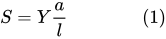
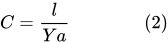

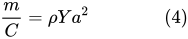
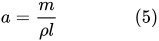
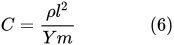

 Done Sorry Tbh®tchTalk © Happy Holidays 06:29, 5 December 2010 (UTC)