


Talk:Martin Van Buren
Add topic| This is the talk page for discussing improvements to the Martin Van Buren article. This is not a forum for general discussion of the subject of the article. |
Article policies
|
| Find sources: Google (books · news · scholar · free images · WP refs) · FENS · JSTOR · TWL |
Archives: 1, 2Auto-archiving period: 12 months  |
 | Martin Van Buren was a History good articles nominee, but did not meet the good article criteria at the time. There may be suggestions below for improving the article. Once these issues have been addressed, the article can be renominated. Editors may also seek a reassessment of the decision if they believe there was a mistake. | |||||||||
| ||||||||||
 | Facts from this article were featured on Wikipedia's Main Page in the "On this day..." column on July 24, 2018, July 24, 2022, and July 24, 2025. | |||||||||
 | This  level-5 vital article is rated C-class on Wikipedia's content assessment scale. level-5 vital article is rated C-class on Wikipedia's content assessment scale.It is of interest to the following WikiProjects: | ||||||||||||||||||||||||||||||||||||||||||||||||||||||||||||||||||||||||||||||||||||||||||||||||
| |||||||||||||||||||||||||||||||||||||||||||||||||||||||||||||||||||||||||||||||||||||||||||||||||


.svg)


Discussion after RfC
[edit]At some point soon this should be presented again, but with just two choices: A and E. E was added late as a crop of D, which came close to being chosen, and arguably presents a better image than D from which it is cropped. Randy Kryn (talk) 23:50, 17 September 2024 (UTC)
- poor guy never got a reply Gabrielgames123 (talk) 06:29, 8 April 2026 (UTC)
PAINTING
[edit]Should we make the portrait of Martin Van Buren a painting, like what we once did with John Tyler? 147.219.50.230 (talk) 22:32, 11 June 2025 (UTC)
- There were substantial discussions at #Infobox portrait and #Rfc for Martin Van Buren's Lede Image. This does not mean that the choice of image is forever frozen, but if you want to change it and you want your change to "stick", you will have to somehow deal with those discussions. Bruce leverett (talk) 12:31, 12 June 2025 (UTC)
Page is self-contradictory
[edit]It seems like the page contradicts itself in stating He was also the first U.S. president who was not born a British subject
but also having the infobox say Born: Maarten Van Buren December 5, 1782 Kinderhook, Province of New York, British America
. I know that he was born right in a period of flux during American Independence, but I am not sure the best way to handle this. Casablanca 🪨(T) 13:34, 26 August 2025 (UTC)
- Fixed.Billmckern (talk) 20:54, 27 August 2025 (UTC)
- Good observation.
- His birth in that period of flux is notable and worth developing (within reason) Cognator15 (talk) 22:45, 9 October 2025 (UTC)
Nationalities at Birth
[edit]It is quite common for people born in/ connected with a disputed (or formerly disputed) territory to hold multiple nationalities. It's not a question of choice or self identification it's a matter of legal status that the relevant governments confer. Similar more contemporary examples, include Emilo Palma who was born in the Argentine and British Antarctic Claim at time when both states has Jus Soli Citizenship (https://en.wikipedia.org/wiki/Emilio_Palma), and also people connected with the Crimea or Donbass now are in a similar situation. Van Buren's situation was analogous, he was born in both "The State of New York, USA" and "The Province of New York, British Empire" both were legal and political realities at that moment. So he was clearly a dual national at the time of his birth, (and likely for the rest of his life even if he didn't know it). By and large British Nationality was acquired automatically, then as now. Essentially the sources cited stating Van Buren was not a "British Subject" at birth appear to be knowledgeable about US political history but not how British Nationality works/ worked at the time and have made some incorrect assumptions. So on that specific point they are not reliable sources. They may be reliable on other point but not British nationality laws of the late 18th century, so will amend. Is Van Buren's status as a dual national (at least at birth) the most interesting thing about him? No, but it is notable that he was the first President born after 4 July 1776, and the last one born before the Peace of Paris. What those facts then mean requires an understanding of American and British nationality rules of the time. Certainly when it comes to his British Nationality status the article at present is flawed. There may need to work on his American nationality too, since he was also born prior to the American Constitution (as the idea is understood now) being adopted, but that probably would benefit from attention of someone more expert on that than this contributor. Cognator15 (talk) 21:57, 9 October 2025 (UTC)
Why is Obama there
[edit]The picture of Martin Van Buren has been replaced with Obama ~2026-78658-8 (talk) 14:15, 5 February 2026 (UTC)
- Thank you. All of that temporary account's edits have been reverted & the IP for that account is now blocked. Peaceray (talk) 23:03, 6 February 2026 (UTC)
infobox image
[edit]| Collapsing this discussion per WP:SOCKHAT as it was started by a now-blocked sockpuppet. Mz7 (talk) 06:40, 11 April 2026 (UTC) |
|---|
| The following discussion has been closed. Please do not modify it. |
I am closing this RfC as withdrawn because the initiator of the RfC recently tried to blank it, indicating they no longer wish to pursue this. Further discussion of the image can take place in a follow-up thread. Mz7 (talk) 06:12, 11 April 2026 (UTC)
Which picture should be in the lead? 15:50, 8 April 2026 (UTC) A painting better represents him cus its from his prime (1837-1838 during his presidency),the problem i have with the photo is that its from 1855, thats like 7 years nearing his death. and dont hit me with the "people remember him that way" cus the reason why ppl remember him that way is because of this article Gabrielgames123 (talk) 05:59, 8 April 2026 (UTC) Update: I have made a fool of himself by not responding to all the messages under this thread ~2026-22185-39 (talk) 04:02, 11 April 2026 (UTC)
Gabrielgames123, are these the main options under consideration?
And is the expectation that all of them will be in the article, and the question is really just which one should be at the top vs. in a relevant ==Section==? WhatamIdoing (talk) 15:51, 8 April 2026 (UTC)
Edit: and also higher quality Gabrielgames123 (talk) 16:20, 8 April 2026 (UTC)
There was a lengthy discussion of the infobox image, featuring exactly these two choices, in 2024; you can find the first part of it in Talk:Martin Van Buren/Archive 1, and the second part (which was an RFC) in Talk:Martin Van Buren/Archive 2. I personally started the discussion because I thought Van Buren looked like a scarecrow in the photograph. However, the great majority of contributors favored the photograph anyway. It is a cropped version of a featured picture, and it has been our infobox picture of Van Buren for a very long time. So I basically lost that argument, but I'm happy that there was a strong consensus. Bruce leverett (talk) 18:25, 8 April 2026 (UTC)
The discussion above is closed. Please do not modify it. Subsequent comments should be made on the appropriate discussion page. No further edits should be made to this discussion.
|

![Official portrait [dubious – discuss], painted 1858](/everything/wiki/File:Mvanburen.jpeg)
.jpg)
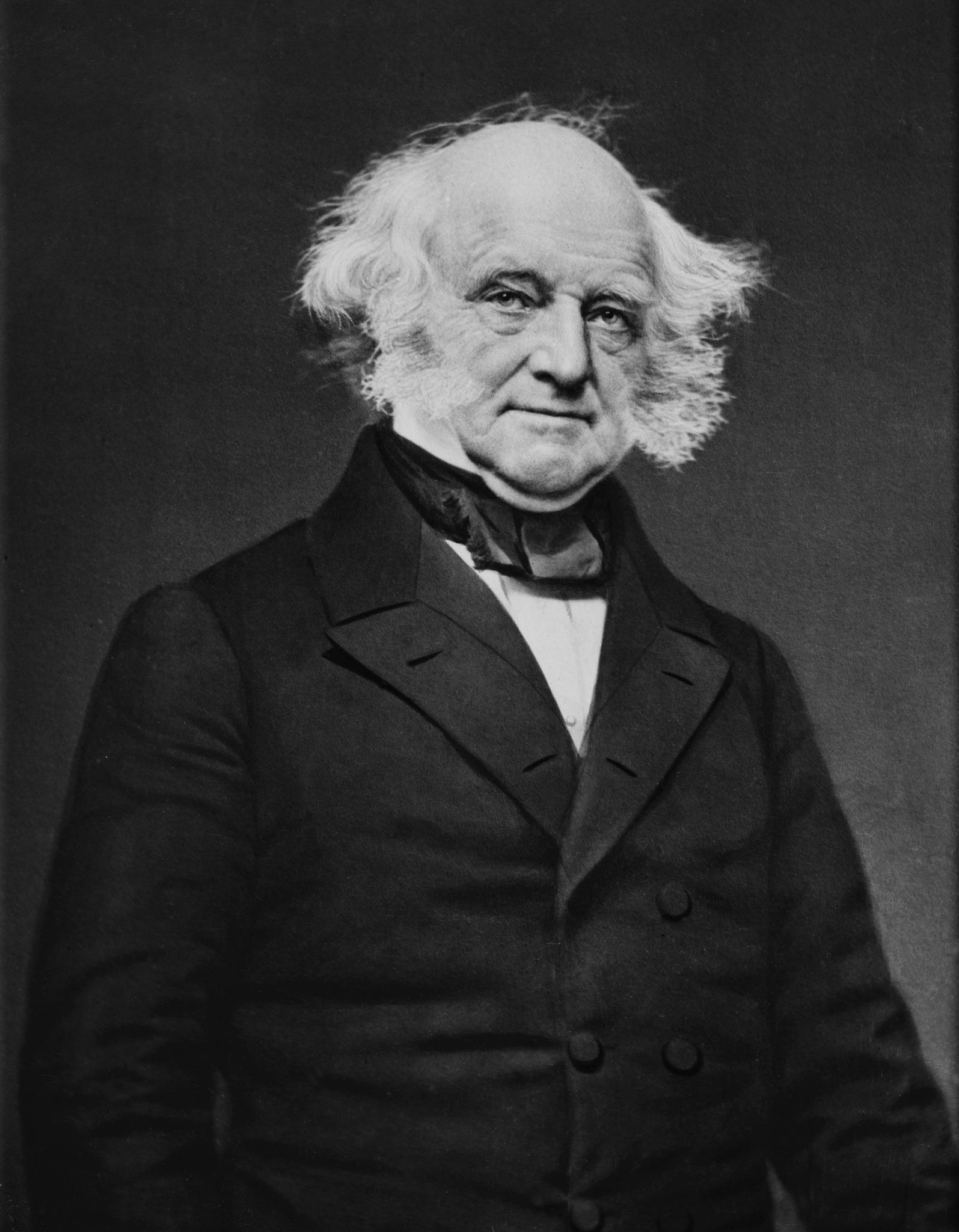
Official portrait? Says who?
[edit]The claim has been made that the 1858 George Peter Alexander Healy painting is the "official portrait" of Van Buren. To that, I say [dubious – discuss]. That is a dubious claim that should be discussed.
Historian Feather Schwartz Foster writes Congress did not pay for “official” POTUS portraits until the early 20th century. Healy used previous portraits, photographs or etchings to depict Martin Van Buren, John Tyler, Franklin Pierce, Millard Fillmore, James Buchanan, Abraham Lincoln, Ulysses S. Grant and Chester Alan Arthur.
That calls into question the "official" designation and raises the very strong possibility that Healy's painting is a derivative work of Brady's daguerrotype. Compare Brady's photo to Healy's painting. A previous criticism of the Brady photo is that it portrays Van Buren as an elderly man with bags under his eyes, hopelessly unruly sideburns
. Healy's painting (which I personally like much better than the unfocused, ruddy cheeked, dark suit on a dark background Henry Inman painting) also shows an elderly man with bags under his eyes and unruly sideburns. Compare also the lines on his forehead in both images. Healy adjusted the head angle and modified the mouth to a bit of a smile but the similarities are striking. I am reminded that Mary Todd Lincoln had to plead with her husband Abe to brush his hopelessly unruly hair before sitting for a photo portrait. The similarities of the two depictions of Van Buren combined with Foster's commentary leads me to believe that Brady's photo was Healy's main source material.
So, what makes a 19th century presidential portrait "official"? Take a look at the web page for this painting on the website of the White House Historical Association. It says that the Healy painting is in the collection of the White House, but nowhere refers to it as an "official portrait". The White House Historical Association has a website gallery of presidential portraits and is an excellent source of information about the presidency, but it is a private, nonprofit group established by Jacqueline Kennedy that has no power to designate a portrait of a president as "official". Congress did so for over a century and allocated money for official presidential portraits that were painted in the years immediately after a presidency, but Donald Trump signed legislation putting an end to that practice in 2018. Do any other editors have actual evidence that the Healy painting is "official"? Cullen328 (talk) 10:07, 9 April 2026 (UTC)
- There is no such thing as an official painting of a former US president (in the context of Wikipedia) and if there was it would be irrelevant to people writing an encyclopedia.
That is a dubious claim that should be discussed.
Nah. Polygnotus (talk) 16:24, 9 April 2026 (UTC)- The status is typically defined as being a portrait used by the White House Historical Association on their gallery. NerdAssembledy (talk) 18:18, 15 September 2026 (UTC)
- I don't see any claim in the article about an official portrait.
- I'm not aware of any law that says an official portrait must have been paid for by Congress. Are you? WhatamIdoing (talk) 16:36, 9 April 2026 (UTC)
- I did not say that the dubious claim was in the article but the dubious claim is made on this talk page when evaluating the suitability of one particular image. The dubious claim is also in the Commons file description page. If Congress allocates funds to create an official portrait, as it regularly did for over a century until 2018, then it is reasonable to call any such painting an official portrait. There may possibly have been some 19th century process for designating a presidential portrait as "official". If so, what was it? Cullen328 (talk) 17:26, 9 April 2026 (UTC)
- I think that being chosen for the National Portrait Gallery (United States), is effectively "the process". The 1858 Healy painting is the NPG portrait. WhatamIdoing (talk) 17:37, 9 April 2026 (UTC)
- Being chosen for the collection of the National Portrait Gallery cannot possibly be the criterion for "official portrait" when the National Portrait Gallery owns multiple portraits of most and probably all presidents, and a quick Google search shows several portraits each of Washington, Lincoln, Obama and Trump in their collection. In the case of Van Buren, their website shows that they own at least 22 Van Buren portraits of varying quality and media, including a different Mathew Brady daguerrotype. Also, Healy did at least two portraits of Van Buren, the first one, better in my opinion, being painted a year earlier in 1857, and also in the collection of the National Portrait Gallery. Cullen328 (talk) 19:31, 9 April 2026 (UTC)
- It sounds like you've done a lot of research on this. Would you like to add some of that to Official portrait? WhatamIdoing (talk) 19:59, 9 April 2026 (UTC)
- So far, I have not found any reliable source that defines an official presidential portrait in the 19th century, so I am using logic and the absence of evidence in this talk page discussion. Cullen328 (talk) 20:34, 9 April 2026 (UTC)
- It sounds like you've done a lot of research on this. Would you like to add some of that to Official portrait? WhatamIdoing (talk) 19:59, 9 April 2026 (UTC)
- Being chosen for the collection of the National Portrait Gallery cannot possibly be the criterion for "official portrait" when the National Portrait Gallery owns multiple portraits of most and probably all presidents, and a quick Google search shows several portraits each of Washington, Lincoln, Obama and Trump in their collection. In the case of Van Buren, their website shows that they own at least 22 Van Buren portraits of varying quality and media, including a different Mathew Brady daguerrotype. Also, Healy did at least two portraits of Van Buren, the first one, better in my opinion, being painted a year earlier in 1857, and also in the collection of the National Portrait Gallery. Cullen328 (talk) 19:31, 9 April 2026 (UTC)
- I think that being chosen for the National Portrait Gallery (United States), is effectively "the process". The 1858 Healy painting is the NPG portrait. WhatamIdoing (talk) 17:37, 9 April 2026 (UTC)
- I did not say that the dubious claim was in the article but the dubious claim is made on this talk page when evaluating the suitability of one particular image. The dubious claim is also in the Commons file description page. If Congress allocates funds to create an official portrait, as it regularly did for over a century until 2018, then it is reasonable to call any such painting an official portrait. There may possibly have been some 19th century process for designating a presidential portrait as "official". If so, what was it? Cullen328 (talk) 17:26, 9 April 2026 (UTC)
Historical reputation
[edit]"Historian Jeffrey Rogers Hummel states that Van Buren was America's greatest president, arguing that "historians have grossly underrated his many remarkable accomplishments in the face of heavy odds". Sounds like WP:FRINGE to me. Is Jeffrey Rogers Hummel notable enough for this to warrant inclusion? Jah77 (talk) 09:36, 10 May 2026 (UTC)
- Agreed, and the following statement, about Martin Van Buren being the "most forgettable", likewise looks like WP:FRINGE. Bruce leverett (talk) 19:27, 10 May 2026 (UTC)
Historical ranking
[edit]The last sentence of the third paragraph of the lead until recently said, "... historians and political scientists often rank him as an average or below-average U.S. president ...". The Legacy section makes the following slightly different statement: "His presidency is considered to be average, at best, by historians." These are more or less equivalent ways to say the same thing. Both link to our article about the historical rankings of presidents. That article has a chart of the results of rankings of the presidents in the last few decades, and indeed, Van Buren has been exactly in the middle as recently as 1996, and close to it as recently as 2018.
Generally, the lead should agree with the main body of the article. The recent change in the lead to say "... historians and political scientists often rank him as a below-average U.S. president ..." causes it to disagree with the Legacy section (and also with the article about historical rankings). Bruce leverett (talk) 03:30, 7 July 2026 (UTC)
- Former good article nominees
- C-Class level-5 vital articles
- Wikipedia level-5 vital articles in People
- C-Class vital articles in People
- C-Class biography articles
- C-Class biography (politics and government) articles
- Mid-importance biography (politics and government) articles
- Politics and government work group articles
- WikiProject Biography articles
- C-Class New York (state) articles
- Mid-importance New York (state) articles
- C-Class Capital District articles
- Mid-importance Capital District articles
- WikiProject Capital District articles
- C-Class United States articles
- Low-importance United States articles
- C-Class United States articles of Low-importance
- C-Class District of Columbia articles
- Low-importance District of Columbia articles
- WikiProject District of Columbia articles
- C-Class United States presidential elections articles
- Low-importance United States presidential elections articles
- WikiProject United States presidential elections articles
- C-Class Presidents of the United States articles
- Top-importance Presidents of the United States articles
- WikiProject Presidents of the United States articles
- C-Class US State Legislatures articles
- Unknown-importance US State Legislatures articles
- WikiProject US State Legislatures articles
- C-Class United States Government articles
- Mid-importance United States Government articles
- WikiProject United States Government articles
- C-Class United States governors articles
- Low-importance United States governors articles
- WikiProject United States governors articles
- WikiProject United States articles
- C-Class politics articles
- Mid-importance politics articles
- C-Class American politics articles
- Top-importance American politics articles
- American politics task force articles
- WikiProject Politics articles
- C-Class U.S. Congress articles
- Mid-importance U.S. Congress articles
- WikiProject U.S. Congress persons
- C-Class International relations articles
- Mid-importance International relations articles
- WikiProject International relations articles