Cloudflare fetched the original article and streamed it through HTMLRewriter to apply an entirely new visual system without rebuilding the source page.
// request.cf · coarse context
A page that knows where it met you.
Only coarse request metadata is shown. This demo does not display or persist visitor IP addresses.
This article is within the scope of WikiProject Mathematics, a collaborative effort to improve the coverage of mathematics on Wikipedia. If you would like to participate, please visit the project page, where you can join the discussion and see a list of open tasks.MathematicsWikipedia:WikiProject MathematicsTemplate:WikiProject Mathematicsmathematics
Latest comment: 3 years ago3 comments3 people in discussion
What is the "trick" in the section "log-sum-exp trick for log-domain calculations"? I had to read the sentence "Like multiplication operation in linear-scale becoming simple addition in log-scale; an addition operation in linear-scale becomes the LSE in the log-domain." three times for it to sort of make sense, I'll try and fix it, assuming log-scale and log-domain are the same thing. --WiseWoman (talk) 20:56, 14 March 2020 (UTC)Reply
The trick is to replace by which is numerically more stable (e.g. when used in a computer program). I think the text is clear (perhaps it has changed since you commented). --80.129.163.20 (talk) 14:39, 20 January 2022 (UTC)Reply
I stumbled on that sentence and math too. Apparently, the point is that applying LogSumExp to a vector of variables transformed to, or taken to be in, log space (which I agree is not obviously defined, as log can in principle output any number), is equivalent to taking the log of the sum of the vector of untransformed variables. Equivalence is symmetric, so LSE can also be thought of as a way to notate/represent/compute the logarithm of a sum. Whether and how it (the trick and the whole function) is useful is another question, perhaps not sufficiently answered by this article.
Then the expected value will be limited to find the terms:
a way to improve considerably
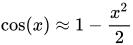
And improvement for this approximation by using the same terms could be found by using the classic *small-angle approximation* for the cosine function but instead of simplifying, by going in the other way around, and then applying the Isserlis's theorem:
and since when the variables are too different I just have:






![{\displaystyle E[Z]\approx \ln(2)+{\frac {E[Y]+E[X]}{2}}+{\frac {E[(Y-X)^{2}]}{8}}}](https://wikimedia.org/api/rest_v1/media/math/render/svg/dd0715bad828b8f4423e621a7f1c63da3aca1780)
![{\displaystyle {\begin{array}{r c l}:Z=\ln(e^{X}+e^{Y})&\approx &\ln(2)+{\frac {Y+X}{2}}+{\frac {(Y-X)^{2}}{8}}\pm 1\\:&=&1+\ln(2)+{\frac {Y+X}{2}}-\underbrace {\left[1-{\frac {1}{2}}\left({\frac {|Y-X|}{2}}\right)^{2}\right]} _{\text{small angle approximation in reverse}}\\:&=&1+\ln(2)+{\frac {Y+X}{2}}-\underbrace {\cos \left({\frac {|Y-X|}{2}}\right)} _{\text{cosine is an even function}}\\:&=&1+\ln(2)+{\frac {Y+X}{2}}-\underbrace {\cos \left({\frac {Y-X}{2}}\right)} _{\text{complex-valued expansion}}\\:\Rightarrow Z=\ln(e^{X}+e^{Y})&\approx &{\begin{cases}1+\ln(2)+{\frac {Y+X}{2}}-{\frac {1}{2}}\left[e^{-i{\frac {(Y-X)}{2}}}+e^{-i{\frac {(X-Y)}{2}}}\right],\quad {\frac {(Y-X)^{2}}{8}}\leq 3\\\max\{X,Y\},\quad {\text{otherwise}}\end{cases}}:\end{array}}}](https://wikimedia.org/api/rest_v1/media/math/render/svg/4b1a3c1a6371007121dea9d6994dc695b0daf69d)
![{\displaystyle E[Z]\approx {\begin{cases}E[X],\quad (X>Y)\wedge \left({\frac {(Y-X)^{2}}{8}}>3\right)\\E[Y],\quad (Y>X)\wedge \left({\frac {(Y-X)^{2}}{8}}>3\right)\end{cases}}}](https://wikimedia.org/api/rest_v1/media/math/render/svg/20b5bd116d5d0ccbc5a0d151d6b1f1e8c4fc129a)

![{\displaystyle {\begin{array}{r c l}:E[Z]=E\left[\ln \left(e^{X}+e^{Y}\right)\right]{\Biggr |}_{{\frac {(Y-X)^{2}}{8}}\leq 3}&\approx &1+\ln(2)+{\frac {E[X]+E[Y]}{2}}-{\frac {1}{2}}\left[e^{-{\frac {1}{2}}E\left[\left({\frac {Y-X}{2}}\right)^{2}\right]}+e^{-{\frac {1}{2}}E\left[\left({\frac {X-Y}{2}}\right)^{2}\right]}\right]\\:&=&1+\ln(2)+{\frac {E[X]+E[Y]}{2}}-{\frac {1}{2}}\left[\underbrace {e^{-{\frac {1}{8}}E\left[\left(Y-X\right)^{2}\right]}+e^{-{\frac {1}{8}}E\left[\left(Y-X\right)^{2}\right]}} _{\text{identicals}}\right]\end{array}}}](https://wikimedia.org/api/rest_v1/media/math/render/svg/13c45618b61a5f8c5fab3321af6260a4ab4c99a3)
![{\displaystyle \Rightarrow E[Z]\approx 1+\ln(2)+{\frac {E[X]+E[Y]}{2}}-e^{-{\frac {1}{8}}E\left[\left(Y-X\right)^{2}\right]},\quad {\frac {(Y-X)^{2}}{8}}\leq 3}](https://wikimedia.org/api/rest_v1/media/math/render/svg/5094b09e5e2202a619150f009ec5bdf00560e32a)


![{\displaystyle E[Z]\approx \ln(2)+{\frac {E[X]+E[Y]}{2}}+1-\cos \left({\frac {E[Y]-E[X]}{2}}\right)\cdot e^{-{\frac {1}{8}}V[Y-X]},\quad {\frac {(Y-X)^{2}}{8}}\leq 3}](https://wikimedia.org/api/rest_v1/media/math/render/svg/ee78bc249b6f8c39ea91c693b5d741da7e209f69)
