


Talk:List of logarithmic identities
Add topic
 | This article is rated List-class on Wikipedia's content assessment scale. It is of interest to the following WikiProjects: | ||||||||||||||||||||
| |||||||||||||||||||||


Missing log limits
[edit], but always .
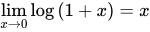


— Preceding unsigned comment added by Reddwarf2956 (talk • contribs) 00:24, 29 March 2015 (UTC)
- I guess you mean or the second one? That follows pretty quickly from the upper bound you gave yourself. I added some inequalities so people may deduce this themselves. Thomasda (talk) 16:19, 16 September 2015 (UTC)

Complex logarithm identities
[edit]Using "Log" and ln to refer to \ln and log to refer to log seems rather pointless and impractical. "Log" with a capital letter should just be ln. Otherwise it's very confusing.
Definitions
[edit]In what follows, a capital first letter is used for the principal value of functions, and the lower case version is used for the multivalued function. The single valued version of definitions and identities is always given first, followed by a separate section for the multiple valued versions.
- ln(r) is the standard natural logarithm of the real number r.
- Log(z) is the principal value of the complex logarithm function and has imaginary part in the range (−π, π].





Harmonic number difference
[edit]Hello everyone,
I've been working on revising the "Calculus identities" section to include the identity for Harmonic number difference. To avoid cluttering this talk page and to facilitate detailed feedback, I've drafted the proposed changes in my sandbox. Please view the draft here: Harmonic number difference.
I welcome all suggestions and comments to ensure that the content meets Wikipedia guidelines and that it's accurate and clearly explained. I would be grateful if you could share your feedback and thoughts here on this Talk page.
Thank you for taking the time to review and for your valuable insights!
Best regards. Twoxili (talk) 15:58, 25 April 2024 (UTC)
Unnecessary Colour
[edit]The use of colour coding is unnecessary and possibly detrimental to the legibility of the article, especially since it seems to only be used in two sections at the beginning of the article Lukamccann (talk) 20:23, 16 June 2024 (UTC)
- agreed. Em3rgent0rdr (talk) 23:44, 16 June 2024 (UTC)
Question about a change-of-base problem
[edit]Most of this article is over my head, so perhaps my question is covered and I'm just overlooking it.
I had a problem of the form , where I wanted to solve for in terms of and . I think the answer is that equals the ratio of the two logarithms (common or natural or any other base) of the known quantities: . Is this correct? If so, it would be worth spelling out, presumably in the "Changing the base" section, for the benefit of readers looking to solve this type of problem. JamesMLane t c 20:48, 4 July 2025 (UTC)


- You’re looking for the identity under the “Trivial identities” header’s “Explanations” subheader, which lists which substituting for your variables nets Change-of-base is something different. It basically states you can find the logarithm of any base b of a, by calculating where c is any [valid] number. Eg: you can use the natural logarithm (log base Euler’s number) to calculate the binary logarithm (log base 2): EmptySora_ (talk) 21:15, 4 July 2025 (UTC)
- Change of base would be useful if you don’t have a way to calculate arbitrary logarithms (eg: in a calculator), which the page already says. You could do, in your case, But note that the base of both logarithms must be the same (which wasn’t the case in your comment). So I don’t think a change is required. EmptySora_ (talk) 21:30, 4 July 2025 (UTC)
- You're right about my comment -- because I messed up both the substance and the math notation. Using common logs, I should have written , but I inverted the fraction and inadvertently made and the bases. Thanks for your patient correction!
- The defect in the article, however, is that the passage you cite doesn't fully explain how to solve the problem, for readers like me who aren't as knowledgeable and who don’t have a way to calculate logarithms to an arbitrary base. That's why I referred to it as a change of base. A reader in that situation who wants to find when (switching from my variables back to the ones in the article) is not shown how to solve the problem on a common calculator.
- Either under "Trivial identities" or "Changing the base", what if we insert a mention that, if , then and/or ? JamesMLane t c 23:44, 4 July 2025 (UTC)
- Np. I was actually worried I came off too snarky or in an “akshually” manner, lol. (I’m nowhere near an expert, too.) The thing, though, is the log–exponent equivalence thing isn’t so much of an “identity” as it is the “definition” of a logarithm (as the article states; see Logarithm § Definition). I feel this might be being a bit too pedantic, though. If you [also] feel like the distinction isn’t that important, or that it’s worth mentioning, I do think it would be helpful to modify the page so the definition is more than just an afterthought for explaining the trivial identities. How we would go about rewording it, I’m not entirely sure. As stated, I’m no expert. I just like math a lot, lol. We should keep in mind WP:NOTTEXTBOOK (see end of item 6,
However, examples intended to inform rather than instruct may be appropriate for inclusion in Wikipedia articles.
. More generally, The point of WP is not to instruct, but inform.)I’ve come to this page countless times because, for the life of me, I just can’t remember that definition with certainty, lmao. Every time, I always got a bit confused at how it was worded as an afterthought on the page.More to the point, I don’t think it should go under the change of base header. The is the definition, and requires the change of base identity to get to In other words, change of base is only relevant once we get to that “log b of y” form. Likewise, I don’t know how we would modify the “trivial identities” header without making the section read worse arguably. Since you initially mentioned only “change of base”, this is why I said “I don’t think it’s required”, if that makes sense. I feel like that header explains it perfectly, at least going from the “log b of y” form to “ln y divided by ln b”.I feel like the core problem is that the definition is treated like an afterthought on this page. So, maybe we create a new header/subheader for the definition to be mentioned somewhere (probably before the Trivial identities header). Eg something like the following (touched up, obviously, lol):
Since that header, as written, is about the equivalence of the logarithm and exponent forms of an equation, I don’t think there’s a good enough reason to go as far as putting in there. It may be worth it to add such an example to the change of base header, though, since I feel like change of base often isn’t explained well—when I first learned it, they never really explained what the common base c is supposed to be/mean. They just said without explaining what c is. EmptySora_ (talk) 02:23, 5 July 2025 (UTC)Log–exponent equivalenceWhile not an identity, the definition of a logarithm, which states, is useful for rewriting equations to solve for variables, such as in the equation which can be rewritten If the logarithm base b isn’t supported, the change of base identity can be used to rewrite the equation in terms of logarithms that are supported – often in terms of the common and natural logarithms.
- I'll tell you frankly that a lot of your comment goes over my head. It's been decades since I took any math classes. I'm continuing as the self-appointed tribune of Wikipedia readers who, like me, are at a less advanced level. From that point of view, I think it's informative to illustrate how one can get from to solving for without having to deal with logs to base . My first draft would be to begin the "Changing the base" section as follows:
- Most calculators have buttons for ln and for log10, but not all calculators have buttons for the logarithm of an arbitrary base. Accordingly, it is sometimes useful to change the base of a logarithm.
- For example, in the identity noted in #Trivial identities above, solving for directly would require working with logarithms to the base . An alternative is to state in terms most calculators can handle: If , then or .
- A more general formula for changing the base can be stated formally:
- There would then follow the current "Proof and derivation" subsection. JamesMLane t c 02:47, 6 July 2025 (UTC)
- Np. I was actually worried I came off too snarky or in an “akshually” manner, lol. (I’m nowhere near an expert, too.) The thing, though, is the log–exponent equivalence thing isn’t so much of an “identity” as it is the “definition” of a logarithm (as the article states; see Logarithm § Definition). I feel this might be being a bit too pedantic, though. If you [also] feel like the distinction isn’t that important, or that it’s worth mentioning, I do think it would be helpful to modify the page so the definition is more than just an afterthought for explaining the trivial identities. How we would go about rewording it, I’m not entirely sure. As stated, I’m no expert. I just like math a lot, lol. We should keep in mind WP:NOTTEXTBOOK (see end of item 6,
- Change of base would be useful if you don’t have a way to calculate arbitrary logarithms (eg: in a calculator), which the page already says. You could do, in your case, But note that the base of both logarithms must be the same (which wasn’t the case in your comment). So I don’t think a change is required. EmptySora_ (talk) 21:30, 4 July 2025 (UTC)
- Sorry! Somehow, I didn’t get notified of your response.I actually really like your approach/draft now that I see what you’re envisioning (plus, it avoids the whole “should we put a section about a ‘definition’ on a page about ‘identities’” issue). The distinction between identities and definitions isn’t that important, I feel, but we should try to use the proper terminology where possible.How about something like this:
I don’t really like the part of the formal definition being listed in the formula. On smaller screens like phones, you have to scroll to see the formula, it obscures when the “formula” part actually starts, and laypeople cannot decipher that part. (It’s loosely equal to the “where blank is…” you see elsewhere on WP). If I’m not mistaken, that part means “where a and b are positive real numbers greater than one, and x is a positive real number.” I would like to change those accordingly so laypeople could more easily decipher those equations without losing the precise meaning, but… I don’t know. Your thoughts? EmptySora_ (talk) 03:43, 7 July 2025 (UTC)Changing the baseMost calculators have buttons for natural logarithms (ln) and common logarithms (log or log10), but not all calculators have buttons for the logarithm of an arbitrary base. Accordingly, it is sometimes useful to change the base of a logarithm.
As briefly mentioned in the § Trivial identities section, the definition of a logarithm is, Solving for x in the exponential equation bx = y could be done on most calculators by using common or natural logarithms: For example, the binary logarithm (log2), which is widely used in computer science, could be calculated on most calculators like:
More generally, the change of base formula can be formally defined as:
Proof and derivation[…]
Summation and subtraction[…]
Exponents[…]
Other or resulting identities[…]
- I had some changes (all minor) to what you wrote. I put your suggestion into the article and then edited it so you could readily see what I did.
- As for your concluding question: Until I happened to come to this article, I had not encountered the notation. Your reading of it seems correct, but I don't feel qualified to opine about how to make the equations easier to decipher (although I certainly endorse that general goal). JamesMLane t c 14:34, 7 July 2025 (UTC)





