


Talk:Limit cardinal
Add topicLatest comment: 13 years ago by JRSpriggs in topic Mistake in the article concerning infinite ordinal omega
 | This article is rated Start-class on Wikipedia's content assessment scale. It is of interest to the following WikiProjects: | ||||||||||||||||||||
| |||||||||||||||||||||

constructing limit cardinals
[edit]The article says
- An obvious way to construct more limit cardinals of both strengths is via the union operation: is a limit cardinal, defined as the union of all the alephs before it; and in general for any limit ordinal λ is a limit cardinal.


Is that obvious? Is it even a theorem of ZFC? I mean, how do we even know that ? The continuum hypothesis article doesn't say anything about this. Maybe I'm just reading the sentence incorrectly? If not, the article could use some added clarification. Thanks 66.127.52.47 (talk) 03:03, 14 March 2010 (UTC)

- The text you quoted does not say , it just says that is a limit cardinal. In general if an ordinal is the limit (union) of a sequence then is the limit of . — Carl (CBM · talk) 11:48, 14 March 2010 (UTC)


- I see what you mean now. I added "weak" to clarify that is a only weak limit. Here is what we know about the relationship between and in ZFC:
- ZFC proves that is not equal to , because of König's theorem (set theory)
- ZFC does not prove either or . The best intuitive way of understanding Cohen's result is that can be any uncountable cardinal with uncountable cofinality.
- — Carl (CBM · talk) 12:00, 14 March 2010 (UTC)
- I see what you mean now. I added "weak" to clarify that is a only weak limit. Here is what we know about the relationship between and in ZFC:


Mistake in the article concerning infinite ordinal omega
[edit]In the article one has , but as it says here, . Why is there the in then? Shouldn't it be after the omega? JMCF125 (discussion • contribs) 15:29, 13 July 2013 (UTC)
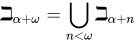


- See Ordinal arithmetic. a+ω=ω only holds when a is less than ω, that is, when a is finite. The α to which this article refers is intended to be any ordinal including infinite ordinals. Assuming the axiom of choice, the article is correct in saying that is a strong limit ordinal for any ordinal α. JRSpriggs (talk) 07:39, 14 July 2013 (UTC)
- Sorry, I hadn't noticed that. Thanks for the clarification. Should I delete this topic off the discussion page? JMCF125 (discussion • contribs) 17:10, 14 July 2013 (UTC)
- Usually we leave discussions which are relevant to the article even if they have been concluded. Someone else may have the same concern that you had and be enlightened by this discussion, or choose to revive it. JRSpriggs (talk) 20:45, 14 July 2013 (UTC)