


Talk:Lexell's theorem
Add topic | This article is rated B-class on Wikipedia's content assessment scale. It is of interest to the following WikiProjects: | ||||||||||
| |||||||||||

In terms of circles at constant latitude
[edit]This theorem is new to me. But if the following is correct, and if it qualifies as WP:CALC or is cited somewhere, should we add it to the article? The mathematical statement in the article starts with points A, B, and C, and defines a small circle through A*, B* and C, wherefrom we can choose X. However, couldn't we start with the small circle and get an exactly equivalent result? That is, suppose we have a small circle. Rotating the sphere we can assume, without loss of generality, that the the small circle has constant latitude in the northern hemisphere (or is the equator, though it turns out that that is a boring case). We could choose two points A* and B* at that northern latitude, but instead we'll choose their antipodes A and B at the corresponding southern latitude. We consider the great-circle arc that connects those two points at southern latitude. Then the spherical triangle that is formed from that great-circle arc and any point at the northern latitude will have an area that is independent of the choice of the third point. And if the third point is not at that northern latitude then the area will be different. —Quantling (talk | contribs) 21:06, 29 September 2023 (UTC)
- Yes, the version where you start with two parallel small circles equidistant from the same great circle ("equator") is formally the same statement but with a slightly different point of view, and there are some sources which write it more or less this way (don't ask me to list them, I wasn't keeping track, though V.-A. Lebesgue (1855) is one example). I hope it should be clear enough to readers that these are equivalent without belaboring the point. The identity a few of the proofs, and the discussions about spherical parallelograms are bit more aligned with this perspective on the situation.
- One reason I didn't make this more explicit in the article is that the situation where 2 vertices of the triangle are at the same latitude and the third vertex is at the opposite latitude is a pretty unusual special case, and I want to make sure readers understand that this theorem holds for any general triangle on the sphere, not just ones satisfying this very particular criterion relative to some given spherical coordinate system. –jacobolus (t) 00:44, 30 September 2023 (UTC)
- Thank you, I'll have to read through again with those thoughts in mind. One tweak to your last sentence ... I don't think about restricting the choice of points to work with the latitudes of a particular coordinate system, but I think instead of starting with any set of points A, B, and C, and then carefully choosing a coordinate system so that the points end up on those opposite latitudes in the chosen coordinate system. But I think we're saying pretty much the same thing here. I'll read through at some point in the next few days, and see whether I have anything else for this discussion. Thanks —Quantling (talk | contribs) 01:45, 30 September 2023 (UTC)
- Yes, I understand that, but trying to describe to readers that given any pair of points and third point on the sphere you can pick a spherical coordinate system such that the two are on the same "latitude" with the third point at the (equal but) opposite latitude is something that I don't expect would be any clearer than just talking about the small circles passing through antipodal points. –jacobolus (t) 03:07, 30 September 2023 (UTC)
- Thank you, I'll have to read through again with those thoughts in mind. One tweak to your last sentence ... I don't think about restricting the choice of points to work with the latitudes of a particular coordinate system, but I think instead of starting with any set of points A, B, and C, and then carefully choosing a coordinate system so that the points end up on those opposite latitudes in the chosen coordinate system. But I think we're saying pretty much the same thing here. I'll read through at some point in the next few days, and see whether I have anything else for this discussion. Thanks —Quantling (talk | contribs) 01:45, 30 September 2023 (UTC)

"small circle" vs. "spherical circle"
[edit]I see that "small circle" matches nicely with the competing concept of "great circle", so that's good, but it could easily confuse the reader into thinking about circles of particularly small radius, instead of all circles that are smaller than a great circle. Furthermore, although it is a degenerate case, the theorem applies even when the spherical circle is a great circle, which seemingly is not stated if we go with "small circle" in the theorem statement. What do you think about changing references of "small circle" to "spherical circle"? FWIW, the Wikipedia article on the concept uses the latter name. —Quantling (talk | contribs) 20:18, 6 October 2023 (UTC)
- "Small circle" (or sometimes "lesser circle") is the standard name used by the vast majority of the existing literature (name comes from 2000+ year-old Greek geometry/astronomy). If it were up to me, in the context of spherical geometry "great circles" (geodesics) would be called "straights" or similar, and great and small circles together just "circles", and the fundamental definition for "circle" in most contexts would be "curve on a surface with constant intrinsic curvature" rather than "set of points equidistant from a point". Oh well. I recently changed the title of the article spherical circle (was previously at circle of a sphere); that article still needs a ton of work, particularly listing and showing pictures of various basic properties, but also describing / linking to (currently red link) more advanced topics.
- I think the current version here is okay though, so long as "small circle" is wiki-linked when it first appears. Usually a degenerate spherical triangle with three collinear points (making it into either a hemisphere or an empty arc, depending how the points are spaced) is not considered to be a triangle at all. –jacobolus (t) 20:52, 6 October 2023 (UTC)
Theorem restatement
[edit]Do you know of any textbooks (or other reasonable sources) that state the theorem in this way?
- Let A, B, X, and Y be points on a sphere. There is a spherical circle that contains all four of these points if and only if the spherical triangles △ABX* and △ABY* have the same area, where X* and Y* are the antipodes of X and Y, respectively.
—Quantling (talk | contribs) 20:41, 6 October 2023 (UTC)
- I don't, but this is a pretty trivial variant, so I don't think there's any issue claiming this kind of thing in a Wiki article. I expect it would be somewhat more confusing to readers than the usual statement though. –jacobolus (t) 20:55, 6 October 2023 (UTC)
- I was thinking about adding this statement rather than using it to replace another statement. The current statement(s) tell us how to find spherical triangles of equal area. By flipping things around, this new statement instead tells us a way to check whether four points on a sphere are co-circular. It's not a particularly practical test, so that's a bummer. IMHO, the question is whether any notable source has thought it to be an interesting perspective. Perhaps the answer will turn out to be "no". —Quantling (talk | contribs) 21:19, 6 October 2023 (UTC)
- Probably more interesting than this is the way the circles through the two antipodal points (see Lexell's theorem § Foliation of the sphere) are analogous to Apollonian circles in the plane – indeed, are their inverse stereographic projection onto the sphere. I'm not sure what the nicest way is to characterize the other pencil of circles orthogonal to these though, or if this has been discussed much in past literature. –jacobolus (t) 20:07, 10 October 2023 (UTC)
- I was thinking about adding this statement rather than using it to replace another statement. The current statement(s) tell us how to find spherical triangles of equal area. By flipping things around, this new statement instead tells us a way to check whether four points on a sphere are co-circular. It's not a particularly practical test, so that's a bummer. IMHO, the question is whether any notable source has thought it to be an interesting perspective. Perhaps the answer will turn out to be "no". —Quantling (talk | contribs) 21:19, 6 October 2023 (UTC)
Opposite arcs of Lexell's circle
[edit]Hi @Quantling. I reverted your change to the statement of the theorem. The area is only constant for points on the same side of the great circle through the base; choices of apex on opposite arcs form triangles of opposite orientation whose signed area differs by the area of a hemisphere. However, if you allow a generalized definition of spherical triangle allowing for sides longer than a semicircle then you can make generalized triangles with apex on opposite arcs and the same area, e.g. by making the base of one triangle go the long way around the great circle between base vertices. Lexell himself suggested this: see Lexell's theorem § Opposite arcs of Lexell's circle for details. The lead section has a slightly imprecise paraphrase of the theorem for concision, and because the more precise version is stated soon enough after. –jacobolus (t) 22:27, 11 October 2023 (UTC)
- It sounds like there is an implicit assumption that the interior of spherical triangle ABC is the part of the sphere that makes all the triangle's interior angles be less than or equal to π (with the ambiguous edge case of ABC being on a great circle, hereafter ignored). Or saying it another way, consider the set of 8 triangles that could be said to have vertices ABC, and consider the set of their 8 areas, each of value in [0, 4π]. If X is anywhere on the small circle A*CB* then its set of 8 areas will be the same as that for ABC. Maybe that's true, or maybe I still don't get it! —Quantling (talk | contribs) 00:12, 12 October 2023 (UTC)
- Or maybe 2 instead of 8?? I clearly need to think more and waste your time less. —Quantling (talk | contribs) 00:38, 12 October 2023 (UTC)
- (Also, please don't worry about "wasting time". I am free to ignore your comments if I wish or if I am busy with something else, but in general am happy to have people read and engage with this article.) –jacobolus (t) 04:12, 12 October 2023 (UTC)
- I personally think of it more in terms of winding number of different regions of the sphere, a perspective that is pretty natural in computer graphics and computational geometry, but in my opinion too off topic to describe in the text of this article.
- Unlike the plane, where the point at infinity is by default considered to have winding number 0, on the sphere there's no a priori "correct" spot to start counting from [this causes real practical problems in GIS applications, etc.]. So if you want you can shift all of the winding numbers of every point on the sphere by any fixed integer which amounts to adding the whole sphere's surface times from the signed area of your shape (to compute the surface area, multiply the winding number by differential area at each point). The rule for winding numbers relative to an oriented boundary is that every time you cross the boundary, the winding number of the regions on either side differ by 1, with the sign of the difference dependent on the curve's orientation. –jacobolus (t) 01:30, 12 October 2023 (UTC)
- I am familiar with winding numbers from complex analysis so that helps my understanding. Thank you —Quantling (talk | contribs) 12:42, 12 October 2023 (UTC)
- Or maybe 2 instead of 8?? I clearly need to think more and waste your time less. —Quantling (talk | contribs) 00:38, 12 October 2023 (UTC)


Leaning in to the triangle ambiguity
[edit]This article is looking good, thank you. I've been musing on the intuition of why Lexell's theorem should be true.
For three points on the surface of a sphere, there is some ambiguity about which spherical triangle they define. For example, with two points on the equator and a third point in the northern hemisphere, we might connect the northern point to the other two with great circle arcs that never enter the southern hemisphere; and for connecting the two points on the equator we can go the short way or the long way around. If the area for the short way is T then the area for the long way is 2π − T, because together they give the entire northern hemisphere. Or starting with any triangle we can flip what we mean by inside and outside to get an area 4π − T. Combining the two, we can transform area T to 4π − (2π − T) = 2π + T. Because any set of three points can be rotated to put two on the equator, these statements are general. Fortunately all of T, 2π − T, 2π + T, and 4π − T have the same cos.
So, I am hoping that cos(T) can be computed directly using cross products and dot products of the unit vectors that indicate the locations of the vertices, u, v, and w, even though we are deliberately leaving the choice of specific great-circle arcs ambiguous. And I am hoping that that approach will also yield a simple proof of Lexell's theorem, starting with something like cos(T) = cos(A + B + C − π) = −cos(A + B + C). But it is all just hoping ... unless you see a way forward?? —Quantling (talk | contribs) 22:08, 28 November 2023 (UTC)
- You can definitely prove it from unit vectors, but I'm not sure if the proof is especially enlightening. The appropriate formula to start from is from Eriksson (1990), doi:10.1080/0025570X.1990.11977515 (a vector expression of a formula published in the 18th century by Euler and Lagrange):
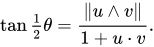
- where are the unit vectors to the vertices of the triangle.
- This is related to the formula for the angle measure between two unit vectors:
- (Incidentally the right-hand side of this second formula also tells the excess of a spherical triangle if one vertex is stereographically projected to the origin and the other two vertices stereographically project to and which in that case are not unit vectors anymore.)
- I should maybe make an article called area of a spherical triangle or something (to which spherical excess could redirect) which could better cover all of the various formulas for the area of a spherical triangle, and their history. –jacobolus (t) 01:28, 29 November 2023 (UTC)
- Thank you. Since there is a tight relationship between cos(ε) and tan(ε/2), that may lead to what I am looking for. —Quantling (talk | contribs) 18:20, 29 November 2023 (UTC)
- If you want to know more about the half-tangent, my (probably unsuitable for Wikipedia, still not sure what to do with it) draft at user:jacobolus/HalfTan may be useful. –jacobolus (t) 18:47, 29 November 2023 (UTC)
- Yes, Area of a spherical triangle would be a nice article to have. Please do! —Quantling (talk | contribs) 18:20, 29 November 2023 (UTC)
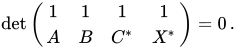
- I don't have a proof, but here's my thinking. Using A, B, C, and X as column vectors in , and C* = −C to indicate an antipode, the points A, B, C*, and X* are co-planar if and only if
- That is, if and only if
- B ∧ C ∧ X − A ∧ C ∧ X − A ∧ B ∧ X + A ∧ B ∧ C = 0.
- On the other hand, the (deliberately ambiguously defined) triangles ▵ABC and ▵ABX have equal "cosine of spherical area" values if and only if
- tan2(ε▵ABC / 2) = tan2(ε▵ABX / 2).
- That is, if and only if
- How hard can it be to show that the co-planarity and "cosine of area" equations are equivalent whenever ‖A‖ = ‖B‖ = ‖C‖ = ‖X‖ = 1?
- The reason that this approach intrigues me is that this formulation and proof might easily go to higher-dimensional hyperspheres to compare the volumes of the likes of tetrahedrons ▵ABCD and ▵ABCX. The co-hyperlanarity equation generalizes trivially. For the case of just one more dimension, that would probably require a formula (similar to the tan ε/2 formula) that provides the volume of S3 for a hyperspherical tetrahedron bounded by . —Quantling (talk | contribs) 15:14, 30 November 2023 (UTC)
- Feel free to try to work out (or find) a clear formula for the volume of a spherical tetrahedron. –jacobolus (t) 15:58, 30 November 2023 (UTC)
- Couldn't I just follow the pattern and declare it to be:
- ?
- Both working things out and finding things are hard. It's much easier to make stuff up. —Quantling (talk | contribs) 18:29, 30 November 2023 (UTC)
- Take a look at Murakami (2012) "Volume Formulas for a Spherical Tetrahedron", about the volume of a spherical tetrahedron in terms of either dihedral angles or edge lengths.
- And here's a unit vector version: Ribando (2006) "Measuring Solid Angle Beyond Dimension Three".
- All of these are kind of gnarly. Maybe you can figure out a clearer formulation. –jacobolus (t) 07:03, 1 December 2023 (UTC)
- Thank you, I will take a look. Because you are so good at finding these references ... can you find one that computes spherical (or hyperspherical) area based upon the normal vectors of the facets from the origin? (That is in the case of spherical area, instead of based upon vertices A, B, and C, the formula would take as inputs the normal vectors of the triangular facets, nA = B ∧ C, nB = C ∧ A, and nC = A ∧ B?) I am thinking that some sort of merging of the results of Law of sines § Higher dimensions and Law of sines § The spherical law of sines might work. (And as always, my apologies for these wild brainstorms, many of which lead nowhere. It entertains me to think about these things, but I acknowledge that your interests may lie elsewhere.) Thanks —Quantling (talk | contribs) 15:46, 1 December 2023 (UTC)
- Finding papers just takes typing some keywords into the query box of a citation index, e.g. Google Scholar. It's not magic. There's a paper Wang, Yang, Yu, & Qi (2014) "The Law of Sines for an n-Simplex in Hyperbolic Space and Spherical Space and its Applications". –jacobolus (t) 16:56, 1 December 2023 (UTC)
- Thank you, I will take a look. Because you are so good at finding these references ... can you find one that computes spherical (or hyperspherical) area based upon the normal vectors of the facets from the origin? (That is in the case of spherical area, instead of based upon vertices A, B, and C, the formula would take as inputs the normal vectors of the triangular facets, nA = B ∧ C, nB = C ∧ A, and nC = A ∧ B?) I am thinking that some sort of merging of the results of Law of sines § Higher dimensions and Law of sines § The spherical law of sines might work. (And as always, my apologies for these wild brainstorms, many of which lead nowhere. It entertains me to think about these things, but I acknowledge that your interests may lie elsewhere.) Thanks —Quantling (talk | contribs) 15:46, 1 December 2023 (UTC)
- Feel free to try to work out (or find) a clear formula for the volume of a spherical tetrahedron. –jacobolus (t) 15:58, 30 November 2023 (UTC)
- Thank you. Since there is a tight relationship between cos(ε) and tan(ε/2), that may lead to what I am looking for. —Quantling (talk | contribs) 18:20, 29 November 2023 (UTC)







Triangles with small-circle arcs
[edit]With , , and concyclic and and on the same side of the great circle , two triangles and will continue to have the same area even if we play a little with the arc that they have in common. For example, instead of connecting and with a great circle arc, we could connect them with an arc that lies within the small circle that contains , , and . I believe that this modification for that arc will remove the same region from both and , so the remaining area within each one-side-modified triangle will continue to be equal.


To me this begs the question: does Lexell's theorem also extend to the case that all three of the arcs are replaced by small circles? That is, is now the arc within the small circle , is now the arc within the small circle , and is now the arc within the small circle . Does Lexell's theorem still hold for this three-sides-modified triangle? —Quantling (talk | contribs) 19:49, 9 November 2025 (UTC)


- The surface area of a spherical triangle (with great-circle-arc sides) is a quantity which is meaningfully uniquely defined by any three points on the sphere. Once you start dealing with small circles, there's not really an obvious reason to prefer one or another, and you now need 3 more parameters to specify a curvilinear triangle. The answer to your explicit question is: no. But the broader answer is: feel free to go investigate the area of curvilinear spherical triangles. Maybe you'll find something interesting. –jacobolus (t) 22:46, 9 November 2025 (UTC)
Glosses of basic terms in the lead
[edit]@Quantling I don't think we can say, without elaboration, that a great circle is "a curve formed by the sphere intersected with a plane that includes the origin" or that "a small circle is a curve formed by the sphere intersected with a plane that does not include the origin". Spherical geometry doesn't inherently involve any kind of ambient Euclidean space, let alone a coordinate system with an origin. So glosses along these lines would require an additional paragraph (or more likely several) of elaboration to provide context, explaining about a sphere's relation to an ambient space, discussing the relation between circles on the sphere and planes in the ambient space, points on the sphere and lines through the sphere's center in space, etc. I think this is all out of scope for the lead section here, and best located in a more generic article such as spherical geometry, sphere, spherical circle, great circle, spherical triangle (doesn't yet exist), etc. Moreover, none of this article currently discusses the relation of Lexell's theorem to an ambient Euclidean space, so introducing it at all (even outside the lead) might be a bit confusing; there could plausibly be a section about that topic, e.g. a proof of the theorem by some vector method, but a source would need to be found for it. Our only current mention of an "origin" in this article is as a name for the point in the plane of a stereographic projection at the center of the "primitive circle". –jacobolus (t) 00:28, 10 November 2025 (UTC)
- I'm willing to yield to your wisdom on this, but please hear me out. As I see it, the alternative to assuming that the sphere is embedded within R3 and inherits its topology and metric from that embedding is to describe it as a manifold with coordinate patches, Cω mappings of the patches with open subsets of R2, and a whole-manifold metric tensor that implies a curvature tensor that is consistent with a fixed positive spherical radius. We could then define a great-circle arc as a geodesic. We could define a small circle as all points within a fixed distance of a central point. An antipode is the point that has maximum distance. The polar triangle of a given spherical triangle ... surely there is a way to define that too.
- But I'm thinking that supposing the existence of an embedding, centered on the origin in R3 and of unit radius, is a legitimate approach that many readers will assume is the only possible approach. The readers who know that there are alternative approaches will know of this simple case and won't be confused. For this article, it's the approach I'd go with. —Quantling (talk | contribs) 02:41, 10 November 2025 (UTC)
- There's no need to make any such assumption. Spherical geometry can be an independent axiomatic system, and does not need to be established in terms of Euclidean geometry or the arithmetic of real numbers. It certainly does not depend on coordinate patches (especially since this theorem is from the 18th century and most of the proofs discussed are from the 19th century; such a foundation would be an anachronism). In this article in a couple of places we make reference to the radius of the sphere, especially noting the case where the radius is 1 – this is implying a sphere in Euclidean space though we don't discuss further (and frankly don't need to); if we really wanted we could replace mentions of unit radius by describing the circumference of a great circle to be (or treating "radius" to be an abstract scaling factor rather than a concrete length), but I think it would be gratuitously confusing for no real benefit.
- If you want a coordinate system, you can also alternately define it by taking the stereographic projection to the plane (with one point at infinity) and choosing the appropriate metric. But that's out of scope for this article. This kind of topic is better left to spherical geometry, sphere, etc. –jacobolus (t) 06:24, 10 November 2025 (UTC)
- Maybe I'm now at the point of repeating myself and I should just let it rest. One more try. Yes, throughout the ages there have been many ways to characterize a 2-sphere. What's nice about many of them is that they can be used to generalize, to another finite number of dimensions, an infinite number of dimensions, fractional dimensions, manifolds with other Euler characteristics, and much more. So, they are very useful in many contexts. However, what makes each of these approaches to characterizing a 2-sphere interesting and/or practical is that the approach is consistent with what the surface of a ball in R3 would give. If it didn't agree with that gold standard then the usefulness of the approach would be very different. Especially because this basic surface-of-an-(n+1)-ball description is likely to be the most accessible to the average Wikipedia reader, I find it to be the better approach. —Quantling (talk | contribs) 14:41, 10 November 2025 (UTC)
- "If it didn't agree with [other definitions] then the usefulness of the approach would be very different" – No, if the definitions weren't equivalent they would be defining a different object. Whether that different object would be useful or not is a new question (and a hard one to answer without knowing what other object we're speculating about). But you're missing my point, which is that this article doesn't need to make such a choice or discuss the topic of the foundations of spherical geometry. That is an interesting topic to write about, but it belongs at spherical geometry, sphere, and similar pages, not here. –jacobolus (t) 15:40, 10 November 2025 (UTC)
- I was trying to say what you re-said as
if the definitions weren't equivalent they would be defining a different object
— I used "different usefulness" and you used "different object" but I believe that it is fair to say that we both agree that both the object and its usefulness would be different. - I continue to think that
a curve formed by the sphere intersected with a plane that does not include the origin
is a slightly better definition of a small circle than merely any smaller circle on the sphere. For example, with the latter and the usual latitude and longitude, would enough readers understand that is not a small circle centered at ? - You and I understand it. I'm worried about accessibility to the average reader. Regardless, thank you for working this out with me. —Quantling (talk | contribs) 16:13, 10 November 2025 (UTC)
- It may well be a better definition, but it would take significantly more unpacking, which would be distracting in the context of the second paragraph of this article. It would be great to significantly improve/expand spherical circle though. I tried to explain various definitions in the lead section there:
But that article would benefit greatly from further unpacking of those various definitions and some discussion of their interrelationships, more pictures, a synopsis of spherical astronomy (the main historical motivation for the topic), a list of circle-related theorems, a discussion of proof techniques, and so on. –jacobolus (t) 17:05, 10 November 2025 (UTC)In spherical geometry, a spherical circle (often shortened to circle) is the locus of points on a sphere at constant spherical distance (the spherical radius) from a given point on the sphere (the pole or spherical center). It is a curve of constant geodesic curvature relative to the sphere, analogous to a line or circle in the Euclidean plane; the curves analogous to straight lines are called great circles, and the curves analogous to planar circles are called small circles or lesser circles. If the sphere is embedded in three-dimensional Euclidean space, its circles are the intersections of the sphere with planes, and the great circles are intersections with planes passing through the center of the sphere.
- Another possibility here would be to just remove the gloss on "small circle"; I had left it out before because I couldn't come up with a one-sentence version that didn't seem either trivial or confusing. –jacobolus (t) 17:15, 10 November 2025 (UTC)
- It may well be a better definition, but it would take significantly more unpacking, which would be distracting in the context of the second paragraph of this article. It would be great to significantly improve/expand spherical circle though. I tried to explain various definitions in the lead section there:
- I was trying to say what you re-said as
- "If it didn't agree with [other definitions] then the usefulness of the approach would be very different" – No, if the definitions weren't equivalent they would be defining a different object. Whether that different object would be useful or not is a new question (and a hard one to answer without knowing what other object we're speculating about). But you're missing my point, which is that this article doesn't need to make such a choice or discuss the topic of the foundations of spherical geometry. That is an interesting topic to write about, but it belongs at spherical geometry, sphere, and similar pages, not here. –jacobolus (t) 15:40, 10 November 2025 (UTC)
- Maybe I'm now at the point of repeating myself and I should just let it rest. One more try. Yes, throughout the ages there have been many ways to characterize a 2-sphere. What's nice about many of them is that they can be used to generalize, to another finite number of dimensions, an infinite number of dimensions, fractional dimensions, manifolds with other Euler characteristics, and much more. So, they are very useful in many contexts. However, what makes each of these approaches to characterizing a 2-sphere interesting and/or practical is that the approach is consistent with what the surface of a ball in R3 would give. If it didn't agree with that gold standard then the usefulness of the approach would be very different. Especially because this basic surface-of-an-(n+1)-ball description is likely to be the most accessible to the average Wikipedia reader, I find it to be the better approach. —Quantling (talk | contribs) 14:41, 10 November 2025 (UTC)
- I tried a bit of rephrasing for this glossary paragraph. Is that an improvement?
–jacobolus (t) 01:42, 12 November 2025 (UTC)A spherical triangle is a shape on a sphere consisting of three vertices (corner points) connected by three sides, each of which is part of a great circle, the analog on the sphere of a straight line in the plane (for example the equator and meridians of a globe); the spherical analog of planar circles, which curve relative to the surface, are called small circles (for example the circles of latitude other than the equator). Any of the sides of a spherical triangle can be considered the base, and the opposite vertex is the corresponding apex. Two points on a sphere are antipodal if they are diametrically opposite, as far apart as possible.
- I would replace the semicolon with a period. For the terms that are defined and are in italics, I would instead leave them in non-italics, but I would make them be Wikilinks to articles that define them; if any of them is already a Wikilink elsewhere in this article, I'd switch to linking from this location where the term is defined. (If any of these defined terms would Wikilink back to Lexell's theorem — which I doubt is the case — then the recipe would be to change the italics to bold and not make it a Wikilink.) Regardless of my suggestions, thank you for the previous edits, which improve the article. —Quantling (talk | contribs) 02:17, 12 November 2025 (UTC)
- They are wikilinked already in the previous paragraph. –jacobolus (t) 06:56, 12 November 2025 (UTC)
- I would replace the semicolon with a period. For the terms that are defined and are in italics, I would instead leave them in non-italics, but I would make them be Wikilinks to articles that define them; if any of them is already a Wikilink elsewhere in this article, I'd switch to linking from this location where the term is defined. (If any of these defined terms would Wikilink back to Lexell's theorem — which I doubt is the case — then the recipe would be to change the italics to bold and not make it a Wikilink.) Regardless of my suggestions, thank you for the previous edits, which improve the article. —Quantling (talk | contribs) 02:17, 12 November 2025 (UTC)


Enormous improvement possible for captioned illustration
[edit]The illustration with caption "There are 8 generalized spherical triangles for any triple of points on the sphere, depending on the arc chosen for each side" has enormous room for improvement.
The main problem with this illustration — making it essentially useless — is that the coloring of the regions does not indicate where the triangles are.
This is an extraordinarily bad decision. Each triangle should be colored clearly in one color. I hope that someone will modify this illustration so that it becomes useful. ~2026-15500-14 (talk) 16:56, 23 April 2026 (UTC)