


Talk:Large set (combinatorics)
Add topic | This article is rated Start-class on Wikipedia's content assessment scale. It is of interest to the following WikiProjects: | ||||||||||
| |||||||||||

Why does divergence imply ...
[edit]Why does the divergence of the harmonic series imply the converse of the Erdos-Turan conjecture? In fact, isn't the converse false?
Thinking about the issue briefly, consider the subset of the series
(1)+(1/2+1/3)+(1/4+1/5+1/6)+(1/8+1/9+1/10+1/11)+(1/16+1/17+1/18+1/19+1/20)
i.e.
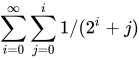
whose reciprocals contain arbitrarily long arithmetic progressions (an arithmetic progression of length n and common difference 1 starts after 1/2^n). But this series converges, bounding above by \sum n/2^n (which converges by the integral test).
So the comment on the converse seems to be in error; any thoughts?
- Agreed. The page is in error, and should be corrected. 67.191.231.108 23:37, 21 August 2007 (UTC)
Sorry
[edit]Hey sorry about the multiple edits with typos -- I am new. —Preceding unsigned comment added by Mackold (talk • contribs) 16:46, 18 October 2008 (UTC)
Decimal reps
[edit]"Another known fact is that the set of numbers whose decimal representations exclude 7 (or any digit one prefers) is small. That is, for example, the set

is small. (This has been generalized to other bases as well.)" —Preceding unsigned comment added by 74.195.135.62 (talk) 00:42, 5 February 2011 (UTC)
How can the set of numbers whose decimal representation excludes 7 possibly be a small set?? This seems absurd and isn't cited. In fact, to me this must necessarily be downright wrong since I could arbitrarily take out any digit of choice, and call that my first set, then move on to the next digit and call that my second set, etc. until i've done this with each digit. Since each of these numbered sets would be small sets, their sum must be a small set. And yet, this sum would contain all of the natural numbers and then some. Since that would necessarily be a large set, we have a contradiction. Not to mention that this purported "fact" has the problem that the set you are subtracting from the natural numbers is smaller than the set that is left. I'm removing this section until its cited. Its possible I'm simply mistaken, or unclear on the definition but without being substantiated this unbelievable "fact" really is unbelievable. —Preceding unsigned comment added by 74.195.135.62 (talk) 00:40, 5 February 2011 (UTC)
- It is correct, you misunderstood. A number like 1234568790 won't be in any of those small sets. --83.23.218.208 (talk) 16:58, 3 July 2011 (UTC)