


Talk:Isomorphism theorems
Add topic | This  level-5 vital article is rated C-class on Wikipedia's content assessment scale. level-5 vital article is rated C-class on Wikipedia's content assessment scale.It is of interest to the following WikiProjects: | ||||||||||
| |||||||||||


Noether's Isomorphism Theorems
[edit]Editor Sbilley made edits adding Noether's name to most references to the isomorphism theorems. The edit summary says that the editor "was tasked" with updating the name; tasked by whom, exactly? Has this been discussed and consensus reached? Further, the proffered justification for the changes is that in Math "it is typical to attribute theorems to the original author". Things are called what they are called, not what they ought to be called (Quadratic Reciprocity is called "Quadratic Reciprocity", not "Gauss's Law of Quadratic Reciprocity", for example). I am not familiar with any standard reference to the isomorphism theorems that calls them "Noether's Isomorphism Theorems". Even if the attribution is accurate, if the theorems are not called that in the literature, then they should not be called that in the article; an attribution is certainly in order, or even a brief mention in the lede, but it seems to me that the kind of wholesale re-branding that this editor is doing here is ill-advised at best, and in any case needs consensus. Magidin (talk) 22:08, 27 October 2016 (UTC)
This naming convention has a long sorted history. Karen_Smith_(mathematician) gave the Noether lecture at the Joint Meetings of the American Mathematical Society and the Mathematical Association of America's in January of 2016 about covering the history. Her argument was very well received that we should be using the name "Noether's Isomorphism Theorems" to follow the standard naming conventions for important contributions in math. She also discussed several sources that have been using this name going back to the time shortly after Noether's paper was originally published. Here are some sources that refer to these theorems as Noether's Isomorphism Theorems:
(1) "Graduate Algebra: Commutative View" by Louis Rowen.
(2) "Commutative Algebra" by A. Altman
(3) "Algebraic Topology" by Edwin Spanier
(4) "Algebra: Rings, Modules and Categories I" by Carl Faith
(5) Check out also the article entitled Noether Isomorphism theorem in the world heritage encyclopedia http://www.gutenberg.us/articles/noether_isomorphism_theorem Sbilley —Preceding undated comment added 23:04, 28 October 2016 (UTC)
- Thank you for the response. I take the introduction to mean that you were not so much "tasked", as that you decided to take it upon yourself, inspired perhaps by the talk in question. As such, I would say that this needs to be discussed, probably at the Wikipedia talk:WikiProject Mathematics page, rather than simply done. If adopted, this would require a lot more changes than just in this page. I will also note that the talk said we should be using the name, not that we do; the page should reflect common usage. I'm at home, but I will look up in my bookshelf to provide specific instances. I think that the name "Noether's Isomorphism Theorems" is simply not widespread enough to warrant the kind of wholesale change you made. I support adding attribution, and perhaps even a section on the name, but this is a sort of advocacy-through-naming-in-Wikipedia that does not seem warranted. We can take it to the WikiProject, if you wish, given the low traffic here, before determining what the consensus is. Magidin (talk) 21:12, 29 October 2016 (UTC)
- Here's from my bookshelf: Groups and Symmetry by M.A. Amstrong; "Isomorphism Theorems". Representation Theory of Finite Groups and Associative Algebras by Curtis and Reiner; "Fundamental Theorem on Homomorphisms". Abstract Algebra, by Dummit and Foote; "Isomorphism Theorems". Basic Algebra by Jacobson; "Fundamental Theorem of Homomorphisms of Monoids and Groups". Algebra by Thomas Hungerford; "Isomorphism Theorems". A course in Group Theory by John Humphreys; "Homomorphism Theorem". Universal Algebra by Grätzer; "Isomorphism Theorems". Algebra by Serge Lang; no name given. Groups and Geometry by Peter Neumann, Gabrielle Stoy, and Edward Thompson; "Isomorphism Theorems". An introduction to the theory of groups (4th Ed) by Joseph Rotman; "Isomorphism Theorems". A course in the theory of groups (2nd ed) by Derek Robinson; "Isomorphism Theorems". Advanced Modern Algebra (2nd ed) by Joseph Rotman; "Isomorphism Theorems". Elements of Algebra by John Stillwell; "Isomorphism theorem for groups". None of my books refer to them "Soether Isomorphism Theorems". Magidin (talk) 16:37, 3 November 2016 (UTC)
- @Magidin: You're wrong about Robinson, look at the name of the section. Njsnyder (talk) 16:59, 31 October 2017 (UTC)
General case
[edit]In the second isomorphism theorem, it says that is the collection of equivalence classes but what follows has no sense. It should probably be
![{\displaystyle [B]^{\Phi }}](https://wikimedia.org/api/rest_v1/media/math/render/svg/3388e546ae462dc19269cbc37063c029e9a26e5e)
![{\displaystyle [B]^{\Phi }=\left\lbrace K\in A\mid \exists \,b\in B,\;\Phi \cap (K,b)\neq \emptyset \right\rbrace /\Phi }](https://wikimedia.org/api/rest_v1/media/math/render/svg/ca1bae42a76e444d6267bfaa5bd587ce2d47ef0b)
Noix07 (talk) 16:22, 17 October 2018 (UTC)
- Ah, now I get it, i previously thought the slash meant "so that". so that... Noix07 (talk) 16:29, 17 October 2018 (UTC)

File:Diagram_of_the_fundamental_theorem_on_homomorphisms
[edit]Hi D.Lazard, could you clarify what is not clear on the removed diagram: https://en.wikipedia.org/wiki/File:Diagram_of_the_fundamental_theorem_on_homomorphisms.svg at https://en.wikipedia.org/w/index.php?title=Isomorphism_theorems&oldid=976843241 ? An extremely verbose explanation can be seen at: https://math.stackexchange.com/questions/776039/intuition-behind-normal-subgroups/3732426#3732426 I was no sure how much to write down on that caption. I believe this diagram can be much more useful to non-experts than existing diagrams on the page.Cirosantilli2 (talk) 11:47, 26 February 2021 (UTC)
- If you use an arrow diagram, isomorphism must appear as arrows, and you must specify which are the exact sequences, which are the commutative triangles and squares. So you must have an exact sequence, say on a line,
- above the exact sequence
- connected by vertical sequences
- and
- With such a diagram, the caption could be
Expression of isomorphism theorem A in terms of an arrow diagram: the aligned sequences of arrows are exact sequences, and the square is a commutative diagram.
- It is possible to orient the diagram differently, for having horizontally. This has the disadventage to have the longest sequence vertically (however, because of the places of figures in WP, this may also be an advantage). The advantage is a better emphasize on the starting arrow. So, the orientation is a matter of taste.
- Note that this diagram is valid only for additive (commutative) groups, vector spaces and modules. D.Lazard (talk) 17:41, 26 February 2021 (UTC)
- By the way, the other isomorphisms theorems can also expressed and even proved in the same way. For example, for the theorem B, one can write the two exact sequences
- the arrow beimg defined by Then, the sequences are connected by natural vertical arrows, and the snake lemma gives the exact sequence (the part of the long sequence that is above the first sequence consists only of zero modules).
- which is theorem B.
- The other theorems can certainly be expressed similarly, but presently I do not remember which diagrams must be drawn.
- This formulation of the isomorphism theorems deserve clearly to be explained in a separate section. D.Lazard (talk) 16:02, 27 February 2021 (UTC)







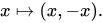

Clarification of universal algebra version of Thm B
[edit]Note that writing for the congruences of , the theorem says the following two ways of quotienting by give isomorphic results:


- Pulling back to by restriction, then quotienting in (this is )
- Pushing forward all the way to and taking the algebra generated by the image (this is )


(not adding to page because it might violate WP:NOR, feel free to steal if I'm mistaken) 77.137.68.75 (talk) 19:36, 22 August 2023 (UTC)
- Correction: the second point should read:
- Taking the quotient of any subalgebra of containing and contained in the closure of under (this closure can be seen as the preimage of under the quotient map)
- 77.137.68.75 (talk) 08:59, 27 August 2023 (UTC)

The *ring*-theoretic isomorphism theorems are *rng*!!
[edit]> Furthermore, (a subring containing ) is an ideal of if and only if is an ideal of .[1]


This is incorrect because a subring contains the unit element from the parent ring , so cannot be an ideal of unless it is the unit ideal and .


[EDIT] I've followed the reference, and the cited textbook does not assume that a ring has an identity. The modern terminology for that object is a Rng (a ring without an identity). So the article needs to be corrected to be in line with modern terminology. Svennik (talk) 15:57, 6 June 2026 (UTC)
- It is not a question of "modern" vs. "old" here; there are actually a number of conventions at play. The convention you name assumes not only that rings have a multiplicative identity, but also that subrings share the identity (and therefore that morphisms are unital, sending the multiplicative identity to the multiplicative identity). From the Universal Algebra point of view, these structures are usually called "rings with identity", with the identity being given by a nullary operation. But in Universal Algebra, you don't work with ideals but with congruences, so it is a wash. By contrast, there is a convention where rings are assumed to be unital but morphisms are not, which means that subrings are not required to include the identity of the parent ring. Finally, there is vast, current literature in which rings are not assumed to have an identity (for example, the rings that functional analysts work with). I agree that it would be good to clarify here, but it is not "incorrect" or "not modern". Magidin (talk) 16:27, 6 June 2026 (UTC)
- Nevertheless , MOS:MATH#Algebra state that in Wikipedia, all rings and ring homomorphisms are unital. This rticle must follow this convention. So, I have removed this sentence, since I am unable to provide a correct version that follows Wikipedia rules and is worth to be included. If you are able to provide a correct and sourced version, please add it.
- Also, as stated, the theorem were wrong for non-commutative rings. I have therefore changed "ideal" into "two-sided ideal" almost everywhere. D.Lazard (talk) 16:42, 6 June 2026 (UTC)
- I've changed every occurrence of "ring" to "rng", and added a note explaining the terms. It was the easiest change I could think of. I hope it's not rng! Svennik (talk) 17:21, 6 June 2026 (UTC)
- I've added the removed text back in, and removed the words "modern" and "old" from the terminology explanation. Svennik (talk) 17:30, 6 June 2026 (UTC)
- I've changed every occurrence of "ring" to "rng", and added a note explaining the terms. It was the easiest change I could think of. I hope it's not rng! Svennik (talk) 17:21, 6 June 2026 (UTC)
- Thanks. I stand corrected. Svennik (talk) 19:40, 6 June 2026 (UTC)
- Wikipedia is aimed for a large audience. Since rings are much more considered than rng in mathematics, one must keep a section on the isomorphisms theorems for rings. So, I'll revert your edits. Feel free to add a section on rngs, which may be very short, by restricting it to the differences between rings and rngs. Hwoever, care is needed to distinguish rng from rng, which is a disambiguation page. Also, two-sided rng ideals and kernels of rng homomorphisms seems to be, presently, not defined in Wikipedia, and, so, other articles must be edited for having blue links for these concepts. D.Lazard (talk) 20:50, 6 June 2026 (UTC)
- Citing Dummit & Foote here is wrong because their "ring" is really a rng, so the article misrepresents its source. Using "Rng" looked like the simplest change to preserve the "ring" section's content while only changing one term. Every rng is a ring, so the theorem is a bit more general that way. I think my approach is easy for the reader since all of the concepts needed to state the isomorphism theorems are defined the same way over rngs as over rings. Svennik (talk) 14:51, 7 June 2026 (UTC)
- It is possible that Dummit & Foote is not a good source here (I never read this book) then we may change the source, since they are plenty of books that state the isomorphism theorems for rings. It is true that every ring is a rng, but it is also true that rings are used in almost all branches of mathematics, while rngs are rarely used outside pure algebra. For the many people who know rings and not rngs, the need of learning what is a rng and that a ring is a pecial s sort of rng is certainely confusing. So, a section on rings is undoubtly needed. This is why I suggested you to write a section on rngs. However, rngs are covered as a special case in § Universal algebra, and I see no reason for having a section on rngs, when there is no section on monoids, which are much more used. D.Lazard (talk) 18:50, 7 June 2026 (UTC)
- Citing Dummit & Foote here is wrong because their "ring" is really a rng, so the article misrepresents its source. Using "Rng" looked like the simplest change to preserve the "ring" section's content while only changing one term. Every rng is a ring, so the theorem is a bit more general that way. I think my approach is easy for the reader since all of the concepts needed to state the isomorphism theorems are defined the same way over rngs as over rings. Svennik (talk) 14:51, 7 June 2026 (UTC)
- Wikipedia is aimed for a large audience. Since rings are much more considered than rng in mathematics, one must keep a section on the isomorphisms theorems for rings. So, I'll revert your edits. Feel free to add a section on rngs, which may be very short, by restricting it to the differences between rings and rngs. Hwoever, care is needed to distinguish rng from rng, which is a disambiguation page. Also, two-sided rng ideals and kernels of rng homomorphisms seems to be, presently, not defined in Wikipedia, and, so, other articles must be edited for having blue links for these concepts. D.Lazard (talk) 20:50, 6 June 2026 (UTC)
References
- ↑ Dummit, David S.; Foote, Richard M. (2004). Abstract algebra. Hoboken, NJ: Wiley. p. 246. ISBN 978-0-471-43334-7.