


Talk:Inline skates
Add topic | Inline skates has been listed as one of the Engineering and technology good articles under the good article criteria. If you can improve it further, please do so. If it no longer meets these criteria, you can reassess it. Review: August 4, 2025. (Reviewed version). |
| This is the talk page for discussing improvements to the Inline skates article. This is not a forum for general discussion of the subject of the article. |
Article policies
|
| Find sources: Google (books · news · scholar · free images · WP refs) · FENS · JSTOR · TWL |
| Archives: 1 |
| This  level-5 vital article is rated GA-class on Wikipedia's content assessment scale. level-5 vital article is rated GA-class on Wikipedia's content assessment scale.It is of interest to the following WikiProjects: | |||||||||||||||||||||||||||||||
| ||||||||||||||||||||||||||||||||


 |
| |||||||||||||||||||||||||||||||||||||||||||||||||||||||||||||||||||||||||||||||||||||||||||||||||||||||||||||||||||||||||||||||||||||||||||||||||||||||||||||||||||||||||||||||||||||||||||||||||||||||||||||||||||||||||||||||||||||||||||||||||||||||||||||||||||||||||||||||||||||||||||||||||||||||||||||||||||||||||||||||||||||||||||||||||||||||||||||||||||||||||||||||||
 | Inline skate wheel setups was merged into this article. The discussion was closed on 24 January 2013 with a consensus to merge. The original page is now a redirect to this article. Its history now serves to provide attribution for the content in this article, and it must not be deleted as long as this article exists. |
Rewriting this article
[edit]I moved prior discussions to the first archive page. I will use those discussions to help with this rewrite. I removed the citation-needed template on the article placed in May 2013, and added an under-construction template instead. I intend to do the following:
- Reorganize this article to be more like modern Wikipedia articles
- Add Types of Inline Skates, and other relevant sections, including but not limited to: safety and protective gear, cultural impact, etc.
- Try to find proper references for paragraphs. And tag places needing additional references for more people to help with.
- At the end, I will reduce the lengthy discussions on wheel setups into summaries, and move the bulk of setup content back to the original Inline skate wheel setups page. Yes, I am aware that that page was merged into this article in the past. But that was then. This is now. Things will be different when the rewrite is done.
- I may shuffle text between this article and its sibling article inline skating during this rewrite.
- There will be proper image thumbnails for most of rewritten text. I will first revise/rewrite/expand text. Images will be added only after text is consistently changed. In particular I have curated more than enough images for every paragraph of the History section and Parts section.
Initially: Fred Hsu (talk) 02:06, 19 November 2024 (UTC). Last edited: Fred Hsu (talk) 14:14, 1 December 2024 (UTC)
Key timestamped versions of this article:
- original version on 2024-11-17 before I got started
- rewrote the lead section, with wiki links and references
- fixed and archived all citations
- 11/25: finished History - Development of wheeled skates
- 11/28: finished History - Development of roller skates
- 11/30: finished History - Adoption of ball bearings
- 12/02: started to add thumbnail images
- 12/03: provided patent drawings for the first two subsections of History
- 12/17: further development of inline skates
- 12/26: finished subsection on "modern" inline skates
- 12/29: begged lots of people to make available their images
Last edited: Fred Hsu (talk) 03:46, 30 December 2024 (UTC)
One month into this rewrite, I realize that I've expanded the history section way beyond what is needed for "inline skates". However, as I researched the history online, bought books, read them, searched Google Books, and made notes, I realized that there was no complete nor accurate accounting anywhere. I amassed extensive notes enumerating incorrect myths and information I stumbled upon. So now there needs to be a place where all keywords and names may be found, and theirs records set straight. The result was the ever-growing number of subsections annotated above. And it's not done. Next is the "precursor to modern inline skates". And then finally the "development of modern inline skates" will recount the story of Rollerblade.
I will finish writing the History section here. But I will move it out into its own article, once written. At that time, the History section will be replaced with an abridged version. Fred Hsu (talk) 04:07, 20 December 2024 (UTC)
The whole History section is done. But there will be further refinement on the 'modern' subsection for a while. I am also getting additional pictures for illustration. Fred Hsu (talk) 17:33, 26 December 2024 (UTC)
Now onto: Types:
- 2025-01-02: but first, add a short Anatomy and Function section which introduces basic names and functions needed for Types and Parts
- 1/6: types lead section done. Added a Recreational skates subsection.
- 1/8: many people I reached out to not only agreed to donate their images, but also cared enough to follow up with a confirmation email to The Volunteer Response Team, to cement their generous sharing
- 1/12: finished the aggressive skates subsection
- 1/20: finished the hockey skates subsection
- 1/25: finished the speed skates subsection
- 1/29: furnished sections with newly-uploaded images
- 2/04: finished the urban skates subsection
Last edited: Fred Hsu (talk) 03:37, 5 February 2025 (UTC)
Now onto: Frames
- Parts as a section already exists with a few subsections. Version prior to the rewrite of this section
- 2/10: Boots done
- 2/12: Non-standard frames
- 2/17: 165mm and 195mm frams
- 2/23: UFS frames, plus lots more aggressive and UFS images
- 3/3: Trinity frames
- 4/28: Heel brakes
Last edited: Fred Hsu (talk) 01:47, 4 March 2025 (UTC)
Now onto: Wheels
- 3/10: Wheels | Polyurethane wheels
- 3/27: Wheel structure
- 3/30: Images for wheel structure, and split into structure vs hubs
- 4/7: Wheel diameter and profile
- 4/18: Wheel hardness and deformation
- 4/20: Dual density wheels
- 4/24: Wheel rebound
- 4/26: Rolling resistance
- 4/27: The Wheels section is now complete
- 5/1: well... added one last section: Wheel rotation
Last edited: Fred Hsu (talk) 02:25, 2 May 2025 (UTC)
Section: Bearing
- 5/5: Setups
- 5/8: Assemblies
- 5/10: Bearings allow wheels to spin freely
- 5/17: Purpose-built bearings
- 5/22: Bearing selection
- 5/25: Bearing shields
Section: Skate Setup
- 6/1: Bearing alignment
- 6/15: Axial play to support side load
- 6/19: Bearing preload
- 6/21: Spacer length
Section: Wheel Setup
- 6/22: Flat setup
- 6/25: Rockered setup
- 6/26: Natural rocker
- 6/26: Front rocker
- 6/28: Hi-lo setup
- 6/29: Alternatives to hi-lo
- 6/29: Forward lean with a rocker
- 6/29: anti-rocker setup
- 6/30: freestyle setup
The rewrite is done. Here is the long article after clean-ups.
Now the splitting process starts.
Last edited: Fred Hsu (talk) 00:52, 2 July 2025 (UTC)
Temporary Repository for Unused Materials
[edit]I am using this section to park temporarily removed materials which I will eventually re-integrate back into the article.
From the lead section:
Some, especially those for recreation, have a rubber "stop" or "brake" block attached to the rear of one or occasionally both of the skates so that the skater can slow down or stop by leaning back on the foot with the brake skate.
Fred Hsu (talk) 03:06, 20 November 2024 (UTC)
From the History section:
Louis Legrange of France created an inline design in 1849.[1] Legrange designed the skates for an opera where a character was to appear to be skating on ice.[1]The skates were problematic and unsuccessful as the wearer could not turn nor could they stop.[1]
- The book has this entry: "In 1849, Loius Legrange of France made a pair of in-line skates for a character in an opera. The opera character was supposed to be on ice skates. Legrange used spools as wheels. But Legrange's skates had the same problems as Merlin's skates had. The actor could not turn or stop".
- Unless this same invention in 1849 shows anything new in addition to the 1760 Merlin skates, I don't think it's worth listing in this article.
- I'll do more research later. If I can find pictures of additional info, I'll think about adding this back
At some point between 1895 and 1899 the UK engineering company D. Napier & Son made Ritter "road skates", which had two comparatively large wheels, front and back, on each skate.[2]
- It's not clear how this relates to today's inline skates. It's one of many branches of roller skates. I found only a few pictures online. I'll reconsider this entry later.
- I can't easily tell the scale of these skates. They appear to be platforms for shoes to stand on. But I am not yet sure.
- Perhaps all of the two-wheel skates can be mentioned together (think Rocket Skate")
In September of 1953 an advertisement by the "Rocket Skate Company" for two wheel inline skates appeared in Popular Science. They were briefly described in the April 1950 issue of Popular Mechanics and again in the April 1954 issue of Popular Science in the section called "New Ideas from the Inventors".[3]
- Another two-wheel skate. This one has normal-sized wheels, compared to the D. Napier one.
- See pictures online such as this one
- Note how modern websites tend to attach "roller skate" to these past ads. The ads themselves say nothing of roller skates. See the text version of the quoted Popular Science page.
- I'll think about how to incorporate it back into the article.
The first U.S. patent for modern in-line skates, designed to behave like ice runners with individually sprung and cushioned wheels, was granted in July 1953 to Ernest Kahlert of Santa Ana, CA.[4]
- The Kahlert skate from 1953 is well after Shaler's 1860 skate which already had a frame with sides, and inline wheels lined up inside the frame.
- As mentioned in references before 1860 that I've already added, Kahlert's is not the first "inline" skates. All wheels skates started inline well before the 1800s. I am not sure I see the importance of this invention. But I'll come back to it later.
- Better OCR-ed text and original scanned patent doc can be found at Espacenet.

In 1978, the German branch of SKF presented the "Speedy"-System, but the product was cancelled less than one year from market, as the management did not want a consumer product in the portfolio of the company.[citation needed]
- Need more textual context about the relevance and importance this played in the history of inline skates.
In 1969, the UK toy company Mettoy produced "Skeelers" (after the Dutch word for ice skaters), inline skates with 3 large wheels, which despite wide promotion, only had limited sales. They were originally developed for Russian hockey players and speed skaters, and in 1972, were unsuccessfully marketed in Canada by Mountain Dew. The wheel frame in these Skeelers are reminiscent of the 1860 wheel-skate from Reuben Shaler.[5]
- I removed Mettoy paragraph and image - I can't get right's owner to confirm cc-by-sa. This paragraph is not useful without an image. There is a only the one single news article to reference.
From the External Links section:
These two links to wheel setups can be reused, but they should be cited inline with text. Showing these are general external links doesn't make sense. I'll get to these when I rewrite the wheel setup section.
References
- 1 2 3 McKenna, Anne T. (1999). Aggressive In-Line Skating. United States: Capstone High/Low Books. ISBN 9780716815822. Retrieved 2024-11-21.
- ↑ Wilson, Charles; Reader, William (1958). Men and Machines: A History of D. Napier & Son, Engineers, Ltd., 1808-1958. London: Weidenfeld and Nicolson. pp. Page 58 and facing Page 45. Retrieved 2024-11-21.
- ↑ "PopSci Archive Viewer - Popular Science". Popular Science. Archived from the original on 20 February 2014. Retrieved 15 September 2014.
- ↑ US 2644692, Kahlert, Ernest, "Roller skate", published 1953-07-07
- ↑ "Mettoy's ad on Skeelers". The Hockey News. Vol. 25, no. 34. 1972-08-01. Archived from the original on 2024-11-22. Retrieved 2024-11-22.
Unsourced materials from wheel setup
[edit]I am moving unsourced materials from the article into this section, as I now rewrite the Wheel Setup section. There are lots of useful information, some I know to be true from personal experience, much can be evidenced from sources I have already collected. The remaining ring true, but can't be used until someone or I find references for them. These unsourced materials will be moved here. For reference, this is the state of the article on 2025-06-21. Fred Hsu (talk) 01:05, 22 June 2025 (UTC)
- (flat setup) This setup also allows for a powerslide, an advanced braking method.
- It's not clear that a slightly-rockered setup can't powerslide. The skate is deeply inclined, and wheels are touching ground at an angle. Wheels in a slghtly-rockred setup can all touch the ground during a slide. After all, folks on Wizard skates with its default rockered setup powerslide all the time. Fred Hsu (talk) 02:50, 22 June 2025 (UTC)
- Perhaps cite Thierstein - he explicitly talks about flat setup and hi-lo (also a flat) setup being helpful for learning to slide. Fred Hsu (talk) 18:58, 22 June 2025 (UTC)
- (flat setup) Aggressive skates are sometimes sold with flat setups, but with a small space in the middle for grinding. With aggressive skates, the flat setup obviously leads to better control on the ground when either accelerating on a push or decelerating on a drag because of increased traction. It also grants a faster speed, translating to faster grinds, more powerful pumps in a skate ramp, and higher heights ('airs') off the edge of a vert ramp. Indeed, flat setups are quick save for the likelihood that they will be heavier and the two standard central wheels tend to 'bite' when grinding. Similar to skateboarding in certain respects, 'biting' is a common hindrance during grinding whereby friction between the wheel(s) and surface it comes into contact causes the wheel(s) then entire boot to suddenly reach a halt and the momentum throws the aggressive inline skater off the rail or ledge. Again, the aspect of wheel profile is key here. A harder wheel on a flat setup will slide and 'bite' less than a softer wheel. Likewise an elliptical profile (Undercover's Dustin Werbeski 'super bullet' wheels for example) possesses less surface area hence it will not bite as much either. Adjusting to a flat setup can even out shock when landing jumps. In doing so, an inline skater's hardware like wheels, bearings, axles and the frame itself are twice as much to be spared damage.
- this paragraph packs a lot of information. The discussion about grinding, biting, grindwheels, etc. are already covered elsewhere in the article when talking about aggressive skates in general. These have little to do with the flat setup.
- the "less damage" with a flat setup is already covered in the flat setup rewrite on why four wheels shoulder landing impacts better than say two.
- but there is a genuine need to show an aggressive frame with two smaller middle wheels forming a flat setup, as yet another variation of flat. But I need to find 1) a picture to illustrate this, and 2) get a source. Fred Hsu (talk) 20:44, 22 June 2025 (UTC)
- (full rocker) Full rockers are used by skaters who favor maneuverability when skating on flat ground. Freestyle skaters, freestyle slalom skaters and artistic inline skaters tend to use this setup. Inline hockey players no less can customize their wheels to implement this setup (especially those who favor nimble change in direction over sheer speed during a match). This setup is called "crescent" or "banana" because it is curved, and mimics a curved ice blade profile. On flat ground this setup will only have 1–2 wheels touching the ground at any one time. This makes the skate much easier to pivot but lacks stability so it is harder to balance on. To attain balance when learning to skate a full rocker, it is recommended that pressure and weight are deposited on either the two middle wheels or the two wheels in the back. Avoid applying pressure on the two front wheels when taking strides since this is what will cause instability. In addition, a full rocker is slower than a flat setup in terms of top speed. Worst of all at high speeds, skates with a full rocker setup can experience a speed wobble, where they oscillate uncontrollably. The skater may lose control and crash to the ground.
- this paragraph is no longer concise as Mark Kempton first wrote it in a separate article that got merged into Inline Skates. See what he initially wrote in 2007. I am using his original version in my rewrite of this wheel setup section. If needed, in the future, the "learning tips" can be retrieved from this parked material. Fred Hsu (talk) 03:55, 23 June 2025 (UTC)
- (Mythical: 'TriDi' Hi-Lo setup) Another variant of the setup in which there are three diameters of wheels. It is supposed to emphasize the same benefits as the HiLo system but with greater maneuverability due to the smaller front wheels. The configuration is 72 mm (2.83 in), 76 mm (2.99 in), 80 mm (3.15 in), 76 mm (2.99 in). It allows one to pivot on the third wheel similar to the brand Wizard Skates. This system is also used by some hockey skaters as it pitches the foot slightly forward.
- I don't know who wrote this. I don't care to even look it up in the edit history. This is not a Hi-lo anything. It's a full rocker if you try to skate on this setup. Nobody can skate on a single wheel (the presumed third wheel). With this mythical setup, you'll end up gliding on the 2nd and third wheel together, and the frame gets a slight forward lean instead. This is not a thing. Also see this article from Endless debunking this urban myth. Fred Hsu (talk) 23:54, 23 June 2025 (UTC)
- I see. This was trying to describe what Thierstein calls "full hi-lo rocker", with the emphasis on the fact that this is a "full rockered" setup with a forward-leaning pitch like created by the hi-lo (flat) setup. I will rewrite it shortly. The smaller front wheels are not what enables maneuverability - it's the forward lean that confers desired traits of hi-lo. Otherwise, this is just a rockered setup as Endless pointed out. Fred Hsu (talk) 00:14, 24 June 2025 (UTC)
- (Aggressive Hi-Lo setup) A few aggressive skate frames (most notably Rollerblade's Switch Frame, Ground Control's Bullet Frame, Oysi Frame and Joe Atkinson Sola Frame) are designed so that there are two big outer wheels, and two small inner wheels, rockered so that they all touch the ground. This gives the benefits of a flat setup, while keeping the frame as low as the height of the smaller inner wheels. It also retains room for an H-block in the center. But out bigger outer wheels give some of the benefits bigger wheels offer such as speed and stability.
- I understand what this is. But unfortunately I haven't collected any pictures of aggressive frames with this setup. The name "Aggressive hi-lo setup" is made-up. Until someone finds better references to cite and write, it will be parked here. Fred Hsu (talk) 16:03, 29 June 2025 (UTC)
- (Tri-rocker setup) Tri-rocker (not to be confused with the 3-wheeled frame/chassis seen on Tri-Skates) is used by some aggressive skaters. It is another method of making grinds easier. A frame with a tri-rocker setup has only one wheel in the middle, either in the second wheel position or in the third wheel position, depending on what kinds of grinds the skater plans on doing. The remaining axle has an anti-rocker wheel, a special grind block, or is just left empty. The purpose of a tri-rocker setup is to give the skater good speed and maneuverability, like on a flat setup. But because of the extra space, grinding is also a little easier than a flat setup.
- I can't find references for this. There are a few Reddit posts - those can't be cited. There are a couple Youtube videos mentioning this. But I am not sure that's enough. Anyone wants to dig up more on this? Thanks. Fred Hsu (talk) 02:57, 1 July 2025 (UTC)
Useful images not incorporated during the rewrite
[edit]This is not a gallery. This is a list of pictures that may be useful for illustrating parts of this article.
 One wheel removed showing axle and bearings
 bearings
 Frame and wheels
 5-wheel speed skating frame
 Inline skate wheels (hi-lo 80mm/76mm)
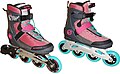 Soft boot
 Falling with protection gear
 Falling at a slalom skating event
 Skating protection gear
 Protective gear: helmet, elbow pads, wrist guards, and knee pads.
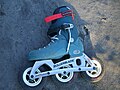 Off-road inline skates
 Police on skates
 Boot detachable from the inline frame


.jpg)


- Will they have an use here o somewhere else? (by 45.232.105.68 in this edit)
- I will use many of them in near-future edits in child articles I've split out. Fred Hsu (talk) 00:50, 31 July 2025 (UTC)
Article looks good take down template
[edit]The article looks well prepared and informative, the tag can be removed. Hausa warrior (talk) 12:53, 30 March 2025 (UTC)
- Thanks for the vote of confidence. The reason why the templates remain at the top is because the "Parts" section and the "wheel setup" section have not been processed. But I've stuck sectional templates there already. So perhaps it's time I retire the article template. I'll continue to work on the last two sections. Cheers. Fred Hsu (talk) 00:02, 31 March 2025 (UTC)
Very long
[edit]This article is too long to read and navigate comfortably. When the tag was added, its readable prose size was 18,204 words. Consider splitting content into sub-article or condensing it. The article size impacts usability in multiple ways: Reader issues, such as attention span, readability, organization, information saturation, etc. (when articles are large). Total article size should be kept reasonably low, particularly for readers using slow internet connections or mobile devices or who have slow computer loading. Some large articles exist for topics that require depth and detail, but typically articles of such size are split into two or more smaller articles.
| Word count | What to do |
|---|---|
| this article 18,204 words | Needs to be divided or trimmed |
| > 15,000 words | Almost certainly should be divided or trimmed. |
| > 9,000 words | Probably should be divided or trimmed. |
— Isaidnoway (talk) 02:45, 10 April 2025 (UTC)—
- Thanks for the suggestion. Splitting this article into a few child articles has been part of the plan during this rewrite. The rewrite has not yet been done. Premature-splitting would cause hardship for citations.
- Please scroll back up for discussions.
- I am going to replace the split template with the rewrite template I'd been using until recently, for now.
- Cheers. Fred Hsu (talk) 00:53, 11 April 2025 (UTC)
3 months on...
So, after a few months the article was completed, and then split. The main article is still long, after the first pass at reducing main text into summaries. Here are the stats for the main article in July 2025:
- Prose size: 88,738 (bytes)
- Word count: 13,846 (words of the main text)
- References size: 37,532 (bytes)
Cheers. Fred Hsu (talk) 01:29, 22 July 2025 (UTC)
Galleries
[edit]I suggest group images in galleries for each section. It would be more readable in portrait/mobile and desktop 45.232.105.68 (talk) 12:47, 20 May 2025 (UTC)
- With the exception of only a few sections, images in each section are meant to illustrate individual paragraphs they immediately preceded. These are not gallery images. Most are illustrations for concepts discussed in a paragraph. About half of these images were tailor-made for paragraphs, after each paragraph was written. Moving them to a gallery serves no practical purposes.
- I do agree that in the present form, they are more usable read on a desktop. On a phone, not so much. But moving them out into a gallery is even worst than they currently are, for phones, I think. On phones, right now an illustration shows up immediately before the text it illustrates. You may not like it that way. But I wish there is a better way. What do you think?
- In a few cases, I had to pile a bunch of images at the top of a section, and let them flow down (on a desktop view) on the right side of paragraphs. This happens where there are not enough text to distribute images immediately preceding individual paragraphs. This has been an issue since the beginning of Wikipedian time.
- But regardless of gallery vs no-gallery, please don't simply remove all pixel specifications from thumbnails. We can debate / adjust individual sizing of thumbnails. But simply removing them all doesn't make anything better. As a starter, look at the two lead images after your first change. The pink Impala skates became huge compared to the urban skates. I don't know that that is better. For another example, look at the Rotations section. Your changes made three different rotation diagrams show up in different scales, while they all illustrate the same two pairs of skates. This is as viewed on a desktop where I edit the article. Can't possibly make the type of edits I make on my phone. I have like ten tabs open given any one edit.
- But it is possible that I am missing something. Help me understand the purpose of removing all pixel sizing from images. I am happy to learn and adapt. Cheers. Fred. Fred Hsu (talk) 23:05, 20 May 2025 (UTC)
- One benefit of removing pixel size is lightening the weight of the page . 45.232.105.68 (talk) 14:59, 22 May 2025 (UTC)
- Interesting. I did not know that. But don't worry, I'll split this article into many child articles when I am completely done writing it. It's ten times longer that it should be. It's now a book. But I can't split it until I am done rewriting. That would be a logistical nightmare for many reasons, chiefly citation nightmare. Fred Hsu (talk) 02:19, 23 May 2025 (UTC)
- One benefit of removing pixel size is lightening the weight of the page . 45.232.105.68 (talk) 14:59, 22 May 2025 (UTC)
- For now I am working on mostly cosmetic edits, although it is primarily an expansion and revision period. Besides the fact that cosmetic changes are important, it is hard to know if it is best to work on the present revision, and hold off until it is completed. Glazer029 (talk) 2:23, 3 June 2025 (UTC)
Cleanup
[edit]I came to this article because it had two "thumb" parameters in file markup, and as long as I was fixing that, I fixed a bunch more things. I hope it's not controversial, but by normal Wikipedia standards, there is supposed to be a nonbreaking space before unit abbreviations, and that includes mm, so I painstakingly did that throughout the article. Additional changes that should be made:
- numbers of wheels should use a times sign (×) not an x, for example, 4x110 mm should be 4×110 mm.
|others=parameters are not used properly and should be pulled out of cite templates.
Respectfully, —Anomalocaris (talk) 07:25, 27 June 2025 (UTC)
- Dude. I appreciate the help. But "4x110mm" is how the industry writes it, in the US. Nobody uses the "times sign" for 4x110mm. Google it. We need to stop thinking of of it as "4 times 100 mm wheels", but as a pre-made label. 4x80 is how the industry label a type of frame. Nobody will be able to find what they want by in-browser search if the article uses "4×110". See .
- I noted that European shops will often use "4x80 mm". But US shops seem to consistently use "4x80mm". This article is written with US English - I don't use colour. I write color. So it seems logical to write "4x80mm". Again, the mm here doesn't just mean wheels of 80 mm diameter. It is a pre-made label. Google it. See , , , etc.
- But thanks for various changes to citation templates. Yeah, I was abusing the "others=" param in the web template. But I am not sure your leaving "others=...." outside the templates is the right solution. I will research and correct.
- I am going to revert all at first, since you made all changes in one sweep. I am going to immediately re-apply back all non-controversial changes you made: including double "thumb", etc. I'll fix the citation template issues (e.g. others=) next. Then I am going to figure out how to leave comments on the article so people don't globally replace 4x80mm all again.
- Cheers. And thanks. I do appreciate the help. Fred Hsu (talk) 00:04, 28 June 2025 (UTC)
- Here is the diff I will be referencing as I re-apply back changes: . Fred Hsu (talk) 00:06, 28 June 2025 (UTC)
- Sigh. I like the AV media changes. I am going to refine in the opposite order. It's probably harder for me to re-apply what should remain. Also, I like how you moved "others=" out of citation macro, and still kept them within the "ref". I didn't think that was kosher. But obviously it's better than my previous abuse. Fred Hsu (talk) 00:17, 28 June 2025 (UTC)
- I am going to retain changes such "80 mm" when it truly is a measure of length. But an "inline 165mm frame" is again a label. "165mm" is the name of the standard. I know it's hard to differentiate between the first and the latter. Please consult: and . Fred Hsu (talk) 00:27, 28 June 2025 (UTC)
Splitting the long article into child articles
[edit]The article has now been rewritten and expanded. It is near book-length now, and is undergoing the next transition to split it into linked child articles. I'll post ideas and updates in this section during the splitting process.
One last round of clean-ups before splitting (ongoing):
- 7/3: Providing additional SVG diagrams
- Filling in small, missing subsections such as:
- Adding additional references
- Moving embedded references usable on multiple child articles into the References section
- Source version
- Target version - simple pasting
- Lead section
- Parent History section reduced to a summary with references:
- Parent article before summarization
- after summarization
- Total num notes: from AS to AD
- Total num refs: from 301 to 240 (this is expected)
Last updated: Fred Hsu (talk) 20:30, 4 July 2025 (UTC)
- Parent source
- Child target - simple pasting
- Filled in missing references
- Parent Types section reduced to a summary with references:
- Parent article before summarization
- after summarization
- Total num notes: from AD to AC
- Total num refs: from 240 to 234 (this is expected)
Last updated: Fred Hsu (talk) 21:04, 6 July 2025 (UTC)
One-piece carbon boots
[edit]Moving the bulk of text under "One-piece carbon boots" subsection into Types of inline skates as a compromise. There isn't a child article for boots. And only this subsection is way too long.
- Parent source
- Child target - pasted subsection
- Parent after summarization
- Child - finished editing
- Total num notes: from AC to AC
- Total num refs: from 234 to 222 (this is expected)
Last updated: Fred Hsu (talk) 01:34, 7 July 2025 (UTC)
Inline skate frame
[edit]- Parent source
- Child article
- Total num notes: from AC to AB in edit - expected. Moved Olson's heel disc to child.
- Total num refs: from 222 to 221 in this edit - this is expected.
- Parent reduced to summaries
Last updated: Fred Hsu (talk) 02:12, 10 July 2025 (UTC)
Inline skate wheel
[edit]- Parent source
- Child article
- Total num refs: from 221 to 220 in summarization of polyurethane wheels - expected
- Parent summarized
- Total num notes: remains at AB
- Total num refs: from 220 to 219
Last updated: Fred Hsu (talk) 02:33, 12 July 2025 (UTC)
Wheel diameter and profile
[edit]- Parent source
- Child article
- Total num notes: AB
- Total num refs: 219
- Parent summarized
Last updated: Fred Hsu (talk) 21:28, 12 July 2025 (UTC)
Wheel hardness and deformation
[edit]- Parent source
- Child article
- Parent summarized
- Total num notes: AB
- Total num refs: 219
Last updated: Fred Hsu (talk) 00:27, 18 July 2025 (UTC)
Dual density wheels
[edit]- Parent original
- Parent reduced
- Total num notes: AB
- Total num refs: 219
Last updated: Fred Hsu (talk) 01:20, 18 July 2025 (UTC)
Wheel rebound
[edit]- Parent original
- Parent summarized
- Total num notes: AB
- Total num refs: 219
Rolling resistance
[edit]- Parent original
- Parent summarized
- Total num notes: AB
- Total num refs: 219
Last updated: Fred Hsu (talk) 03:15, 18 July 2025 (UTC)
- Source version
- Target version - simple pasting
- Target with references restored
- Source summarized
- Total num notes: AB
- Total num refs: 219
Last updated: Fred Hsu (talk) 18:15, 19 July 2025 (UTC)
- Source version
- Target version - simple pasting
- Target with references restored
- Source summarized
- Total num notes: AB
- Total num refs: 219
Last updated: Fred Hsu (talk) 22:10, 20 July 2025 (UTC)
- Source version
- Target version - simple pasting
- Target version - reference restored
- Source summarized
- Total num notes: AB
- Total num refs: 219 -> 218
- With the new Inline skate wheel setup, the merging work from 2013 of "wheel setups" (plural) into this article is now moot. I moved the merge template out of this talk page into archive 1.
Last updated: Fred Hsu (talk) 01:20, 22 July 2025 (UTC)
FIN
[edit]The splitting work is done. Fred Hsu (talk) 01:30, 22 July 2025 (UTC)
Wikilinks and bolded words
[edit]- Bolded words were useful during the rewrite. I'll start to remove these highlights and start to add wikilinks.
- Before editing
- Finished editing
- Total num notes: AB
- Total num refs: 218 -> 222
Last updated: Fred Hsu (talk) 03:04, 30 July 2025 (UTC)
GA review
[edit]| GA toolbox |
|---|
| Reviewing |
- This review is transcluded from Talk:Inline skates/GA1. The edit link for this section can be used to add comments to the review.
Nominator: Fred Hsu (talk · contribs) 02:06, 22 July 2025 (UTC)
Reviewer: Pbsouthwood (talk · contribs) 11:29, 2 August 2025 (UTC)
I will give this one a go. First impressions are that it ids thorough and detailed. I have done one ref check so far and it was good. There have been a few points that I think need to be clarified if possible, and I will mark them in text with the [clarification needed] template. For background, I am an engineer, but not a skater. This may affect my requests for clarification. Cheers, · · · Peter Southwood (talk): 11:35, 2 August 2025 (UTC)
- I am indebted to you for such detailed requests for clarification and other pointers you added to the article. I will investigate and address. But it may take longer than usual. I have a week to write a rebuttal to a patent application rejection, so I won't have my full attention on this GA as I wished to. I will ping you when most things are addressed, so you don't need to frequently check. Thanks so much. Fred Hsu (talk) 17:24, 2 August 2025 (UTC)
- Oh, and thanks for adding that section sizes template. I had no idea it existed. I will continue to trim the article using that as a guide. But that will take even longer. My plan is to eventually first shift attention to child articles I split. They need to be cleaned up, wikilinked and have bolded words removed the same way I did for the main article. Then I will slowly move better-phrased summaries I made on the main article into child articles, and then further reduce the main article. It will take long. Fred Hsu (talk) 17:36, 2 August 2025 (UTC)
- I don't mind a bit of delay, but good enough is good enough. Perfection is neither required nor expected, and improving further after GA is fine and normal, and from what I have seen so far this is very close to good enough. Obviously there are things I have not checked yet that could be obstacles, but there is nothing I have seen yet that I would fail it on, so I will continue to assess and report back, and you can let me know what you plan to do about anything I bring up in the comments. This will also take some time, because there is so much of it. Fortunately a lot of the content is basic mechanical engineering, and fairly obvious to a mechanical engineer, which makes it easy to check. When I have finished working through the checklistI will specify what is necessary for a pass, and what is just further suggestions for improvement later. Cheers, · · · Peter Southwood (talk): 13:07, 3 August 2025 (UTC)
- I addressed all of these clearly annotated clarification notes you left. Thank you for lending a fresh pair of eyes that identified quality and logical issues I was blind to. The article is currently at this version. I am going to take a break to go back to my patent rebuttal. But when I resume, I will try to read the article using the same fresh viewpoints, and add my own clarification-needed notes for the rest of the article. Cheers! Fred Hsu (talk) 16:51, 3 August 2025 (UTC)
- I don't mind a bit of delay, but good enough is good enough. Perfection is neither required nor expected, and improving further after GA is fine and normal, and from what I have seen so far this is very close to good enough. Obviously there are things I have not checked yet that could be obstacles, but there is nothing I have seen yet that I would fail it on, so I will continue to assess and report back, and you can let me know what you plan to do about anything I bring up in the comments. This will also take some time, because there is so much of it. Fortunately a lot of the content is basic mechanical engineering, and fairly obvious to a mechanical engineer, which makes it easy to check. When I have finished working through the checklistI will specify what is necessary for a pass, and what is just further suggestions for improvement later. Cheers, · · · Peter Southwood (talk): 13:07, 3 August 2025 (UTC)
Review report
[edit]GA review – see WP:WIAGA for criteria
- Is it well written?
- A. The prose is clear and concise, and the spelling and grammar are correct:

- B. It complies with the manual of style guidelines for lead sections, layout, words to watch, fiction, and list incorporation:
- A. The prose is clear and concise, and the spelling and grammar are correct:
- Is it verifiable with no original research, as shown by a source spot-check?
- A. It contains a list of all references (sources of information), presented in accordance with the layout style guideline:
- B. Reliable sources are cited inline. All content that could reasonably be challenged, except for plot summaries and that which summarizes cited content elsewhere in the article, must be cited no later than the end of the paragraph (or line if the content is not in prose):
- C. It contains no original research:
- D. It contains no copyright violations nor plagiarism:
- A. It contains a list of all references (sources of information), presented in accordance with the layout style guideline:
- Is it broad in its coverage?
- A. It addresses the main aspects of the topic:
- B. It stays focused on the topic without going into unnecessary detail (see summary style):
- A. It addresses the main aspects of the topic:
- Is it neutral?
- It represents viewpoints fairly and without editorial bias, giving due weight to each:
- It represents viewpoints fairly and without editorial bias, giving due weight to each:
- Is it stable?
- It does not change significantly from day to day because of an ongoing edit war or content dispute:
- It does not change significantly from day to day because of an ongoing edit war or content dispute:
- Is it illustrated, if possible, by images?
- A. Images are tagged with their copyright status, and valid non-free use rationales are provided for non-free content:
- B. Images are relevant to the topic, and have suitable captions:
- A. Images are tagged with their copyright status, and valid non-free use rationales are provided for non-free content:
- Overall:
- Pass or Fail:
- Pass or Fail:
Discussion
[edit]- Why the quotes in
"Wheel diameter" plays another key role in rolling resistance, especially on "rough terrain".
? OK, for rough terrain there is some uncertainty as to what the reader might consider "rough", but wheel diameter is unambiguous. · · · Peter Southwood (talk): 12:58, 2 August 2025 (UTC)- I will address the abuse of double quotes further. I have been balancing two contradictory goals: 1) write in prose, vs. 2) highlight related or contrasting terms a la engineering/math textbooks. You will be horrified if you look at the rewritten version right before I turned bolded words into wikilnks or double quoted terms. I think I am going to give up on #2, and just focus on good prose. In the end, LLMs will be able to summarize in engineering formats for people who care seeing them that way. Fred Hsu (talk) 17:30, 2 August 2025 (UTC)
- I have no need for horror so I probably won't · · · Peter Southwood (talk): 13:20, 3 August 2025 (UTC)
- I removed most double quotes that do not serve as "defining terms". Thanks for prodding. Long live GenAI, for its ability to summarize and contrast ideas from proses on demand, so we can just concentrate on writing proses. Fred Hsu (talk) 20:29, 2 August 2025 (UTC)
- I will address the abuse of double quotes further. I have been balancing two contradictory goals: 1) write in prose, vs. 2) highlight related or contrasting terms a la engineering/math textbooks. You will be horrified if you look at the rewritten version right before I turned bolded words into wikilnks or double quoted terms. I think I am going to give up on #2, and just focus on good prose. In the end, LLMs will be able to summarize in engineering formats for people who care seeing them that way. Fred Hsu (talk) 17:30, 2 August 2025 (UTC)
- There seem to be a large number of "quotes" of this type for no obvious reason. I suggest you remove those which do not serve any useful purpose. · · · Peter Southwood (talk): 13:09, 2 August 2025 (UTC)
- Yeah. I am going to fold and reduce double quotes. Same as above ^^^. Thanks :) Fred Hsu (talk) 17:31, 2 August 2025 (UTC)
- Is wizard skating a common noun? Capitalisation is inconsistent. · · · Peter Southwood (talk): 14:14, 2 August 2025 (UTC)
- Wizard skating and Flow skating are upcoming nouns. It's not clear when they cross that boundary. The inline skating population is a mere shadow today compared to the heydays. Will address. Fred Hsu (talk) 17:32, 2 August 2025 (UTC)
- Consistency of capitalisation is my aim here If it is later decided that it should be the other way it can be changed accordingly. · · · Peter Southwood (talk): 13:18, 3 August 2025 (UTC)
- Wizard skating and Flow skating are upcoming nouns. It's not clear when they cross that boundary. The inline skating population is a mere shadow today compared to the heydays. Will address. Fred Hsu (talk) 17:32, 2 August 2025 (UTC)
- I was able to find what a foot stand is and added a note, but still cant work out what makes an axle dual purpose as the linked page also doesn't explain. I assume one purpose is to support the wheel, but what is the other purpose? · · · Peter Southwood (talk): 14:15, 3 August 2025 (UTC)
- Now that you've shown me the visible anchor, I will create anchors for those and link to the right section/phrase/andhor directly. In fact, I can use this for a few things on the main article itself, including "axle" and "spacer" which are not currently subsections. Cheers. Fred Hsu (talk) 14:22, 3 August 2025 (UTC)
- Ah, to answer your question: an dual-purpose axle acts as an axle for the inner race of bearings, and also as a bolt with a threaded end. That's expanded on the history child article that I linked to, in the Precursors section. Fred Hsu (talk) 14:26, 3 August 2025 (UTC)
- That was one of my guesses, but it is better not to need to guess. I did not see that in the linked article · · · Peter Southwood (talk): 14:31, 3 August 2025 (UTC)
- I meant this:
Fred Hsu (talk) 15:34, 3 August 2025 (UTC)gave each wheel axle dual purposes: 1) interlocking with the inner race of double ball bearings, as an axle, and 2) being threaded into one sidewall of the wheel frame, as a bolt.
- So would a single purpose axle not screw into the frame? Not clamp the sides of the frame together? · · · Peter Southwood (talk): 06:23, 4 August 2025 (UTC)
- Yes, as you described. Here is an example of such dual-purpose axle bolt. But it's hard to see it in action without cutting a frame in half. All "Endless" frame pictures used in the article use such axles. Here is an anti-example where you need the equivalent of a nut and a bold, or this.
- Honestly, this article simply needs more sections that focus on the 'axle'. Same with 'spacer'. Fred Hsu (talk) 17:11, 4 August 2025 (UTC)
- So would a single purpose axle not screw into the frame? Not clamp the sides of the frame together? · · · Peter Southwood (talk): 06:23, 4 August 2025 (UTC)
- I meant this:
- That was one of my guesses, but it is better not to need to guess. I did not see that in the linked article · · · Peter Southwood (talk): 14:31, 3 August 2025 (UTC)
- Adjustable wheel rockering is also not explained at the linked page/section that I could find. I think I can guess what it means - making the radius of the rocker line tangent to the wheels adjustable, but no mention of how that is done, and while I can come up with various possible mechanisms, the real one may have been simpler, more elegant, or more robust and I am interested in what it actually was.· · · Peter Southwood (talk): 14:27, 3 August 2025 (UTC)
- Were you looking at the right History child article? Search for Gordon. It's in the Precursor section I currently link (but I will eventually replace with a visible anchor):
Fred Hsu (talk) 15:33, 3 August 2025 (UTC)In this design, wheel axles served a second purpose - that of securing overlapping segments through specific axle holes. This allowed the frame to adjust to various shoes and sizes. In addition, the front wheel and the rear wheel could be placed higher than the middle two, to create various rockered wheel setups for better turning.
- I did not see that. The link should go to the information as directly as possible or the reader may think it is a mistake and give up on it. It does not help to have to search when you don't know what search string to use. Anchors can help when there is no suitable section header. · · · Peter Southwood (talk): 06:08, 4 August 2025 (UTC)
- Were you looking at the right History child article? Search for Gordon. It's in the Precursor section I currently link (but I will eventually replace with a visible anchor):


- I have added a redlink for composition wheels, as I don't know where to link it to. It is not a problem to have some redlinks to show what still needs to be done somewhere else. You may know of an article or section for a redirect, otherwise it can just wait until someone gets around to it. I am interested to know how the clay is used in the composition. Is it a filler in some flexible binder? Is it fired to form a ceramic matrix? My understanding of clay does not mesh with use as an unfired binder, which I would expect to crunble, and if fired I would expect it to be hard and possibly brittle. · · · Peter Southwood (talk): 06:02, 4 August 2025 (UTC)
- That's the right choice. Some other things you flagged earlier should probably receive the same treatment - some of them now redirection to a related section, but that's unclear to a casual reader, as you pointed out. I'll continue to refine, in a week. Fred Hsu (talk) 17:12, 4 August 2025 (UTC)
- I have given a pass on item
3B. It stays focused on the topic without going into unnecessary detail (see summary style)
It does go into a lot of detail, and it is probably possible to reduce some of it by linking out to other articles or sections, some of which may already exist, but I don't think any of the detail is inappropriate. How necessary some of it is is open to debate, and here I will defer to the knowledge and experience of those who wrote the article. I did not see anything that I thought should be removed, and have requested more detail in a few cases for clarification. The article is long and not many will read it through. It is moderately technical, but not excessively so, and most subject specific terminology is handled adequately for a reader with a reasonable technical background. It is not perfect, but it is good, which is good enough. · · · Peter Southwood (talk): 07:19, 4 August 2025 (UTC)- Thanks for the guidance. I think as I continue to refine this article, it will grow more sections. But at the same time, more details will be moved into child articles that it already has. However, before that happens, I'll revise child articles to bring up their quality, before moving better-written summaries from the main into them. Cheers. Fred Hsu (talk) 17:14, 4 August 2025 (UTC)
- I have given a pass on the source check for verifiability, as all those sources I looked up appeared to support the content associated with them. I didn't count, but would guess between 5 and 10% sample size, which is quite a few considering the number cited. That finalises the review and I am happy to give a pass for GA. My congratulations to the main author/nominator on a job well done so far, as I fully expect it will be improved further over time. I found the topic surprisingly interesting for a non-skater. Cheers, · · · Peter Southwood (talk): 07:39, 4 August 2025 (UTC)
Did you know nomination
[edit]- The following is an archived discussion of the DYK nomination of the article below. Please do not modify this page. Subsequent comments should be made on the appropriate discussion page (such as this nomination's talk page, the article's talk page or Wikipedia talk:Did you know), unless there is consensus to re-open the discussion at this page. No further edits should be made to this page.
The result was: withdrawn by nominator, closed by Launchballer talk 00:58, 30 August 2025 (UTC)
- ... that inline skates sat ignored for 160 years until Rollerblade tricked them out with plastic ski boots, polyurethane wheels, and double ball bearings?
- Source: Bernstein, Ross (2007) pp. 184–185 mentions Scott Olson's own design for inline skates which included "polyurethane (aka plastic) boots, and (polyurethane) wheels, dual bearings..." For full background please refer to Inline skates#Modern inline skates and its many references. For even more details please see its child article History of inline skates#Precursors and History of inline skates#Modern inline skates. Also refer to the three wikilink section references for boot, wheels and bearings found in the hook.
- ALT1: ... that inline skates were in use by 1819, but didn't take off worldwide for another 160 years, until Rollerblade adopted plastic ski boots, polyurethane wheels, and double ball bearings?
- Source: Bernstein, Ross (2007) pp. 184–185 mentions Scott Olson's own design for inline skates which included "polyurethane (aka plastic) boots, and (polyurethane) wheels, dual bearings..." For full background please refer to Inline skates#Modern inline skates and its many references. For even more details please see its child article History of inline skates#Precursors and History of inline skates#Modern inline skates. Also refer to the three wikilink section references for boot, wheels and bearings found in the hook.
- Reviewed:
Fred Hsu (talk) 02:55, 5 August 2025 (UTC).
| General: Article is new enough and long enough |
|---|
Policy compliance:
- Adequate sourcing:
 - n
- n - Neutral: - n
- Free of copyright violations, plagiarism, and close paraphrasing:

| Hook: Hook has been verified by provided inline citation |
|---|
|
| QPQ: None required. |
 Fair amount of uncited material in the article, which at 14,000 words (not including 2,000 words of notes) makes it a wonder to have satisfied GA criterion 3b).Lots of unreliable sources too: random YouTube videos , internet forums , blogs or blog-like websites , etc.Some parts of the article, especially the notes, exhibit original research: see notes R, W, or AE.On the hooks themselves, they are essentially the same but ALT0 is much more informal and probably too far; thus ALT1 would be preferred, possibly even ending after the second comma.But any real discussion of hook preparation is premature, given the extensive issues with the article, which need to be worked on to avoid not only a DYK nomination fail but also a WP:GAR. ~~ AirshipJungleman29 (talk) 17:39, 18 August 2025 (UTC)
- I respectfully ask, by what criteria did you judge these as random YouTube videos? The first is by Jim from Rerolling, a well-respected skater. Here is an interview he did with Brad, the founder of Endless Blading whose frame is mentioned several times in the article. The second is by Ivo, a well-respected figure in the industry whose YT channel and website house one of the most treasured stack of information about skates not found elsewhere. The third is by Lawrence, a veteran of the industry, and the current owner of the formerly glorious Fifty/50. Since 1996, the peak, all sorts of formal sources have dried off. Take a look at the 227 unique references in the article, and look the year of publication for books. The current set of references took more than half a year to find and assemble. Cheers. Fred Hsu (talk) 23:17, 19 August 2025 (UTC)
- Fred Hsu, Jim, Ivo, and Lawrence may be "well-respected skater"s or "veterans of the industry" but unless their "work in the relevant field has previously been published by reliable, independent publications" their self-published YouTube videos may not be considered reliable (WP:RSSELF). Thanks, ~~ AirshipJungleman29 (talk) 17:01, 20 August 2025 (UTC)
- AirshipJungleman29, two of the three links I posted above are work in the relevant field published by reliable, independent publications. But this is a never-ending game. Now one asks, how does one know these are reliable and independent publications? Who even are these publishers? And, which "work" is independently published, all of the previously mentioned videos? The truth is, inline skating is a niche market now. It has been ever since its peak in 1996. By the year 2000, barely anyone cared about it. A few people still wrote books about the sport in the early 2000's, but they were of the quality represented by this and this, with huge fonts, few words, large margins and no refererences, as cited in the article back in Nov 2024 - clearly recycled materials from proper books that had seen better days. The skates themselves continued to evolve even after its peak, for the last 30 years. But it's hard to find better sources for changes in the last 30 years than what I've managed to assemble so far. I try to use the best and earliest possible sources for any given topic, even buying two extant copies of the first-ever published book on inline skates. I discovered that book from an archived page of the Oxford dictionary's definition of Rollerblade. You are looking at the best of all available up-to-date sources very unfortunately. Thanks for taking an interest. Cheers :) Fred Hsu (talk) 00:54, 21 August 2025 (UTC)
- Fred Hsu, Wikipedia's sourcing policy does not take into account rises and falls in a subject's popularity. If the best sources are from the 1990s, then they should replace the recent YouTube videos—reliability is prioritised higher than being up-to-date. I cannot approve this nomination in the article's current state. ~~ AirshipJungleman29 (talk) 15:10, 21 August 2025 (UTC)
- AirshipJungleman29, two of the three links I posted above are work in the relevant field published by reliable, independent publications. But this is a never-ending game. Now one asks, how does one know these are reliable and independent publications? Who even are these publishers? And, which "work" is independently published, all of the previously mentioned videos? The truth is, inline skating is a niche market now. It has been ever since its peak in 1996. By the year 2000, barely anyone cared about it. A few people still wrote books about the sport in the early 2000's, but they were of the quality represented by this and this, with huge fonts, few words, large margins and no refererences, as cited in the article back in Nov 2024 - clearly recycled materials from proper books that had seen better days. The skates themselves continued to evolve even after its peak, for the last 30 years. But it's hard to find better sources for changes in the last 30 years than what I've managed to assemble so far. I try to use the best and earliest possible sources for any given topic, even buying two extant copies of the first-ever published book on inline skates. I discovered that book from an archived page of the Oxford dictionary's definition of Rollerblade. You are looking at the best of all available up-to-date sources very unfortunately. Thanks for taking an interest. Cheers :) Fred Hsu (talk) 00:54, 21 August 2025 (UTC)
- Fred Hsu, Jim, Ivo, and Lawrence may be "well-respected skater"s or "veterans of the industry" but unless their "work in the relevant field has previously been published by reliable, independent publications" their self-published YouTube videos may not be considered reliable (WP:RSSELF). Thanks, ~~ AirshipJungleman29 (talk) 17:01, 20 August 2025 (UTC)
@Fred Hsu: Please address the above.--Launchballer 15:46, 29 August 2025 (UTC)
- Launchballer, I am clueless about why POV is marked not neutral. I don't know how to address the identified POV issue. As for sourcing, I stopped replying because I did not feel my comments were actually read and processed. For many topics like inline skates, including other equipment and manufacturing fields, there are no academic publications after an initial fad period - these are treated nowadays as mostly trade secrets, leaving the public with only ads written by marketing departments that are half-facts with random claims. Thank deities for patents - they are one reliable source which this article now heavily relies on. The article already cites more than a hundred credible sources, but often from early days. Lacking modern academic and journal publications, the best public sources of information for today's skates are from respected figures from the industry. Without these sources, the article could only be written from the point of view of 2000s. There is a reason why Wikipedia as a whole is top-heavy with articles on sport "events", "athletes", battle "ships", books, movie stars, movies, and pop stars, but sports few if any articles of the types similar to inline skates. If anyone tries to make these rare articles better, they are quickly discouraged because these cannot measure up to the more popular articles, with orders of magnitude more sources of information. This article has 227 well-sourced references, out of a thousand more I've investigated in the last 9 months. But my words above are not excuses. Rules are rules. I am merely expressing my personal view from a discouraged Wikipedian trying to shore up what I see as weak areas of Wikipedia. Fred Hsu (talk) 00:54, 30 August 2025 (UTC)
- I withdraw this nomination. But I am not sure whether I am allowed to edit the top template to subst:DYKsubpage with a passed=withdrawn. Please let me know how to proceed. Thanks. Fred Hsu (talk) 00:54, 30 August 2025 (UTC)
The article is long and already has child articles
[edit]It is known that this article is long. Child articles have been spawn. And this article has been summarized and shortened once. It is still long. But there is no need to keep adding the long-article template to it. As of this comment, prosesize.toolforge.org clocks inline skates @now at 90,493 prose size, and Elvis Presley @now at 88,192 prose size. I don't see a great hurry to greatly reduce this article's size at this moment - but will continue to chip away and summarizing it. Cheers. Fred Hsu (talk) 02:59, 19 August 2025 (UTC)
- WP:OCON is never that great an argument, but in this case the question "is an article on a transient phenomenon of the 90s worthy of more detail than one of the most significant figures of the 20th century?" can be quite illuminating. ~~ AirshipJungleman29 (talk) 17:07, 20 August 2025 (UTC)
6005 Aluminum ( Detachable frame)
[edit]I removed these changes by User:1catbj14 earlier today, from the article. I preserved the addition below. This article is now a Good Article. Let's preserve its quality by adding new materials with more care than usual. I recommend that a proper name for this type of frames be found first - preferably something that is not wedded to a brand and well-recognized. 6005 Aluminum is the material. That is not a type of frame. Then a new section can be developed on the child article Inline skate frame, with good references. I love rollerenligne.com. They used to have English versions of articles too, but those appeared to have been deliberately taken down in the last half year for untold reasons. You may be able to find archived English versions at the Internet Archive like I found for quite a few. I still referenced a few French ones when no English versions were archived. Yet another candidate is History of inline skates. The new material can be developed there as advances since the initial development of modern inline skates in the 1980s. Cheers! Fred Hsu (talk) 01:45, 5 September 2025 (UTC)
The used of 6005 aluminums make it possible to have a lever on the back of nylon and fiberglass composite boots. This technology lock and unlock for that easy quick access to remove the framer with ease. The company Hypno originated in Italy near Treviso is the birthplace of the detachable frame for inline skates.[1] Fred Hsu (talk) 01:45, 5 September 2025 (UTC)
- ↑ Ces Marques qui ont fait le roller : Hypno. (n.d.). https://www.rollerenligne.com/dossier/ces-marques-qui-ont-fait-le-roller-hypno/
- Wikipedia good articles
- Engineering and technology good articles
- GA-Class level-5 vital articles
- Wikipedia level-5 vital articles in Everyday life
- GA-Class vital articles in Everyday life
- GA-Class Engineering articles
- Unknown-importance Engineering articles
- WikiProject Engineering articles
- GA-Class Technology articles
- WikiProject Technology articles
- GA-Class sports articles
- WikiProject Sports articles