


Talk:Inductive type
Add topicLatest comment: 7 years ago by Klbrain in topic Merge
 | This article is rated Start-class on Wikipedia's content assessment scale. It is of interest to the following WikiProjects: | |||||||||||||||||||||||||||
| ||||||||||||||||||||||||||||


Merge
[edit]I propose merging this page with Recursive data type, which even says in its lead that recursive types are also known as inductive types. siddharthist (talk) 00:20, 18 January 2018 (UTC)
- Weak oppose, on the grounds that Recursive data type focuses on computer science application, while Inductive type is approach from mathematics of Type theory. They certainly need to be better linked, perhaps using an about hatnote. Klbrain (talk) 05:14, 10 June 2019 (UTC)
Misleading examples
[edit]In the example with natural numbers and lists encoded as W-types, the text suggests that f(12) = 0 is "representing the constructor for zero, which takes no arguments". The constructor for zero is , where is any function (here assumed to be polymorphic). It is difficult to see how f(12) could represent this constructor.
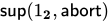


Similarly, the successor function is encoded by , where is defined by .



I propose moving the examples to after the introduction of and updating the examples accordingly.
