


Talk:Hadamard transform
Add topic | This article is rated Start-class on Wikipedia's content assessment scale. It is of interest to the following WikiProjects: | ||||||||||
| |||||||||||

Why are these results interesting?
[edit]What's missing from the page is a brief description of what these mean. Why are the these results interesting?
- .
- .
- ;
- .
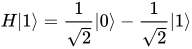
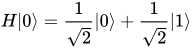


— Preceding unsigned comment added by 86.142.160.167 07:16, March 8, 2008 (UTC)
- Agreed. It's clear that you use this technique to take two equal-length power-of-2 numeric vectors, and generate a third vector. But, somewhere in the first paragraph, it should say WHY someone would want this third vector. My (strong) guess is that it has to do with cross-correlating the original two vectors, but that's just my guess (and a lot of Googling hasn't found any clear statement on the topic). -- Dan Griscom (talk) 11:24, 4 August 2015 (UTC)
A terrible analogy!
[edit]> This would be like taking a fair coin that is showing heads, flipping it twice, and it always landing on heads after the second flip.
This is a terrible analogy! Flipping a coin implies observation of the result. Had we used Hadamard transform for flipping a coin, the subsequent flips would not be any different. Quantum effects should never be explained using classical analogies! — Preceding unsigned comment added by Kallikanzarid (talk • contribs) 11:44, 16 September 2012 (UTC)
- Real analogies are always classical. Everything else is just defining one unknown thing relative to another unknown thing. 98.156.185.48 (talk) 03:03, 15 September 2023 (UTC)
- classical analogy help learners understand the concept and can relate them easily. 114.143.130.110 (talk) 06:31, 12 September 2024 (UTC)
Quantum machine learning section overly promotional
[edit]This section seems overly promotional. There is a large amount of detail, cited mostly from a single source, about one research project. The main reference could be considered a primary reference. Suggest keeping the top paragraph, but moving the rest to either its own page, or to the Quantum Machine learning page ~2026-11891-76 (talk) 00:01, 23 February 2026 (UTC)
Hadamard transform vs. Hadamard matrix
[edit]- The following discussion is closed. Please do not modify it. Subsequent comments should be made in a new section. A summary of the conclusions reached follows.
- While there is consensus that the material related to Hadamard matrix might be duplicated and/or unnecessary, there is no consensus to split/merge to Hadamard matrix. Gramix13 (talk) 00:42, 10 June 2025 (UTC)
The section titled "Definition" in this article duplicates material in Hadamard matrix. I propose merging this section into Hadamard matrix which then opens the possibility of having this article actually talk about the transform. 67.198.37.16 (talk) 21:08, 28 March 2025 (UTC)
- I'm not sure what there is to be merged as the Hadamard matrix article already has a lot of detail about this construction—possibly too much since this construction is just one of hundreds of quite different Hadamard matrix construction methods, which the Hadamard matrix article does not yet mention. I do agree that the material may not be needed here, at least not in this level of detail, but I don't know enough about the uses of the Hadamard transform in practice to know what the best thing is. Will Orrick (talk) 20:12, 30 March 2025 (UTC)