


Talk:Goad
Add topic | This article is rated Start-class on Wikipedia's content assessment scale. It is of interest to the following WikiProjects: | ||||||||||||||||||||||||||||||||||||||||||||||||||||||||||||||||||||||
| |||||||||||||||||||||||||||||||||||||||||||||||||||||||||||||||||||||||


 | This article was nominated for deletion on 2006 July 24. The result of the discussion was speedy keep. |
What does a picture of a plough have to do with a stick (goad)?
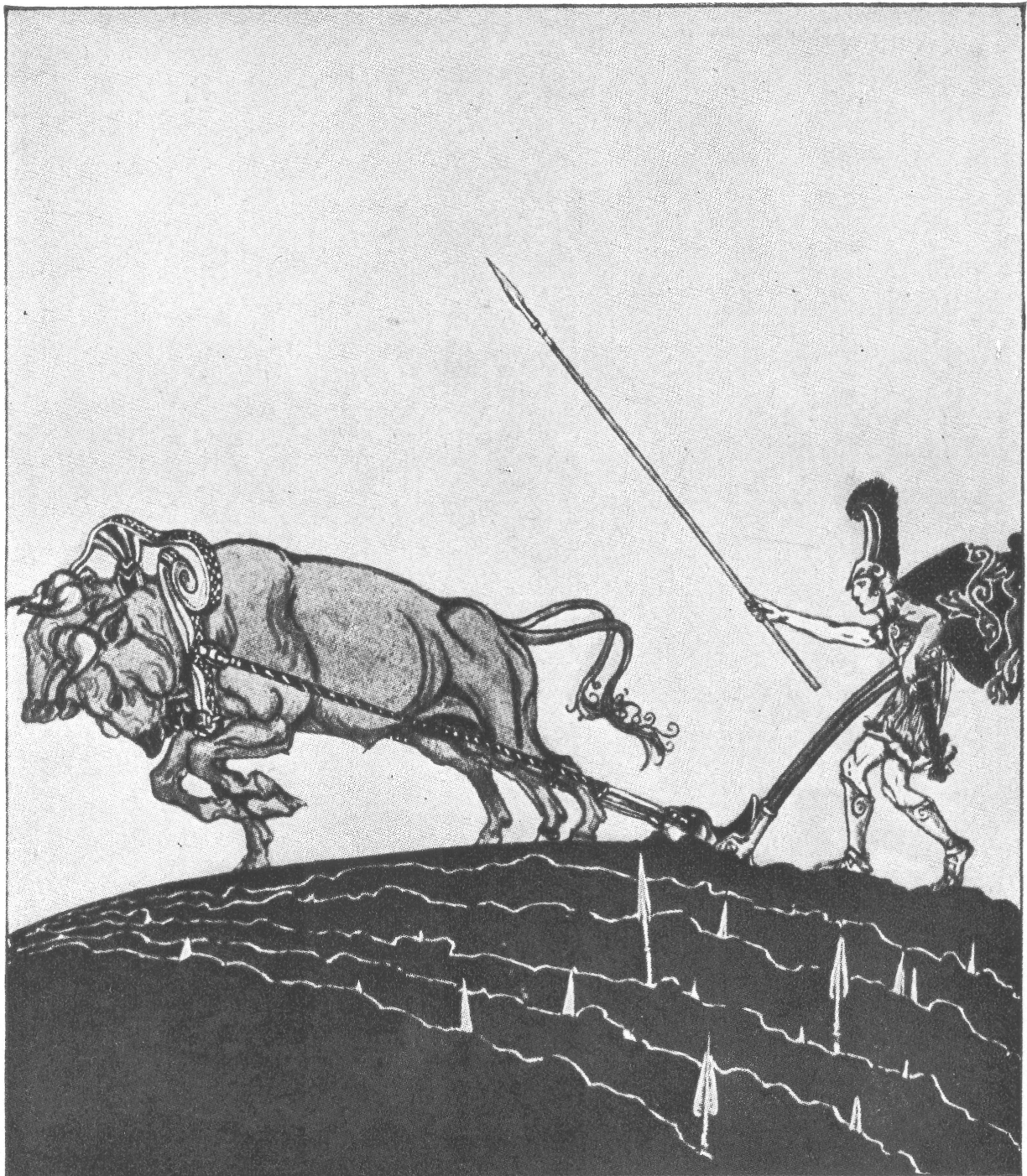
This would be a better picture.
Perhaps something could be mentioned about the killing of Palestinians in the Old Testament with a goad?
Faro0485 (talk) 01:21, 7 September 2008 (UTC)
- The current image is used because it shows a goad which presumably was used to keep the oxen pulling the plow moving. As for the image you think is better: 1. Is it free? (i.e., is it in the public domain or released under a license at least as free as the GFDL?); 2. Is that a goad or a spear that the man is holding, as he is in what appears to be a war chariot, even though it is being pulled by a bull? -- Donald Albury 13:11, 8 September 2008 (UTC)
- The second image is from Greek mythology; Cadmus is raising an army by sowing a field with dragons' teeth. He has his spear in hand and the spear-tips of the supernatural army can be seen rising from the furrows of the plough. It is not clear if he is using the spear as a goad and the spear is certainly not typical of an ox-goad, it is clearly a hoplite killing weapon and not an agricultural implement. Not an appropriate image, the one in the actual page is much better. --Charlie —Preceding unsigned comment added by 205.153.180.229 (talk) 15:36, 24 October 2008 (UTC)
This article says In the early days, before Israel had its own metal industries, farmers had to rely on the Philistines to sharpen their goads, as well as other metal tools, the plowshares and mattocks, forks, and axes (1 Sam. 13:21).
The relevant quote actually begins with 1 Sam. 13:19: Not a blacksmith could be found in the whole land of Israel, because the Philistines had said, "Otherwise the Hebrews will make swords or spears!" Of course this is just an English translation. I don't know what the original Hebrew or Aramic says, but metal tools and weapons were used throughout the Middle East thousands of years before the Hebrews or Philistines existed. I think the real issue here was the use of iron, which circa 1100 BC (plus or minus a few centuries) was a closely guarded secret. Zyxwv99 (talk) 17:00, 11 March 2012 (UTC)
Rollback to March 2025 version
[edit]@Sahilmotan16: This is the page for the ancient farming implement known as a goad. I am reverting back to the most recent version before your edits. You should instead create a new page here for the article you've written about Goad (Mahenderagarh), and move the article there. KumquatSquash (talk) 05:30, 24 November 2025 (UTC)
Connection to Hebrew article
[edit]In the Judges verse cited in this article, the word goad (or oxgoad) is, in Hebrew, מלמד הבקר. There is a Wikipedia article for that here: https://he.wikipedia.org/wiki/מלמד_בקר However it is connected to “cattle prod” in English Wikipedia. Should this article, Goad, be linked to the מלמד בקר article in Hebrew Wikipedia? Smoothhenry (talk) 11:30, 25 April 2026 (UTC)
- Start-Class Agriculture articles
- Low-importance Agriculture articles
- WikiProject Agriculture articles
- Start-Class Religion articles
- Low-importance Religion articles
- WikiProject Religion articles
- Start-Class Bible articles
- Low-importance Bible articles
- WikiProject Bible articles
- Start-Class Christianity articles
- Low-importance Christianity articles
- WikiProject Christianity articles
- Start-Class Judaism articles
- Low-importance Judaism articles
- Start-Class Ancient Near East articles
- Low-importance Ancient Near East articles
- Ancient Near East articles by assessment
- Start-Class Phoenicia articles
- Low-importance Phoenicia articles
- WikiProject Phoenicia articles