


Talk:Generalized arithmetic progression
Add topic | This article is rated Start-class on Wikipedia's content assessment scale. It is of interest to the following WikiProjects: | ||||||||||
| |||||||||||

[Untitled]
[edit]Please use subscripts to avoid ambiguity. Also, why do m and n and so on need to be restricted? — Preceding unsigned comment added by Eternalblisss (talk • contribs) 16:37, May 29, 2008 (UTC)
[Critique Upon An Initial Reading]
[edit]This page is horribly written. I wanted to learn from it. Now I probably will have to learn the subject and THEN edit the page to make sense. In the description of semilinear sets, new symbols are introduced willy nilly without any indication of the domain of discourse for the new symbols, so that the reader is left fairly confused about what is meant by anything written. Matt Insall 00:58, 4 August 2017 (UTC) — Preceding unsigned comment added by Espresso-hound (talk • contribs)
[Recommended Revision #00001]
[edit]In the sentence
"More generally, let

be the set of all elements in of the form


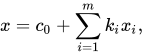
with in , in , and in ."


the symbol should have been introduced with its domain of discourse, prior to use. It is confusing to have to figure out later from context that must be a subset of the n-fold power of N. Someone knowledgeable about semilinear sets needs to clean this up. Matt Insall 01:22, 4 August 2017 (UTC) — Preceding unsigned comment added by Espresso-hound (talk • contribs)
Problems
[edit]Agreed with others that this article needs serious work. For starters, a semilinear set is over multiple dimensions (a set of vectors), unlike what is called a generalized arithmetic progression, so I corrected that description in the lead.
However, another problem is that what is called a generalized arithmetic progression is simply the same as an eventually-periodic set of integers, and this is not at all clear from the article. Caleb Stanford (talk) 19:47, 11 December 2021 (UTC)
- Caleb Stanford's second point above identifies a real inconsistency in the article, though I would locate it slightly differently. The lead describes a set generated by starting at 17 and repeatedly adding 3 or 5, with no bound on how often each is used, and that set is indeed eventually periodic. The formal definition in the section below, however, bounds each coefficient below , so a finite GAP is a finite set and cannot be eventually periodic. The article has been describing two different objects without saying so, which I think explains why the subject reads as incoherent.
- The unbounded version is a linear set, and a finite union of these is a semilinear set. That is now the subject of a separate article, Semilinear set, and the section here states the distinction: linear sets have unbounded coefficients, finite GAPs do not. I intend to amend the lead so that the illustrative example is not mistaken for the definition.
- I have removed {{technical}}: the lead introduces the concept through a concrete numeric example before any formalism. I have left {{refimprove}} in place, since the Tao–Vu footnote is currently the only inline citation and the material on size, properness and the grid projection is unsourced. {{context}} I have also left for now; a sentence placing generalized arithmetic progressions within additive combinatorics, which is what the Freiman's theorem link in See also gestures at, would likely resolve it. Marc Schroeder (talk) 14:33, 8 September 2026 (UTC)

