


Talk:Fourier transform
Add topic | This  level-4 vital article is rated B-class on Wikipedia's content assessment scale. level-4 vital article is rated B-class on Wikipedia's content assessment scale.It is of interest to the following WikiProjects: | |||||||||||||||||
| ||||||||||||||||||


Section: Fourier transform for functions that are zero outside an interval
[edit]The result of this section seems to be the statement:
Under appropriate conditions, the Fourier series of f will equal the function f. In other words, f can be written:

At the very least it needs to clarified that the first equality only applies in the interval T.
But also we already know that can be recovered from So what you are showing is that when its domain is bounded, it can also be recovered from discrete samples of which, by the way, is the dual of the time domain sampling theorem. This is mildly interesting, but it strikes me as a proof looking for a home, and the whole article is already pretty cluttered with stuff.
--Bob K (talk) 09:00, 27 December 2022 (UTC)


Erroneous square integrable function
[edit]The function is listed as a square integrable function (Line 207). I think this is only true if . However, this condition is not mentioned, and if this condition is included, (Line 207) becomes just a restatement of (Line 206) with the replacement . 18.29.20.123 (talk) 16:40, 10 February 2023 (UTC)


- I believe α is assumed to be purely real. Im(α) = 0. Constant314 (talk) 17:57, 10 February 2023 (UTC)
- The IP editor is correct (if you read this, I hope you make an account and stick around). If then which is definitely not square integrable. I don't think the citation says what the author thought it said. There are a couple of other places like this too. If I can at some point I will try to run through the citations and verify and fix what I see.
- I agree. Still, I think α is assumed to be purely real, if so, it should not be in the table at that point. Constant314 (talk) 17:25, 13 February 2023 (UTC)
- Yes, I think you're right. I will do a bit of research, once I find a source for this particular formula, I will cite it, move it, and include conditions. Thenub314 (talk) 20:17, 13 February 2023 (UTC)
- The IP editor is correct (if you read this, I hope you make an account and stick around). If then which is definitely not square integrable. I don't think the citation says what the author thought it said. There are a couple of other places like this too. If I can at some point I will try to run through the citations and verify and fix what I see.


Recent revert
[edit]I would like to discuss the recent revert of my edit. The edit, in part, addresssed the comment from the IP editor about that our tables were incorrect. While looking at the article I noticed it was inconsistent in the placement of vs so I fixed it. It seems the objections are mostly about the later. For which I would like to point out, the prevailing culture is that if a is used, it is before the i to see this I would like to point to:


- MATLAB Documentation
- Mathematica Documentation (see Details and Options)
- The makers of FFTW, the open source FFT engine
- The first few articles I looked at from the IEEE
- This article, for a minimum of a decade until last May when it was changed without discussion.
Aside from the last one, these are large professional orgainzations trying to make something for the masses. About the last one, I include the last one because I would like to return to the status quo for the article. I also feel it would benefit readers because they are (in my opinion) more likely to encouter in books/papers/references. Thenub314 (talk) 15:47, 15 February 2023 (UTC)
- I'm not aware of our tables being incorrect nor of the inconsistencies. I looked and did not find them. So there must have been very few, and so it can more easily be addressed by changing a small number of things instead of everything else. Sorry to be disagreeable, but I also don't think 2πi is more common than i2π. Regardless of that, they are both common, so I think we should look at the rational for each. Besides the (very good) reason I cited in the undo, leading with the i makes it more obvious that it's a complex exponential, which is its most important attribute.
- --Bob K (talk) 18:47, 15 February 2023 (UTC)
- The issue with the table being incorrect started on this talk page! A kindly IP editor spotted it, and left a comment here. I said I would research and fix it and I did.
- You're right, I did reply to the edit summary stating your preferred format is more logical. Clearly, I disagree. There are plenty of these arguments around, and they all boil down to a matter of taste. This is a bit like vs . This is why I am pointing to things that are external to me. To put some data behind my argument, I ran through each of the books cited by this article.
- Excluding the few that I couldn't get access to, in the ones that use just over 80% place the i after.
- And as a proportion of total references those that put an i before the are less frequent than those that avoid complex number all together by using sine and cosine.
- IMO, the most important attribute is to be a service to the readers, particularly the non-experts who may be thrown off by the change. They will most likely be looking at a reference where i following the . Thenub314 (talk) 21:27, 15 February 2023 (UTC)


- And I think it serves the non-experts more to put the in the most prominent location, and to keep 2πξ (= ω) together, especially when side-by-side in the tables with
- --Bob K (talk) 23:19, 15 February 2023 (UTC)


- My experience has an educator leads me to disagree. IMO students are more thrown off by disagreements in notation that some philosophical point about i being important, so it should come first. But we may be at an impasse, hopefully someone else while chime in and help us out.Thenub314 (talk) 00:25, 16 February 2023 (UTC)
- I agree with Bob K. I prefer to see the i in front, so I can tell immediately if it is there without searching. The fact that the figures and text disagree is not a problem. Anyone who does not realize that i2π is the same as 2πi won't understand anything anyway.
- On the other hand, there was a mistake in table item 207 as the function was not square integrable. Please go ahead and fix that while the discussion about i2π continues. Constant314 (talk) 01:38, 16 February 2023 (UTC)
- My experience has an educator leads me to disagree. IMO students are more thrown off by disagreements in notation that some philosophical point about i being important, so it should come first. But we may be at an impasse, hopefully someone else while chime in and help us out.Thenub314 (talk) 00:25, 16 February 2023 (UTC)
- Sure, but I have no better way than to copy and paste from the diff, which I cannot do from my phone, but I'll try when I am able. Thenub314 (talk) 02:57, 16 February 2023 (UTC)
- I only use a laptop, so I'll take a look at that. Also, I'll take a look for those remaining "inconsistencies". I don't like them either.
- --Bob K (talk) 13:22, 16 February 2023 (UTC)
Symmetry section
[edit]I removed a reference from here because the cited reference wasn't discussing the Fourier transform in the section indicated. I will try to find something more specific to this topic. Thenub314 (talk) 20:47, 16 February 2023 (UTC)
A Commons file used on this page or its Wikidata item has been nominated for deletion
[edit]The following Wikimedia Commons file used on this page or its Wikidata item has been nominated for deletion:
Participate in the deletion discussion at the nomination page. —Community Tech bot (talk) 14:53, 17 February 2023 (UTC)
Error in inversion section?
[edit]In the inversion section the integrals are over the variable σ but the variable ξ appears in the integrands. Where does the ξ come from? — Preceding unsigned comment added by 2.27.171.228 (talk) 21:25, 21 August 2023 (UTC)
Code sample
[edit]I reverted this edit, because Wikipedia articles do not usually include code samples (see MOS:CODE), unless those code samples illustrate some fundamental aspect of an algorithm. In this case, the algorithm (the fast Fourier transform, for which there is already a separate article) is not actually shown. Instead, it uses a builtin function of the numpy library. So this code is very python-specific, and is not a good illustration of the Fourier transform. Tito Omburo (talk) 10:42, 23 May 2024 (UTC)
- Since the code apparently produces a graph, perhaps Wikimedia is an appropriate host for this creation. And it welcomes the inclusion of source code. Here is a link to an example, where the code is in a portion of the Summary section. But it can also have its own separate section.
- --Bob K (talk) 12:13, 23 May 2024 (UTC)
- I agree with @Tito Omburo:. That code sample just shows calls to library functions and serves no useful purpose in the article. Constant314 (talk) 13:09, 23 May 2024 (UTC)
Error in Symmetry Section?
[edit]I think there may be an error in the symmetry section. For example, it says "even-symmetric function ..."
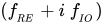
But isn't even symmetric, right? Shouldn't the even symmetric function be ?

Is there a reference for this section? Jackmjackm (talk) 22:01, 17 June 2024 (UTC)
- "Even symmetric" apparently means here. I assume this is a standard ise of the term in signal processing, but agree that a reference seems desirable. Tito Omburo (talk) 22:56, 17 June 2024 (UTC)
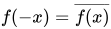
- The article links to Even_and_odd_functions#Complex-valued_functions. That's where the reference should be.
- --Bob K (talk) 11:42, 19 June 2024 (UTC)
- But at 15:45 on 16 February 2023, an editor removed what appears to be a directly relevant reference: (Proakis 1996, p. 291)
- I don't think I have access to the reference.
- --Bob K (talk) 10:32, 20 June 2024 (UTC)
- This usage is supported by Oppenheim and Schafer, fwiw. Tito Omburo (talk) 11:03, 20 June 2024 (UTC)
- Thank you. I added the citation to Even_and_odd_functions#Complex-valued_functions, which also contains the Proakis reference, except the page number is 411, instead of the one that was deleted here (page 291). Maybe that was the problem all along. (I don't have the Proakis book to verify.)
- --Bob K (talk) 12:58, 20 June 2024 (UTC)
Lebesgue integrable functions
[edit]@Tito Omburo, thank you for your contributions. Could you be so kind to look at the subsection Fourier_transform#On_Lp_spaces as well? I feel there's a lot of semi-duplicate content.
Kind regards, Roffaduft (talk) 15:07, 7 December 2024 (UTC)
- @Tito Omburo what exactly do you mean with
the integral does not exist
? Just that it is not absolutely convergent? Or that cannot be in either? - I was reading up on: https://math.stackexchange.com/questions/2551297/fourier-transform-of-frac1-sqrt1-x2 as well as Carleson's theorem which got me questioning the generality of said statement.
- Kind regards, Roffaduft (talk) 12:47, 11 January 2025 (UTC)
- ps. does not imply that the integral does not exist at all. E.g., the Fourier transform might be an improper integral, or converge in the sense of distributions. Roffaduft (talk) 13:21, 11 January 2025 (UTC)
- The Lebesgue integral does not exist. Tito Omburo (talk) 14:05, 11 January 2025 (UTC)
- ps. does not imply that the integral does not exist at all. E.g., the Fourier transform might be an improper integral, or converge in the sense of distributions. Roffaduft (talk) 13:21, 11 January 2025 (UTC)


Fourier Transform table reference to 207
[edit]In the Fourier Transform tables, for the transforms of cos(ax^2), sin(ax^2), there is a reference to line 207, however this line seems to have been removed. The relevant content now appears to be in 308, maybe this should be updated? 130.37.105.189 (talk) 14:20, 17 January 2025 (UTC)
- See lines 306, 307 for reference Dirkdoo (talk) 14:24, 17 January 2025 (UTC)
Reference for Uniform Continuity
[edit]The statement of uniform continuity refers to Katznelson, Yitzhak (1976). The statement is on Page 153, and says the proof is similar to I.1.4 on Page 4. I.1.4 refers to I.1.5 on Page 4, which says the proof is left to the reader. This is NOT an acceptable reference! (Relevant pages can be seen in Google Books.) 76.89.203.71 (talk) 18:14, 9 April 2025 (UTC)
- It is proven in my 2004 edition of Katznelson, on page 134 (and anyway, the proof is rather trivial). Tito Omburo (talk) 19:56, 9 April 2025 (UTC)
- The 2004 edition, with p134, is also in Google Books. You mean the lemma in section 1.2 on lacunary series? And then the stuff about t goes away somehow? Regardless, it appears that the reference has issues, since the page reference would then be from a different edition that the 1976 one.
- (I am personally interested in the norm inequality, not the uniform continuity.) Skewray (talk) 17:01, 12 April 2025 (UTC)
- I'm looking at my copy right now. It's Theorem 1.2 in Katznelson. If you're having trouble finding it, you can pick up basically any textbook on the subject and read that. The norm inequality follows because . Uniform continuity follows by a similar estimate. Tito Omburo (talk) 18:15, 12 April 2025 (UTC)

General definition
[edit]@Tito Omburo Thank you for your recent edits. While I think I understand your reasoning for no longer defining as an integrable function (i.e. if then is not necessarily a function nor integrable), I'm not sure if that is the best approach to take at the beginning of the Defintion subsection.

Not only is (Eq.1) a poor/inaccurate reflection of this generalization, it also makes it harder to structure the article (going from the most common interpretation to generalizations later on). Similarly, the example is a poor reflection of (Eq.1) and (Eq.2)

Instead of saying "The Fourier transform is defined as...", you could write: "... is called the Fourier transform of ." after (Eq.1). That would be more accurate. After Eq.1) and (Eq.2) have been defined in the right context, you could then address the generalization.
Now I think of it, "Tempered distbrutions" as subsection of "Fourier transform on function spaces" might not be appropriate either.
Anyways, let me know what you think.
Kind regards, Roffaduft (talk) 07:49, 31 August 2025 (UTC)
- I think the main problem with requiring integrability at the outset is that the properties of the Fourier transform are rather special in that case, and not characteristic of most applications. The Fourier transform is then uniformly continuous and decays at infinity (but notably may not itself be integrable, so that Eq. 2 does not necessarily work as advertised). So I put these properties later in the paragraph, and then a brief description of generalizations which are more characteristic and taken up elsewhere in the Definition section. I also removed the comparison with Fourier series, which was out of place here. But maybe I was too zealous in removing integrability from the hypothesis, and the first paragraph should go (definition for integrable f) -> (indication that the integral makes sense weakly for other functions/distributions) -> (special properties such as continuity in the integrable case). Tito Omburo (talk) 13:10, 31 August 2025 (UTC)
- Were you willing to have a look at it? Otherwise I'll have a try first.
- Kind regards, Roffaduft (talk) 05:37, 20 September 2025 (UTC)
- Looking at it now, I'm not sure anything needs to be fixed. The basic definition is followed by literal technical requirements, and then by generalizations. Tito Omburo (talk) 20:42, 20 September 2025 (UTC)
- I understand your reasoning, but the way it is written feels a bit strange to me. Let's consider the first two sentences:
The Fourier transform of a complex-valued on the real line, is the complex valued function , defined by the integral
Evaluating the Fourier transform for all values of produces the frequency-domain function.
- This leads me to two questions:
- What mathematical "entity" that is not a function(al), is subject to the above integral transfrom? In other words, what has been gained by no longer calling a function?
- Why adhere to this level of abstraction in the first sentence, only to start talking about the (highly specific) frequency domain in the second sentence?
- If you're looking for a more abstract start to the definition, you could take inspiration from Gel'fand en Shilov - 1968 - Volume 2: Spaces of Fundamental and Generalized Functions - Chapter III
In the general case, a functional in the space of Fourier transforms of functions of the space will be the Fourier transform of a generalized function in the spacе . Непce, we should first consider Fourier transforms of the fundamental functions of the space ; Section 1 is devoted to this. Fourier transforms of generalized functions are considered in Section 2...
- ps. The FT of the Delta function, as example of a Fourier transform pair, seems to suggest that you can simply substitute in (Eq.1).
- Kind regards, Roffaduft (talk) 06:06, 21 September 2025 (UTC)
- I understand your reasoning, but the way it is written feels a bit strange to me. Let's consider the first two sentences:
- Looking at it now, I'm not sure anything needs to be fixed. The basic definition is followed by literal technical requirements, and then by generalizations. Tito Omburo (talk) 20:42, 20 September 2025 (UTC)


Hat or widehat
[edit]The article uses a mix of \hat and \widehat as in the following sippet:

From this, various relationships are apparent, for example:
- The transform of a real-valued function is the conjugate symmetric function Conversely, a conjugate symmetric transform implies a real-valued time-domain.

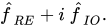
I would like to propose convering all instances of \widehat to \hat as follows. I think it looks better.

From this, various relationships are apparent, for example:
- The transform of a real-valued function is the conjugate symmetric function Conversely, a conjugate symmetric transform implies a real-valued time-domain.
Constant314 (talk) 13:36, 31 August 2025 (UTC)
- I think all hats should be widehats, because it is more visible and has generally better positioning over the function symbol. Tito Omburo (talk) 15:41, 31 August 2025 (UTC)
- Here is a third style in which the widehat also includes the subscript. I particularly dislike this as the width of the widehats are not the same throughout the article.
- into Eq.1 produces this convention, where function is relabeled
- But I am good with any consensus. Constant314 (talk) 19:33, 31 August 2025 (UTC)
- Agree, is better. Tito Omburo (talk) 20:25, 31 August 2025 (UTC)
- I think that I got them all. Constant314 (talk) 22:00, 31 August 2025 (UTC)
- Agree, is better. Tito Omburo (talk) 20:25, 31 August 2025 (UTC)
- Here is a third style in which the widehat also includes the subscript. I particularly dislike this as the width of the widehats are not the same throughout the article.


- The TeX system gives a markedly different width of the hat produced by
\widehatdepending on the letter (for example: , ), which I find unpleasing. Switching to\hatis one solution (which gives , ). I have not found a reasonable way to force the greater width for all letters. Thoughts? —Quondum 20:00, 28 February 2026 (UTC)
- The TeX system gives a markedly different width of the hat produced by


Unclear sentence
[edit]This sentence appears in the section Angular frequency:
"Unlike the Eq.1 definition, the Fourier transform is no longer a unitary transformation, and there is less symmetry between the formulas for the transform and its inverse."
First of all, it is entirely unclear which version of Fourier transform this is referring to.
But also: This appears to imply that the Eq. 1 definition is a unitary transformation. But this is nowhere stated explicitly.
I hope that someone familiar with this subject will make both of these things a lot clearer. 2601:204:F181:9410:F00A:A5AF:A897:8D69 (talk) 16:35, 19 September 2025 (UTC)
- Unitarity is stated explicitly later, although it makes sense to defer this mention of non-unitarity. Tito Omburo (talk) 20:30, 19 September 2025 (UTC)
Integral transform
[edit]The statement in the lead,
- ... the Fourier transform (FT) is an integral transform ...,
is pointless. If we allow distributions (as we inevitably do in this area: the delta function is too useful here), then an integral transform and a linear operator are the same thing, and it is best say that it is a linear operator. The kernel of the transform does not include non-function distributions, but is this so significant as to be emphasized in the first words through a term than might not even convey this meaning? The article Integral transform is sketchy anyway – "a type of transform that maps a function from its original function space into another function space via integration" is not a property of the transform, but of the description used to define it. —Quondum 12:41, 20 September 2025 (UTC)
Error in the table
[edit]There seems to be an inconsistency in the table "Square-integrable functions, one-dimensional".
For "Fourier transform unitary, ordinary frequency" the transformation for rect can be checked manually quite easily. But evaluating the formula at the top, the solution should be : 147.161.250.180 (talk) 11:25, 22 September 2025 (UTC)

This depends on which definition of the function you use, see : https://en.wikipedia.org/wiki/Sinc_function. — Preceding unsigned comment added by 147.161.250.104 (talk) 11:31, 22 September 2025 (UTC)

Howe
[edit]Regarding this edit I am vaguely aware of earlier attempts to "correct" this fundamental literature, with my subsequent discovery that these corrections rely on inconsistent assumptions. Anyway, a good edit, but worth double-checkimg. Tito Omburo (talk) 18:57, 6 December 2025 (UTC)
Involution
[edit]The fourier transform
|Eq.1
is almost equal the inverse, but not quite.
By taking the complex conjugate you get a transform which is exactly equal the inverse.

As this is original research on my part it may not be welcome in wikipedia, but it is a useful simplification. We no longer need to distinguish between the fourier transform and the inverse fourier transform.
A further simplification arises by the convention The transcendentials need appear in the formula no more.


Regarding Section "Properties"
[edit]The subsection "Eigenfunctions" could be significantly improved for clarity. I suspect other beginners, such as myself, will also have no idea what's going on. ~2025-35665-33 (talk) 13:46, 16 February 2026 (UTC)
Regarding Section "Generalizations"
[edit]In subsection "compact non-abelian groups", second to last paragraph about inversion theorem, fhat(sigma) has not been defined, or perhaps needs clarification. ~2026-12001-15 (talk) 19:23, 28 February 2026 (UTC)
In the Table of Functional Relationships in 1d, Formula 106.5
[edit]In the Table of Functional Relationships in 1d, Formula 106.5, has its notes with the statement,

When read as the mathematics instructs, this expression is divergent! From inspecting the entry, its meaning, and its references, it appears this expression is wrong in the source reference, which contains an essentially identical statement of the form,
![{\displaystyle \int \limits _{-\infty }^{\infty }\left[\,g(\tau )-C\,\right]\;d\tau =0.}](https://wikimedia.org/api/rest_v1/media/math/render/svg/8a95c6f84b54a57d573a61e8954bc2110cc8f1e1)
This is the same statement as the first, and both are divergent. I believe the meaning that was intended is the following,

The above can be written more succinctly as, , where is the Fourier transform of , evaluated at zero.


Can someone (preferably the author of 106.5) verify that there is indeed this issue with the note in 106.5?
Once/If verified, I will then make an edit to reflect the changes. MMmpds (talk) 23:15, 5 August 2026 (UTC)