


Talk:Four fours
Add topic | This article is rated Start-class on Wikipedia's content assessment scale. It is of interest to the following WikiProjects: | ||||||||||
| |||||||||||

Untitled
[edit]this seems pretty similar to the 24 game, where you try to make 24 using some set of operators and 4 random integers found by drawing 4 cards from a deck. anybody want to add something about the similarities?
33 = 4! + 4 + sqrt(4)/.4 --Bobbymcr 04:48, 5 August 2006 (UTC)
Untitled
[edit]39 and 41 are also the subjects of impossibility.
39 = 44 - sqrt(4)/.4 41 = 44 - sqrt(4/.4')
Where .4' means 4/9. ZtObOr 00:38, 6 October 2007 (UTC)
Integrals?
[edit]Can I use integrals? For example, is allowed? --Aruseusu (talk) 20:07, 1 May 2009 (UTC)
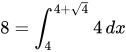
- It depends on how far you are willing to stretch the rules. HyperTetration (talk) 18:24, 7 December 2025 (UTC)
123 hard?
[edit]Not really: 123 = 44/.4' + 4! where .4' = .444... = 4/9 Mark314159 (talk) 11:31, 6 October 2010 (UTC)
Or 123 = (√4/.4)! + √(4/.4'). Definitely don't require those silly-looking nested roots.
Untitled
[edit]What does "!" mean? Please help! — Preceding unsigned comment added by 24.63.195.130 (talk) 19:43, 7 June 2011 (UTC)
- n! means 1*2*3*…*n-1*n HyperTetration (talk) 18:26, 7 December 2025 (UTC)
- " ! means factorial "
113, Wheeler, and fives
[edit]Certain numbers, such as 113 and 123, are particularly difficult to solve under typical rules. For 113, Wheeler suggests Γ(Γ(4)) −(4! + 4)/4. But who is Wheeler? He is not mentioned elsewhere in the article.
Whoever he is, his solution to 113 uses the gamma function. I have long believed that 113 is impossible to obtain using the set of operations I was restricted to (essentially, all those listed in the article except gamma function and subfactorial) but has this ever been proved? (Annoyingly, the value 113/16 can be obtained with only three fours, but there seems to be no way to reach a solution for 113 from this.)
There is no indication in the article of why the five fives and six sixes variants are considered notable enough for so much space to be given to listing their solutions. Whereas four fours is an excellent recreation because it has enough scope to hold the solver's interest for a long time, while being restrictive enough to require a lot of creativity in solving the harder numbers, allowing five or six digits makes the lower numbers too easy, and the puzzle becomes only of interest to computer algorithmists.
However, four ones, four twos, four threes and four fives are all rather interesting variants, although all of them have a smaller range of obtainable values than four fours (because sqrt(4) is an integer, and 4! is small enough to be very useful). Four fives is solvable for all integers from 0 to 67 inclusive, and 67 requires a particularly cunning solution:
67 = (5! x .5...) + sqrt(.5.../5) 2.25.142.67 (talk) 15:56, 19 July 2011 (UTC)
113 = (4! + 4 + 4′) × 4, where 4′ is the multiplicative inverse of 4 (like -4 is the additive inverse of 4). — Preceding unsigned comment added by 117.19.167.29 (talk) 15:33, 24 August 2017 (UTC)
Untitled
[edit]Is ( integer ) allowed, which provides 11 = 4 + 4 + 4 - ( integer ) ( sqrt ( sqrt ( 4 ) ) ) ? Reg nim (talk) 17:59, 5 November 2011 (UTC)
- Probably, because rounding down can be notated as brackets without tops. HyperTetration (talk) 18:32, 7 December 2025 (UTC)
How about using just one 4?
[edit]See: Knuth on representing numbers with one four, also algorithms for one three (which is equivalent to one four). — Preceding unsigned comment added by Davidbak2 (talk • contribs) 06:09, 27 June 2012 (UTC)
- Very interesting! I support adding a mention of both in the article. --Waldir talk 20:15, 3 July 2012 (UTC)
Untitled 2
[edit]Why "sqrt" can be used, but "sqr" can't? — Preceding unsigned comment added by 140.113.136.218 (talk) 08:02, 15 April 2014 (UTC)
- Probably because the default notation for square roots is the radical symbol, while the default notation for squares is the number 2, raised. AltoStev (talk) 22:50, 27 November 2024 (UTC)
five fives solutions are optimal
[edit]I checked the five-fives solutions with my own code and as one can see from https://github.com/icecream17/Stuff/blob/main/math/five-fives and five-fives.js, no solution improved on the article. (I think including solutions themselves is just Wikipedia:CALC (basic calculation exception to no original research), but at some point it runs into notability issues, so the current amount is probably the limit) AltoStev (talk) 06:31, 24 May 2025 (UTC)
Identity Four
[edit]Are there any ways to make it so if x=α where the expression α has three fours, is there a way to make it have four fours, like an extra four? HyperTetration (talk) 18:38, 7 December 2025 (UTC)