


Talk:Fock space
Add topic | This article is rated Start-class on Wikipedia's content assessment scale. It is of interest to the following WikiProjects: | ||||||||||
| |||||||||||
.jpg)

Help!
[edit]Could somebody knowledgeable in this area take a look at the article. The sentence "WARNING: Fock space only describes noninteracting quantum fields. See Haag's theorem." is strange, but I don't know what to do about it. Thanks! Oleg Alexandrov 02:34, 9 Mar 2005 (UTC)
"(to describe many species of particles, made the tensor products of as many different Fock spaces)." I assume that "make" is meant, and not "made." Since I don't know that, I'll let someone else fix it.
Why there are two different types of phi??? --77.176.71.6 (talk) 17:25, 18 December 2009 (UTC)
Definition
[edit]In the definition section it says:
- is a vector of length 1, called the vacuum state and is a complex coefficient,
- is a state in the single particle Hilbert space,


But it doesn't say anywhere whether
- is a different state in the same single particle Hilbert space or if it is a state in a two-particle Hilbert state.

Can somebody who knows clarify the article? — Preceding unsigned comment added by 129.6.107.65 (talk) 15:44, 25 June 2014 (UTC)
The 10th line is wrong.It is instead (-1)^{\pi{ij}}. — Preceding unsigned comment added by 183.63.97.18 (talk) 12:04, 30 August 2016 (UTC)
Bottom two paragraphs
[edit]I can't seem to make head or tail out of the last two paragraphs, so I have moved them over here instead:
- WARNING: Fock space only describes noninteracting quantum fields. See Haag's theorem. However, if the model has a mass gap, the asymptotic past and asymptotic future states can be described by a Fock space. Fock space does not describe finite temperature physics as well.
- While Fock space is appropriate for free massive particles with finite energy (i.e. zero temperature) because for a collection of these particles, finite total energy and finite particle number mean the same thing, it is no longer appropriate for massless particles because an infinite number of them can still have finite energy. See soft photon
Some of the terminology seems out of place, and sounds extremely foreign in the context of quantum chemistry. Perhaps it would make more sense in quantum electrodynamics? --HappyCamper 02:02, 19 November 2005 (UTC)
- The context doesn't have to be quantum chemistry. Fock spaces are used in quantum field theory in general. I dunno what the guy is talking about though. I think this is an example of people from different fields talking past each other - for instance I've seen Fock space used to derive temperature-dependent stuff, but then again I'm a condensed matter guy. These kinds of conflict are somewhat common on physics-related pages, I wonder if there's some kind of resolution mechanism. Nvj 20:57, 29 May 2006 (UTC)
Is all the notation correct within this article, why these different phi for single particle states? and one could better describe the indices, because this is where many of the things are that one needs to understand. why are the indices sometimes in the bracket, sometimes out of the bracket?
- I think the caveats arising from Haag's theorem are very important and should be restored. 86.147.126.104 (talk) 03:49, 30 March 2023 (UTC)
Hilbert space
[edit]As far as I understand it, it is not true that the Fock space is a Hilbert space. It is not possible to have a scalar product between states with a different number of particles.
For every k, the k-particle space is a Hilbert space. But the direct sum of all these spaces is not.
FelixP (talk) 15:12, 16 November 2009 (UTC)
Well, as far as I know and also according to Wikipedia, this is possible ([]) Joasiak (talk) 17:17, 29 November 2009 (UTC)
Ok thanks, I undid it. I had misinterpreted something in the chemistry liturature. FelixP (talk) 01:24, 2 December 2009 (UTC)
Relation to Bargmann-Fock space
[edit]This article could do with a discussion of how Fock spaces are related to the Bargmann-Fock space i.e.
- , where


Perhaps the relationship is just "there isn't one (apart from the name)", but even mentioning this would be useful. But if, as I suspect, they are different views (quantum mechanical / pure mathematical) of the same thing, a description of this would be very useful. 128.86.179.98 (talk) 15:30, 21 June 2011 (UTC)
According to the one answer to this related question, the two are isomorphic, and "the creation and anihilation operators are just the multiplication a_j = z_j and the derivation a*_j = d/dZ_j and consequently, the theory of several complex variables can be used for the analysis on this space". Obviously that page isn't a reliable source itself, but the author also gives a couple of useful references. 128.86.179.98 (talk) 15:48, 21 June 2011 (UTC)
Convergence Issue
[edit]The following quote, at the end of the Definition section, is confusing:
"The convergence of this infinite sum is important if is to be a Hilbert space. Technically we require to be the subspace of which consists of all vectors with finite norm (where the norm is defined by the inner product as )."


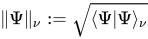
The direct sum requires that all but finitely many coefficients are zero, so every vector is a sum of finitely many vectors. Since is a Hilbert space, every vector in has finite norm. The simple way to fix this would be to eliminate the paragraph entirely, since at the moment it's irrelevant and confusing. However, I may be misinterpreting this. If the direct sum should instead be a direct product, then some sense can be made of the statement. In particular, then the statement would be necessary. Not being a professional physicist, I don't know which is correct, but I suspect the latter space is the one that is intended. Could someone who knows about this sort of thing edit the page (or reply here to tell me why it's correct as is)? 129.15.139.211 (talk) 01:44, 13 December 2011 (UTC)

Okay, ignore the above. Direct sums in the category of Hilbert Spaces are defined differently from arbitrary modules. The quoted paragraph is certainly unnecessary then, but it's not incorrect and not really confusing. I'll leave it up to the regular editors whether any change should be made. Btw this is the same person as above even though my ip is different. 68.97.39.154 (talk) 12:02, 13 December 2011 (UTC)
Changed the formulation such that the Hilbert direct sum is a subspace of the (algebraic) direct _product_ of spaces with finite norm--RogierBrussee (talk) 18:47, 31 January 2012 (UTC)
Missing coefficient in defnition?
[edit]In the defnition, we read that:
A typical state in is given by
- .

Why is there no coefficient for ? I suggest the following (with an ):


- .

——Mcasariego (talk) 13:21, 19 August 2015 (UTC)Mcasariego
PR stunt
[edit]The comment about the error in the end of section "Wave Function Interpretation" does not respect the Wikipedia rule stating that articles should not contain original work. — Preceding unsigned comment added by 130.233.206.195 (talk) 07:23, 8 August 2016 (UTC)
Simple example?
[edit]There is quite a bit of mathematical abstraction here, but no concrete example, which can make it hard for newbies to get a sense of what's going on.
Abstract, generalized discussions are useful as a reference for experts, but inappropriate as an introduction. Wikipedia is not a textbook, so I'm not requesting exercises and worked examples, but a single intuitive example would make this page useful rather than useless as it is. — Preceding unsigned comment added by 129.219.43.70 (talk) 20:19, 10 November 2016 (UTC)
Undid 20 revisions from 1346453012 until 1348534220
[edit]Hi @Sławomir Biały: - could you clarify where exactly you found "factual errors" - I would want to know obviously because I would think I wouldn't make such errors - this is something I would consider the case because, as you recently mentioned for other reasons I add quotes - which I think confirm the validity of the information I introduce. I see in your editorial summary your most edits are on Hilbert space
- reverted version
- Fock space is a Clifford or Weyl [1] algebraic construction used in quantum physics to construct [2] the quantum states space of non-singular [3] identical particles [4] from a single particle Hilbert space H. It is named after Vladimir Fock who first introduced it in his 1932 paper [3] "Konfigurationsraum und zweite Quantelung" ("Configuration space and second quantization").[5][6]
- current version
- The Fock space is an algebraic construction used in quantum mechanics to construct the quantum states space of a variable or unknown number of identical particles from a single particle Hilbert space H. It is named after V. A. Fock who first introduced it in his 1932 paper "Konfigurationsraum und zweite Quantelung" ("Configuration space and second quantization").
Reviewing the sources (I'm using the quotes here to show my choice of evidence for the changes)
- 1: changed: an algebraic construction → "Clifford or Weyl" source: "Fermionic Fock spaces are naturally representations of a Clifford algebra...Bosonic Fock space is naturally a representation of a Weyl algebra"
- 2: no change= used to source "construct"
- 3: some change: "variable or unknown number" → "non-singular" source: "single objects to states of collections of these objects...sets of objects
- 4: no change
These are all the changes I made (unless I made an error in my review, which is possible) Cattenion (talk) 22:07, 24 May 2026 (UTC)
With regards to 1 above, which is currently the only place I could have made an error I think: selection=google books: Albert Schwarz (2024). "Poincaré Group. Relativistic Theories 3.5 Free Theories". Quantum Mechanics and Quantum Field Theory from Algebraic and Geometric Viewpoints. Springer Nature Switzerland. p. 95. ISBN 3031679156. Fock representation of Clifford/Weyl algebra
, Michael Kekainalu Lau (2004). Fock Representations and Central Extensions. University of Wisconsin--Madison. p. 1. spaces of quadratic operators acting on certain highest weight modules for Weyl or Clifford algebra. These modules, called Fock spaces
Cattenion (talk) 22:37, 24 May 2026 (UTC)
- The problem is not that Clifford and Weyl algebras are unrelated to Fock space. The problem is that the wording you added made this relation into the opening definition of Fock space. Fock spaces are used to construct representations of Clifford/Weyl (super-)algebras. But they are not themselves usually constructed using Clifford/Weyl algebras. I don't know what "non-singular" is supposed to mean here, and if I don't know what it means, chances are that no other likely reader will. Apart from these blatant errors, the first sentence of the lead is not supposed to contain lots of technical detail. So even if the errors could be corrected (if someone can ever determine what you are talking about), it would not be appropriate to put them in the first sentence. Sławomir Biały (talk) 05:37, 25 May 2026 (UTC)
- 3: current version: "unknown number" could be any number >1 source3: "states of collections of these objects...sets of objects" is plurality; current version: "a single particle Hilbert space". So a Fok space is a plurality of particles - a Hilbert space is a singular particle. Cattenion (talk) 09:07, 25 May 2026 (UTC)
- I think you are confused about the construction itself. It starts from the Hilbert space H of a single particle, and then builds the Hilbert space for a variable number of identical particles out of that Hilbert space. So the text is correct as written. Sławomir Biały (talk) 09:13, 25 May 2026 (UTC)
- "starts from the Hilbert space H of a single particle, and then builds the Hilbert space for a variable number of identical particles" - this suggests increasing, but the introduction mentions zero-particle state - which is the vacuum state Cattenion (talk) 09:45, 25 May 2026 (UTC)
- With regards to your contention of application of construction=which the cause is: the Fok space is an actual existing / hypothetically existing space in the quantum scale, the behaviors of particles within the space are described by the relevant algebra; in the mind of a mathematician it would be vice-versa: that spaces cause algebra - as algebra is the primary focus/attention, but to think this is an error because algebra describes something=mathamatics is used to describe reality not vice-versa. Cattenion (talk) 09:16, 25 May 2026 (UTC)
- I think you are confused about the construction itself. It starts from the Hilbert space H of a single particle, and then builds the Hilbert space for a variable number of identical particles out of that Hilbert space. So the text is correct as written. Sławomir Biały (talk) 09:13, 25 May 2026 (UTC)
- 3: current version: "unknown number" could be any number >1 source3: "states of collections of these objects...sets of objects" is plurality; current version: "a single particle Hilbert space". So a Fok space is a plurality of particles - a Hilbert space is a singular particle. Cattenion (talk) 09:07, 25 May 2026 (UTC)